
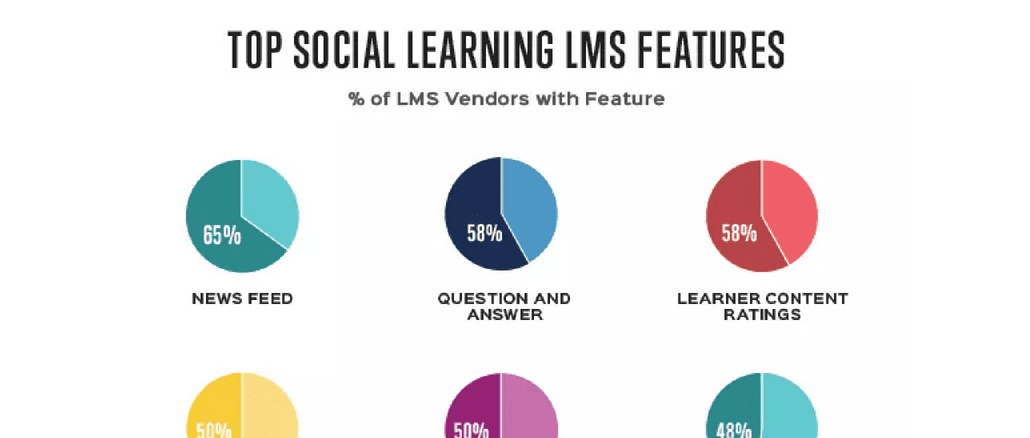
In 2016, most people are accustomed to social media and the conventions associated with profiles, friends, posts, liking and sharing. But how are these new social business behaviors influencing social learning features of today’s learning management systems (LMS)?
We wanted to find out, so we surveyed 74 diverse LMS vendors about the social learning functionality available in their platforms. We targeted the LMS vendor community because these organizations have a vested interest in developing and supporting only the features they believe the market wants and they know they can sell.
To achieve a representative sample of global demand, we limited each LMS vendor to a single survey response. Here is what we found:

What’s Going on with the Social Learning LMS?
Technically, social learning features were built into learning management systems long before social media was invented. In the 1990s, the social LMS feature set included threaded discussions, coffee groups, collaboration centers, forums, FAQ and chat — typically occupying a seldom-used tab in the navigation menu.
In reality, this social LMS feature set was all sales sizzle. Social capabilities were underutilized, mainly because no one understood how to deploy, promote and support them. Common logic was flawed — assuming training professionals and subject matter experts (SMEs) would regularly visit these social “spaces” and interact, keeping content fresh and learner engagement high. Unfortunately, content quickly became stale and learning interaction ceased.
But now, progressive LMS vendors are leveraging the recent business culture shift toward social media to fulfill the promise of social learning. Social functionality has become integral to LMS solutions for extended enterprise, ecommerce and (to a lesser degree) employee LMS solutions. These social LMS features serve many strategic business functions including:
- Community development and on-demand support
- Increased visibility to attract and retain volunteer learners
- Accelerated content curation and knowledge sharing
- Enhanced productivity for workgroups and remote team projects
- Stronger collaboration for self-paced and live instructor content (peer-to-peer and peer-to-instructor)
- Effective drip, drip, drip microlearning and marketing
With these LMS features, organizations have an opportunity to create and sustain learning communities around virtually any topic, course or idea. More importantly, people can leverage all the social behaviors they apply elsewhere to the process of learning. However, there is still tremendous room for improvement in designing and deploying social LMS capabilities. “Best practices” are still very much a work in process.
Proof of Change?
The large Talent Management providers are retaking a serious look at useful social learning after losing many pure LMS opportunities to the socially focused cloud LMSs. For example, when finalizing this post I became aware of the new SAP Jam collaboration learning platform. SAP is attempting to inject social learning into their platforms to adapt to the new way learners want to learn. The big talent LMS providers have been late to the social party– mainly because they focus only on employee development and not extended enterprise solutions where the social ROI is more evident. With the recent announcement by Workday to release their own socially enabled LMS the other Talent providers are now following suit. The behemoth laggards are finally back to investing in learning innovation.
Industry Social Learning LMS Feature Set
In addition to conducting our LMS vendor survey, Talented Learning has also conducted over 100 in-depth LMS reviews in the last two years. We have documented all the social features we encountered and divided them into two groups: basic and advanced complexity.
Basic Social Learning LMS Features
- Billboards and news
- Email and text notifications
- Question and answer tools
- Discussion boards, threaded discussion, forums and best practice centers tied to classes or topics
- Blogs — Often these look more like threaded discussion than WordPress
- “Friending” and “following” – users must become “friends” to share deeper information
- User profile (and ability to see others’ profiles) with bios, user photos, biographies and status tracking visible in LMS
- Ability to like, share and comment on content in catalog
- Ability to create and share content in user profile and in peer newsfeeds
- Ability to recommend content to peers
- Content tagging (new word for keyword metadata) and search by tag
- Most popular content, highly rated content and frequently accessed content
- Find-the-expert functionality with people search and communications via chat or mail
- Allow users to create accounts, log in, port contacts, access feeds using their existing Facebook, LinkedIn, Google+, SharePoint, Twitter or other existing social account credentials
Advanced Social Learning LMS Features
- Integrated social interface – not a separate tab in the LMS
- Intra-content social discussion for learners and teachers
- Newsfeed, leaderboard, “find expert” or other social widgets on user homepage
- Integration with existing corporate social networks (like Yammer or Bloomfire) to share courses on timeline, invite users from contact list and share success in personal feeds
- Post course enrollments, completions, awards, badges, levels or other gamification progress to external social networks to encourage comments, competition and additional enrollments
- Personal activity feeds, journals and news streams
- Ability to provide peer “recommendations” or “kudos”
- Web conference events integrated into social groups – video, screen sharing and recording
- Capture chats, video chats and webinars. Record and use for discussion and continued learning
- Polling and response stats
- Seamless integration with LMS gamification features
- Volume of comments or level of social interaction can be used as criteria for learning activity completion
- Manage social engagement of users and have relative scores for users (more engagement = higher score)
Conclusion
Use of mainstream social media has been the guiding force for social learning LMS relevance. New and progressive cloud LMS providers have been integrating the best of social media features with social learning — and guess what? It’s working.
These features don’t replace popular social channels and tools nor are they intended to do so. However, with more sophisticated social capabilities integrated into LMS platforms, organizations are finally able to create sustainable learning communities within an LMS environment. And that means the long-awaited benefits of more continuous, holistic formal and informal learning are beginning to be realized.
Thanks for reading!
WANT TO LEARN MORE? JOIN OUR MAY LIVE WEBINAR:
How to Drive Online Learning at Scale: Corporate Market Strategies for Associations
Selling online learning content to individuals is challenging enough. But selling that same content in bulk through corporate customers or partners can be even more demanding. The business models are fundamentally different. Plus, business-to-business relationships require specialized content management functionality.
What does it take to succeed?
Join John Leh, CEO and Lead Analyst at Talented Learning, as he hosts a live virtual panel with experts who have developed and managed profitable B2B online education programs:
- William Hold, Chief Development Officer, The National Alliance for Insurance Education and Research
- Linda Bowers, CTO, WBT Systems
In this dynamic one-hour roundtable, you’ll learn how to:
- Build a viable business model for bulk sales
- Develop effective pricing and marketing strategies
- Compare tradeoffs of selling through sales reps versus online channels
- Delegate content administration, reporting and user provisioning
- Integrate core learning systems with CRM platforms and other operational applications
- Achieve internal buy-in, drive project momentum and maintain organizational alignment
All live webinar attendees will receive 1 credit toward a Certified Association Executive (CAE) credential application or renewal.
Need Proven LMS Selection Guidance?
Looking for a learning platform that truly fits your organization’s needs? We’re here to help! Submit the form below to schedule a free preliminary consultation at your convenience.
Share This Post
About the Author: John Leh

Related Posts

How to Enhance Conference Learning With Online Video
To make the most of conference-related video for educational purposes, focus on creating an environment that lets 1000 flowers bloom.

Extended Enterprise Learning Systems: Shifting Into High Gear
Businesses are interested in developing measurable learning initiatives so they can evaluate outcomes and compare their value with other priorities.

Measurement Matters: 3 Data Analytics Lessons to Remember
Perhaps the most important lesson of all is the hardest lesson to accept. Insight is only half of the measurement battle.

Think xAPI is Next-Generation SCORM? Think Again
xAPI is flexible, granular, flexible, portable, flexible, consumer-friendly – and most importantly, flexible!

AI and Learning Systems: Is This Combo as Great and Powerful as it Seems?
In a comprehensive new AI industry analysis, MMC says that as pervasiveness takes hold, the distinction between "AI companies" and other software providers will blur and eventually disappear.

Customer Training Pricing and Packaging: What’s the Best Strategy?
Price points should reflect the cost of the core product, the perceived value of educational content, the level of expected demand and competitive pricing pressures. More complex products naturally command a higher price for related education.

Innovative LMS Features: Real or Hype?
By having an LMS and keeping it updated, AI will come your way sooner or later as a new feature commonly covered by your license cost.

2019 Talented Learning Continuing Education Systems Awards
Which learning systems are best for associations and training companies to use? See winners of our 2019 continuing education systems awards!

2019 Talented Learning Awards: Corporate Extended Enterprise Systems
In the following section, we briefly describe our impressions of the winners and finalists, so you can learn about each solution and its strengths.




CASE STUDY DIRECTORY


FOLLOW US ON SOCIAL