

No doubt about it. If employees are the only learning audience you serve, it’s easy to find an LMS that will meet your needs. For decades, corporate training programs have focused on employee compliance training and skills development. So naturally, learning systems embraced an employees-only mentality. But that insular worldview is fading fast.
Now, companies large and small are extending education programs to customers, channel partners and others outside traditional corporate boundaries. In fact, many organizations are proving that a “big tent” learning strategy is actually a profitable business move.
Regardless, it’s no picnic for buyers who must find an LMS that fits unique extended enterprise needs. With more than 800 systems available, what’s the best way to narrow the field?
We recommend a thoughtful, structured selection process. It may not be the fastest path. But as a consultant who’s been down this road, I guarantee that it’s worth the effort as you find an LMS.
Want to see for yourself? Let’s walk through a real-world case together…
How to Find an LMS: Inside One Example
Assume for a moment that you’re the decision-maker at one of our client companies. Imagine this:
Your Business Profile
- You work for a rapidly growing B2B software-as-a-service (SaaS) company, based in the U.S.A.
- Your company develops operations management solutions for manufacturers of all sizes.
- Organizations worldwide purchase your software through a direct sales force.
- Revenues come from annual software fees, based on the number of users in customer organizations and the products they license.
- Customers use your software at one site or many locations, depending on their organizational size and structure.
- You train customers as well as your own employees.
Your Learning Programs
Customer Training
- Your company serves 3,000 customers around the world.
- The potential customer learner base is 300,000 – expected to grow to 500,000 in a few years.
- Historically, you delivered customer training in-person at your location. But recently, up to 50% of new customer training is delivered digitally via webinars and online product portals.
- The source of learner record is Salesforce CRM platform.
Employee Training
- 1000 employees – expected to grow to 1500 employees within the next few years.
- You rely on an inexpensive cloud LMS for employee onboarding and compliance training.
- Source of learner record is Workday HCM platform.
Key Learning Systems Issues
Several challenges are prompting you to find an LMS that will serve your growing business:
Customer Training Challenges
- Current live training events are costly and don’t scale well, compared with migration to a fully digital approach.
- Individual training activity isn’t tracked. Data reveals which customer organizations access training sessions, but not who attends these sessions. This lack of person-specific data has several negative implications:
- You’re unable to offer individual or customer certifications, personalized content recommendations or role-based learning assignments.
- It’s impossible to gauge training effectiveness and business impact.
- The power of Salesforce CRM integration is minimized.
- Lack of LMS integration with your organization’s customer IT ecosystem exposes multiple issues:
- It negatively affects customer learning experience.
- It requires more manual administrative intervention.
- Content duplication occurs when developing learning for customers and customer-facing employees.
- Weak reporting and analytics capabilities make ROI measurement difficult.
Employee Training Challenges
- Your existing LMS poses administrative and usability issues – too many clicks, too much irrelevant content and overly complex workflow.
- Because you lack Salesforce CRM integration, you can’t automatically create accounts or assign learner roles.
Two Paths: Which Would You Pick?
There are two apparent solutions:
1) An all-in-one extended enterprise learning system
2) A pure customer-focused learning systemWhich would work best for in this scenario? Consider these pros and cons:
1) All-in-One Extended Enterprise LMS
This approach could reasonably address both customer and employee learning needs. But it also raises concerns:
Positives
- These solutions are purpose-built to support multiple scenarios – customer-only, employee-only or a combination of audiences. Also, many of these vendors are highly experienced in addressing extended enterprise needs.
- You’ll enjoy the convenience of a single-vendor relationship – only one contract to negotiate and one point-of-contact for support.
- With only one content database, you’ll eliminate the need to create, track and maintain multiple versions of the same content, and avoid the need for a separate SCORM cloud or course container solution.
- With a single system to learn, configure, deploy and manage, you’re likely to operate more efficiently and reduce your administrative burden.
Negatives
- Your employee LMS is not broken. It needs improvement, but any new system could require just as much effort to optimize.
- Although customer education is your priority, an all-in-one platform may require you to settle for less-than-ideal customer learning functionality.
- The default settings in all-in-one systems tend to emphasize employee learning. To reflect a customer mindset, you may need to rework interface language and logic on a regular basis.
- Because your vendor’s core competency is likely to be employee training, you may need to educate the project team about customer education needs and issues.
- All-in-one vendors offer broader suites – including things like talent management and performance management. These capabilities are forever out-of-scope for your organization, yet they compete for a vendor’s thoughts, priorities and investment in research and development.
- These platforms are typically priced higher than customer-only solutions. The most common license model is named-user licensing. But with 300x more potential customer learners than employees, you should prefer volume licensing based on customer location or actual usage.
2) Pure Customer-Focused Learning System
This choice means that your organization will need to manage two specialized solutions – one for employees and another for customer learning. Under what conditions does it make sense to add a second LMS, rather than choose a replacement?
If each audience has highly specific needs, an all-purpose solution may be only marginally effective, at best. Why settle for one platform that doesn’t serve either audience particularly well, when best-of-need options are within your reach?
On the other hand, it’s important to respect the limits of specialized systems. For example, some excellent employee-focused systems would be a terrible foundation for customer education. And conversely, some phenomenal customer-oriented learning systems would be useless as employee training platforms.
Positives
- Your business serves 300x more customer learners than employees.
- Customer education directly affects many metrics that help your business remain competitive – including customer acquisition, time-to-value, churn rate, product satisfaction, subscription renewals and account expansion.
- Pure customer LMS vendors focus 100% of their attention and development effort on features and enhancements that address customer education.
- Customer LMS staff (including executives, sales, R&D, product development and customer service reps) offer significant domain expertise to help advance your mission.
- These vendors recognize that CRM integration and automation with sales channel platforms is essential.
- Additionally, customer LMS platforms offer a broader API toolset for integration with your company’s software and other business systems – including ecommerce, marketing automation and customer service platforms.
- You won’t need to reconfigure or rework an interface that was designed for employees.
Negatives
- Licensing two systems may cost more than increasing user count in an all-in-one platform.
- There’s potential for duplication of courses and other content. A SCORM cloud would help resolve this issue and also let you deploy content on your customers’ LMS platforms.
- Your IT teams may have extra work. For instance, one solution may use REST APIs while the other may use SOAP APIs.
- For some users, both systems may need to record completion of a course. The transcript will need to be transferred from one system to the other, or the course will need to be completed twice.
- Your support personnel will need to develop expertise with two systems.
- You’ll need to be involved with both vendors over time – following updates about both platforms and attending events such as user meetings and conferences.
- The software selection process is likely to take longer – requiring separate research and evaluation cycles for each type of platform.
What’s the Best Path? Consider Strategic Goals
Above all, your organization’s future depends on stronger customer relationships. You must find an LMS that will support this goal with customer education driven by meaningful metrics.
On the other hand, you don’t want to lose sight of employee training needs. But you’re unsure if adding employees to this buying equation will dilute the results. Let’s take a closer look at your goals:
Customer-Oriented Goals
- Increase customer success rates and reduce onboarding time in a scalable manner.
- Increase customer satisfaction and renewal rates.
- Drive stronger customer retention and account expansion.
- Encourage customer self-sufficiency by developing deeper product knowledge across customer organizations.
- Integrate relevant learning content into your software to facilitate just-in-time customer learning.
- Increase product usage by involving customers in ongoing learning opportunities.
- Promote higher standards of professional development by introducing customer certifications.
- Gain deeper, more timely customer insights by integrating learning data with Salesforce CRM.
- Drive new sales by offering professional development as a competitive differentiator.
Employee-Oriented Goals
- Improve usability for administrators and employees.
- Expand employee development content options.
- Eliminate content duplication and unnecessary maintenance.
What Do These Goals Tell Us?
Whew. With all these factors and goals, what’s the best answer? One system or two? Perhaps even three? It depends on the answer to even more questions.
Which audience is more important to your company? Which audience is underserved – and at what cost to your broader business objectives? How can you serve both audiences without jeopardizing learning quality for either?
Keep thinking. Which approach will deliver the biggest net positive effect? Is efficiency more important than results? Is moving the needle on customer success more important than leadership development? Or are both achievable?
When answering these questions, two key takeaways emerge:
- The need for stronger customer education touches every aspect of this business, from new client acquisition to global long-term growth.
- At this time, improving employee learning is more of a nice-to-have than a mission-critical goal.
Our Final Recommendation
Although the top priorities were clearer, we still weren’t convinced that one type of platform would outperform the other. So we recommended a “best-of-both-worlds” approach.
First, we documented LMS requirements and developed an RFP mapped to those requirements. Then we contacted highly qualified vendors in both categories:
- Stellar employee-oriented extended enterprise LMS platforms that include viable customer learning capabilities.
- Highly innovative customer learning platforms that aren’t built to support employee training.
Our Rationale
With this approach, the buyer could weigh the incremental value of a specialized customer-focused solution on its own merits. This freed decision-makers from muddying the process with concerns about employee compliance, skills development and talent management.
After all, even if the client selected an all-in-one system to serve immediate customer needs, roll-out plans for employee improvements weren’t expected for several years. By then, who knows what kind of solutions will be available for employees?
However, by including strong all-in-one vendors, we covered all the bases, in case specialized pure customer learning solutions couldn’t demonstrate enough value to outweigh the headaches and inefficiencies of managing multiple systems.
What Did This Client Actually Choose?
In the end, a pure customer-centered learning platform won the day. But the decision could have just as easily gone in the other direction.
Either way, our client wouldn’t have been wrong. That’s what makes these LMS decisions so tough. There is no guaranteed road to success. No silver bullet. No straight line.
With this kind of uncertain terrain, your best path is to identify key business issues, goals and related requirements. Then evaluate the importance of these factors, so your decision truly reflects your priorities.
And of course, if you need guidance to find an LMS, I’m always at your service.
Thanks for reading!
Share This Post
About the Author: John Leh

Related Posts
2026 LMS Awards: Best Enterprise Learning Systems
Which enterprise learning systems are best? Find out about top solutions as our Lead Analyst, John Leh, reveals winners of our 2026 LMS Awards!

Your LMS is Not Your Learning Ecosystem: Why Infrastructure Maturity Matters
Does your organization rely on multiple learning systems and tools? That doesn't mean it's a coherent learning ecosystem. Find out how to assess the maturity of your tech stack...

Breaking Down Learning Silos: 4 Extended Enterprise Strategies
Want stronger results from your enterprise learning initiatives? Be sure to remove common learning silos. These strategies will help...

Want to Replace Your LMS? Start With a Reality Check
Should you replace your LMS? Before moving forward, it's smart to weigh the pros and cons. This case study illustrates how the process works...
5 Essentials for a Great LMS RFP | Customer Ed Nugget 35
Finding the right customer education platform often starts with a request for proposal. But what does it take to write a great LMS RFP? John Leh explains on this mini-podcast...

Learning as a Revenue Growth Engine: 5 Strategies for Associations
Associations often depend on member dues for revenue growth. But these days, non-dues education programs are more effective. What strategies work best?

How to Measure the Business Impact of Professional Education Programs
Are your professional education programs as successful as they could be? To improve their business impact, try this measurement framework...

Don’t Cut Training Content. How to Reuse, Refresh, or Rebuild Instead
In a world where learning organizations must do more with less, how can you make the most of training content? These strategies can help...
Learning System Vendors: Enter the Talented Learning Awards 2027
Awards season is under way! Find out how to enter the 2026 Talented Learning Awards to showcase your learning solution, gain industry recognition, and increase visibility in the marketplace...




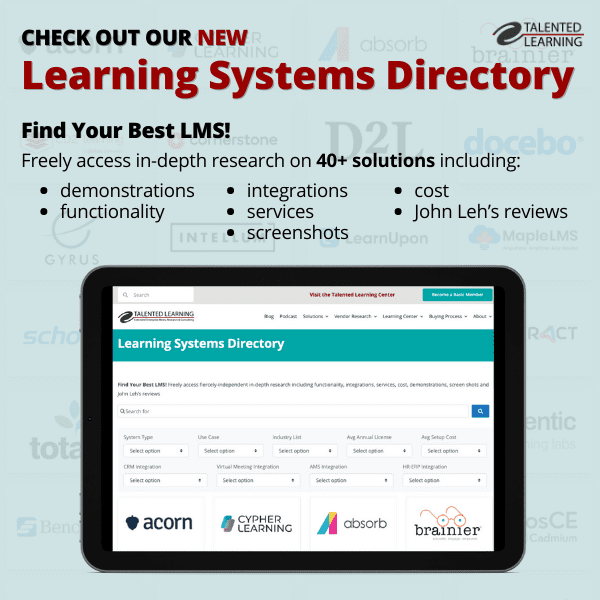
CASE STUDY DIRECTORY


FOLLOW US ON SOCIAL