

LMS Workflow Automation is Leveling Up
Our firm’s recent research has confirmed a surprising finding about learning management systems. Vendors are upgrading their LMS workflow automation capabilities in multiple ways and the business implications are significant.
Yes, I know what you’re thinking. What could possibly be new about LMS workflow automation? After all, learning management systems were invented 40 years ago specifically for this purpose. They have always automated processes for course assignments, email notifications, manager approvals and reporting.
But now, LMS workflow automation is much deeper, more flexible and more sophisticated. It’s also more configurable, so administrative processes can be uniquely defined for each client. And all of this is, well, more automated than ever.
How do I know? As a part of the standard vendor review process for our 2022 Talented Learning Systems Awards, we’ve surveyed almost 100 platform providers over the past year. We’ve researched their capabilities in detail – including LMS workflow automation.
Here’s our top takeaway:
71% of vendors tell us their buyers consider LMS workflow automation a critical feature set. Not surprisingly, 0% say it’s unimportant.
Decisive response. But what’s behind this statistic? Let’s look closer…
Do you want deep comparative data on the world’s top 40 learning systems vendors? Check out our 2023 Corporate Learning Systems Market Update report – now available for purchase and download! GET DETAILS HERE
CRMs Point the Way Forward
For decades, LMS workflow automation stood still. Then customer relationship management systems (CRMs) like Salesforce and HubSpot transformed the marketing function, and our industry began to see the light.
From day one, CRMs were designed to help organizations build, drive and measure marketing workflows. But what exactly is a “workflow“? It can be as simple as a single-step process.
For example, when a website visitor submits a landing page form for a marketing brochure, the system automatically responds by ensuring that the requested document is sent to the email address provided.
More complex examples often include a series of conditional “if/then” branching scenarios. For instance:
- If a site visitor submits a form, then send a brochure via email.
- If the recipient opens a) the brochure email only or b) the email and the brochure, then send a follow-up email X hours/days later with an invitation to schedule a demo via online calendar.
- If the recipient requests a Zoom meeting, then send an email confirmation to the requestor and assign an appropriate inside sales rep to initiate the session.
- If the recipient does not open the brochure email (or brochure) within X hours/days, then send a 2nd message as a follow-up reminder.
Now LMSs essentially think and act just like CRMs.
Other Ways to Enhance the Learning Experience
Most LMSs also include the concept of automatically assigning content to learners based on details in a user profile, such as job role and/or organization. In addition, specific due dates can be associated with any of this assigned content.
Alternatively, some LMSs make it possible to use these same capabilities to create a static group of diverse learners and assign the same content to everyone in that group. These connections are hardwired only once by administrators and can support learning programs for decades without further intervention.
In other words, think of LMS workflow automation as the opposite of labor-intensive manual administration.
LMS Workflow Automation “Engines”
LMS workflow automation engines are one functional category where you’ll see significant differentiation among vendors. In my opinion, the best vendors provide an actual software “engine” where learning administrators can create rules and automation paths to support a spectrum of scenarios, from very simple to highly complex.
At the core of an automation engine is Boolean “if/then” logic.
The “ifs” are called triggers. These are prompts in the LMS (or outside of it) indicating that a response is required. The engine continuously monitors activities to detect any triggers. The “thens” are called actions. These are the automated activities an LMS performs whenever a trigger occurs.
Triggers and Actions
The more triggers and actions an automation engine provides, the better and more powerful it is. The possible combinations are endless. Here are some examples…
LMS workflow automation “ifs” could include these triggers:
- A customer, not a customer, a long-time customer, a former customer, or another organization’s customer
- Lives in Germany and speaks Japanese, has earned X degree, or Y certification
- Register, start, finish, almost finish, start but not finish, no access in x days, fail, fail a 2nd time, pass with x score, login, not login
- Buy (or not buy) a piece of content (or product) in the LMS (or outside of it)
- Post a comment, follow a thread, submit content, like content, share content
- Submit an assignment, upload an external certification
- Receive a webhook from any other application (such as a survey, event, CRM, advertising or any other external event)
- Any combination of the above, using “if”-and-“if” or “if”-or-“if” logic
LMS workflow automation “thens” could include these actions:
- Recommend or assign content, with or without a due date
- Award points, badges, awards, assign a thumbs up
- Send a custom text, email or social post
- Provide a coupon, discount or enter a promotional contest
- Subscribe to a new interest thread
- Enroll in a webinar
- Send an invite to a LinkedIn group
- Send a webhook
- Send information to an existing employee performance appraisal
- Any combination of the above, using “then”-and-“then” or “then”-or-“then” logic
(NOTE TO LMS VENDORS: Want to schedule a product briefing with me? To start the process contact me here.)
Above and Beyond Features
To kick it up yet another notch, the best LMS workflow automation engines also make it possible to build multi-level combinations. This means you can create an infinite number of combinations.
But wait. It gets even better. Some vendors now also embed Workato or Zapier into their automation engine scheme, so you can automate triggers and actions in potentially thousands of different third-party applications.
The possibilities are mind-blowing.
Best LMS Workflow Automation Vendors
Which vendors are driving this feature set forward?
All learning platform vendors have at least some LMS workflow automation features. However, not all vendors focus on this feature set as a core differentiator.
Some of my favorite vendors at the forefront of automation innovation include:
Acorn LMS, CD2 Learning, LearnUpon, Cypher Learning, Docebo, Growth Engineering, LearningCart, NetExam, Thought Industries and Training Orchestra.
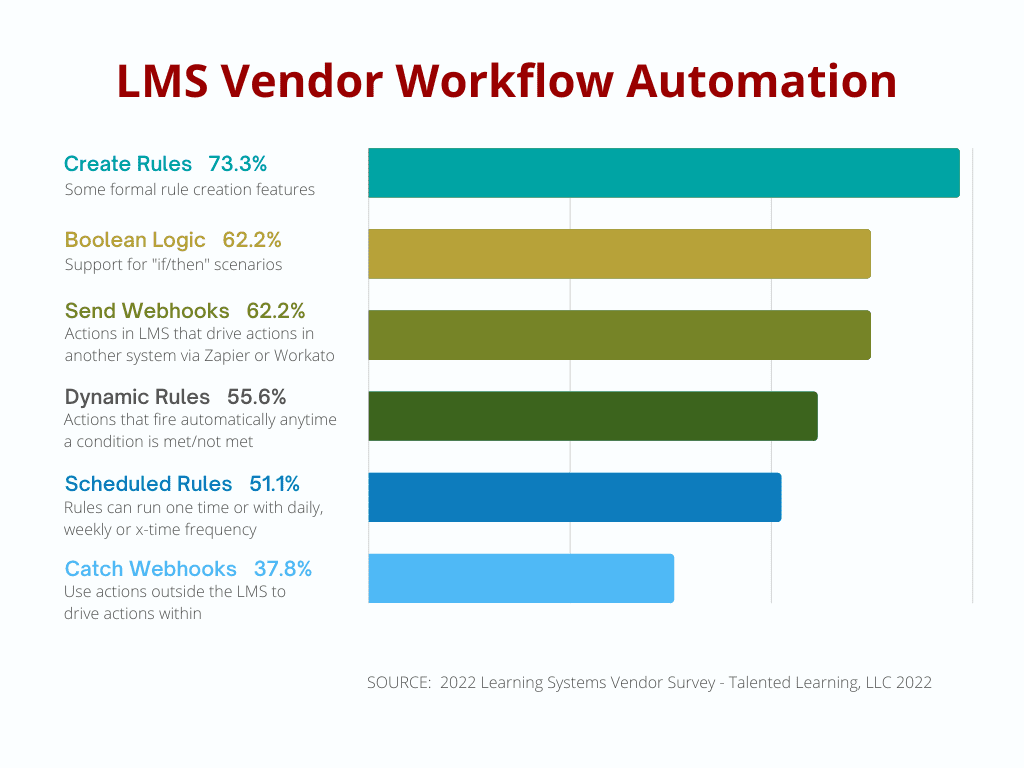
Top LMS Workflow Automation Features
You’ll find tremendous differentiation when you compare LMS workflow automation feature sets across vendors. No two companies provide exactly the same functionality.
But keep in mind that most vendors are actively investing in this feature set, and collectively, their efforts are advancing automation capabilities across the industry.
Conclusion
In today’s market, LMS workflow automation is setting industry providers apart in impressive ways. Innovation is happening in all LMS use cases, including extended enterprise learning, employee development, training content businesses and academic applications.
Leading the pack are LMS providers that specialize in helping organizations sell instructional content. This makes sense because these vendors have the requisite marketing expertise to understand the significance and competitive advantage that comes with LMS workflow automation.
But whatever your needs and whatever direction you take, just remember this – the opposite of manual administration is LMS workflow automation. This, alone, should give you a reason to investigate what these capabilities can offer you.
Thanks for reading!
Need Help Finding The Best Future-Friendly LMS For Your Organization?
Want expert assistance to find a specialized learning platform that truly fits your organization’s needs? We’re here to help! Submit the form below to schedule a free preliminary consultation at your convenience.
Share This Post
About the Author: John Leh

Related Posts

Should You Renew Your LMS? Navigating 4 Decision “Gates”
If your organization uses one or more learning platforms, you'll eventually need to renew your LMS contract. But first, what should you do? Try this...

Running Training as a Profit Center: How Does an LMS Help?
What can a learning platform do to help drive training revenue and growth? LMS innovator Nick Eriksen suggests focusing on these factors...
How to Find the Best LMS for Your Needs: Customer Ed Nugget 31
When it's time for a new or replacement platform for customer education, how can you find the best LMS for your business? Find out on this Customer Ed Nugget episode...

AI in Corporate Training: What to Expect From Your LMS
AI is making a huge impact on enterprise systems, including LMS platforms. But what does that mean for the future of corporate training? An LMS innovator digs deeper...

Need to Build Workforce AI Skills? Try These Go-To Training Methods
Organizations everywhere are scrambling to develop key workforce AI skills. But which training methods actually work? 13 business leaders share their best advice here...

How Do You Drive AI Adoption? 12 Proven Strategies
Which learning strategies are improving workforce AI adoption? Find how a dozen business leaders are making a positive impact

16 Enterprise LMS Trends Shaping 2026: An Analyst’s View
Learning tech innovation is all around. But which enterprise LMS trends will matter most this year and beyond? See what independent analyst John Leh says...

LMS RFP Tips: How to Find Your Best Learning Technology Fit
RFPs: Love them or hate them, they're widely used by software buyers, and for good reason. To get better results when choosing a learning platform, try these LMS RFP tips...

Top Podcasts and Posts of 2025 – Talented Learning’s Greatest Hits
2025 was our biggest year as an independent source of enterprise learning information. Which were our top podcasts and posts? Take a quick look back with us...





CASE STUDY DIRECTORY


FOLLOW US ON SOCIAL