

It happens at least once a week. I bump into LinkedIn posts from professionals who are overwhelmed by learning management system (LMS) challenges. Often, these posts attract dozens of responses from LMS vendors, each claiming they offer the best solution, based on the incredibly detailed information provided in the original 1-sentence post. What’s an LMS owner to do? Brace yourself. It might be time for a new system. If that answer makes you shudder, keep reading. I have some advice to make it easier to achieve LMS selection success.
Many organizations frustrated with the limitations of their current learning infrastructure. They’ve hit a wall with features that don’t accomplish what a vendor promised. They can’t get sufficient assistance from customer support. Or they’ve given up entirely on their system of record, but don’t know how to choose a better solution from among hundreds that might work.
It shouldn’t have to be this way. No one should have to post random SOS alerts on social forums, hoping someone will toss them an LMS lifeline. But what’s the alternative? Roll the dice? Spin the wheel?
New LMS Realities
If you read our blog, listen to our podcasts or attend our webinars, you know the LMS world is vastly different now than it was 10 years ago. You also know why and how the cloud has forever changed the LMS landscape for the better, from a buyer’s point of view.
Previously, before a multitude of specialized solutions burst onto the scene, LMS choices were limited to a handful of “one-size-fits-all” vendors. What if your organization had a unique business use case? You were forced to shoehorn your needs into a traditional multi-purpose system or cobble together your own solution. Either way, the outcome was less than ideal, but better than Excel. You got what you got, and lived with the results. And for many organizations, it wasn’t pretty. No wonder learning professionals began to hate their LMS!
But fortunately, in less than a decade LMS options have made major strides. Now a new breed of LMS is ready for mobile, social and gamification at scale. What’s more, most of these solutions are designed and developed for specific business uses and learner audiences. That means you have a good chance of finding a learning platform that fits your particular needs.
Regardless, a startling number of organizations still rely on the LMS they’ve had for years. No matter how badly they may want to upgrade to a cloud LMS, they continue to hold back. Rather than taking their chances on a solution designed to improve engagement and business results, they remain tied financially and contractually to their historical learning infrastructure.
Are You Stuck With Your LMS?
Try this quick assessment. Do any of these describe your organization?
- You purchased your LMS before 2012 (probably for reasons no one remembers)
- You are a small or medium-sized business that is paying for an oversized SAP, Oracle, SumTotal, Saba or Cornerstone LMS and feel like plankton in an ocean of priorities
- You are an association or commercial training company limping along with a graying, semi-custom open source solution and multiple manual workarounds
- You pay “annual support and maintenance” fees but continue to use an older version of LMS software because upgrade costs are prohibitive
- You periodically activate and deactivate users to stay under the license count, trying to minimize costs
If you answered “yes” to any of these, there is hope. You may feel stuck, but you don’t need to stay in that predicament. In fact, I bet you could select and deploy a relevant cloud LMS sooner than you imagine.
How Do You Find the Ideal LMS?
In the past, the challenge in choosing an LMS focused mostly on how much time and money it would take to bend one of a few well-known systems to your will. Now with literally hundreds and hundreds of LMS variations, it’s about how to find a very specific needle in an ever-expanding haystack.
So, who can you trust to point you in the right direction?
You can ask around. Well-meaning colleagues can be helpful. However, unless they know your organization’s unique circumstances and priorities, even the most knowledgeable people are only taking shots in the dark.
In my experience, the best results aren’t based on someone else’s opinion. Instead, they come from relying on a proven process. For example, let’s take a look at what has worked for organizations I’ve guided through LMS selection projects.
LMS Selection Success: 6 Proven Steps
1) Carefully Audit Current Usage
LMS vendors have vastly different licensing models. To find the right option, you need a crystal clear understanding of your organization’s current and anticipated usage. Some relevant questions to explore:
- How does your current LMS charge for usage? (Named users? Registrations?)
- How many active users do you serve?
- How many inactive learners do you serve?
- What are your usage patterns?
- How frequently do users access the LMS?
- How does your organization use the LMS?
- How are your active users and usage rates expected to grow?
2) Calculate and Compare Current/Future Costs
One of the easiest ways to replace your LMS is to identify relevant solutions that provide more value at a lower price point, including one-time setup fees. If your approach is methodical and coherent, it’s easy to get budget authorization.
- How much are you currently spending?
- What was the total expense with your LMS vendor in each of the past two years? If possible, calculate costs per category. For example, how much did you spend annually on your LMS license, support, content, hosting or other services?
- What do you anticipate spending for this solution next year?
- Based on your growth estimates, what will you spend per year over the next three years?
Once you develop a short list of replacement candidates, you can consider how their costs compare with this baseline.
3) Document High-Level Requirements
There are 700+ learning technology vendors today, many of whom offer specialized solutions. Differentiation often starts with the target learning audience — employees, extended enterprise (customers, sales channel, contract workforce), academic institutions, association members, continuing education or commercial training.
All facets of the vendor solution – functional use cases, pricing and license models, implementation and setup services, integrations, as well as support services – are designed to win a particular type of customer, often in a particular industry. By carefully mapping your requirements along these same dimensions, you can quickly and easily screen vendors.
4) Identify a Handful of Qualified Solutions
With your requirements and usage patterns in hand, identifying qualified vendors moves from a popularity contest to a methodical selection process. At this stage, it’s appropriate to consider recommendations from industry blogs, research reports, professional colleagues and consultants. Of course, with so many possibilities, qualifying vendors yourself can be time-consuming, costly and confusing. That’s why organizations often ask LMS selection specialists like me to help narrow the field.
5) Solicit Demos, Proposals and Customer References
After verbally confirming requirements with each vendor, get a demo that aligns with your requirements. If all goes well, request a proposal based on current and future usage, as well as estimated costs to migrate from your current system. At this pre-budget stage, high-level pricing is good. The goal is to get low and high estimates from 3-4 LMS vendor candidates and compare them with your current total cost of ownership.
6) Test-Drive Each Finalist
Seeing is believing. And the best way to see if an LMS will really work in your situation is to test the solution with a working prototype or free trial. Create a test plan that includes real or sample courses and data. Give stakeholders (administrators, managers and end users) an opportunity to interact with the system and offer specific feedback. Be sure to allocate sufficient time for this phase of the process. Believe me, no one has ever said, “I wish we spent less time with hands-on evaluation before we made our final decision.”
Conclusion
Once you compare your current LMS expenses with pricing estimates from qualified vendors, it should quickly become apparent whether you can afford the switch to a new LMS. If so, you are ready to take your case up the ladder for budget approval. Armed with this analysis and insight from the test-drive phase, you should have a strong sense of how your organization will benefit from each option. Even if for some reason you discover that switching isn’t cost-effective for your organization, you will understand why and feel better about your current situation.
Choosing the best LMS may seem intimidating. It may even be the reason why your organization sticks with a less-than-ideal status quo. But it’s probably easier than you think if you trust a proven process — and even easier, if I lend you an experienced, fiercely independent hand.
Interested? Reach out! I’m happy to schedule 30 minutes on the phone or Skype to learn about your LMS situation and determine what level of service (if any) I’d recommend to help you move toward a better solution.
Thanks for reading!
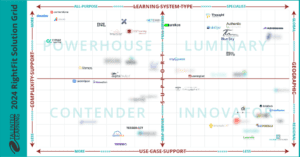
NEW FOR 2024
Which Learning Systems Are Your Best Fit?
Use our FREE RightFit Grid tool to build a shortlist based on our independent research. 50 leading learning systems mapped to common buyer requirements!
LEARN MORE AND GET YOUR FREE COPY…
Need Proven Guidance for LMS Selection Success?
Looking for a learning platform that truly fits your organization’s needs? Submit the form below to schedule a free preliminary consultation with me, John Leh, to discuss your learning systems needs.
Share This Post
About the Author: John Leh

Related Posts

Mobile LMS: The Facts
At Talented Learning, an independent learning tech market research and consulting firm, we recently compiled an obnoxious 85 question survey detailing over 450 points of LMS business, market and functional data. We collected statistically significant [...]

2015 Talented Learning LMS Vendor Award Recipients
Learning management systems didn’t die. They evolved, and today we recognize them. Brief LMS History Corporate LMSs were invented almost 30 years ago to manage and report on the training and compliance of their employees [...]

Customer Training: 5 Reasons to Put Them “In the Know”
Consider creating training modules which are, in effect, focus group vehicles. Introduce your customers to the product ideas you are considering through online training, and leverage embedded surveys, quizzes, social media, and mobile enablement technologies to have conversations with your customers.

LMS eCommerce: B2C and B2B Feature Sets
My best recommendation is to fully develop your business model, LMS use case scenarios and resulting requirements before engaging LMS vendors so you can find the best-qualified options to drive your online learning business.

Salesforce.com + LMS = Measurable Training Bliss
Integrating training workflows and data with customer and sales-related data elevates training from a cost center to a profit center, because it helps prove the business value of learning.

Workday Announces New LMS: My Thoughts
For LMS, instead of a having nothing, Workday chose to identify quality LMS partners, primarily Saba and Cornerstone, to provide that piece of the solution if LMS was important to the opportunity.

Top 10 Association LMS Solutions in the World
An LMS vendor must derive the majority of its revenue from association clients, and publish top-notch client case studies on its website as proof of excellence in serving member-based organizations.

World’s Best Association LMS Case Studies
Association LMS systems are similar to employee LMSs but have richer features sets to attract voluntary learners and members, build a community, integrate with an AMS and sell complex continuing education.

15 LMS Vendors, 15 Channel LMS Case Studies
These organizations have proven that educating their channel provides a measurable return on investment and more importantly a significant competitive advantage, and as a result, these organizations treat channel learning as an ongoing mission-critical initiative.





CASE STUDY DIRECTORY


FOLLOW US ON SOCIAL