

Artificial intelligence has been making its way into all types of business platforms in recent years. But new industry data shows just how prevalent learning systems AI has become. (For simplicity’s sake, let’s call it “AI in LMS.”)
As part of our ongoing vendor research and 2022 Learning Systems Awards evaluation process, our team has surveyed more than 100 of the world’s best learning systems providers about how their platforms leverage artificial intelligence, and whether customers consider AI in LMS a critical priority.
Interestingly, a whopping 79% of vendors already deploy AI for various functional uses. Yet, only 13% of these companies believe buyers consider AI in LMS a critical feature. That’s a hefty perception gap! However, it indicates that vendors are ahead of the game in meeting the market’s expectations.
No doubt these vendors see how AI in other kinds of systems contributes to business transformation. They anticipate strong growth for AI in LMS as well, with the potential for exponential impact on ROI. However, learning industry players still don’t communicate, demonstrate and prove AI benefits in ways that drive significant demand.
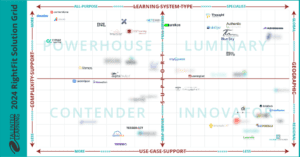
Which learning system is best for you? Check the 2024 RightFit Solution Grid, based on our team’s independent research! Learn more and get your free copy!
Additionally, maybe deep in buyers’ minds, they haven’t yet wrapped their collective heads around the threat of investing in a potential professional replacement. After all, in a world where AI can defeat leading chess champions, diagnose cancer and fly fighter jets, how can instructional designers, LMS administrators and data scientists expect job security?
To answer that question, let’s briefly step back and look at the bigger picture.
What is Artificial Intelligence?
Artificial intelligence is not a learning systems invention. As Lexico defines it, AI is, “The theory and development of computer systems able to perform tasks that normally require human intelligence, such as visual perception, speech recognition, decision-making, and translation between languages.”
Straightforward enough. This definition explains why AI innovation has become so prevalent. When implemented strategically, it has the potential to replace or augment humans. Either way, it can lead to significant economic benefits.
Not surprisingly, as technological advances made AI more cost-effective to develop, companies in every industry have been experimenting and innovating with solutions that automate routine manual and digital tasks, human interactions, and even complex business processes. And learning management processes are no exception.
AI in LMS
AI in LMS is being applied to a wide variety of actions on the front-end and back-end of learning platforms. However, AI functionality is difficult to see in action because works in the background and often requires access to a massive amount of data to learn, adapt and discover patterns that are otherwise invisible.
In other words, measuring the business impact of AI in LMS typically depends upon an iterative machine learning process that takes time to bear fruit.
As a result, it’s easy to overexaggerate and difficult to quantify the impact of AI in LMS. But the goal is always the same — to improve the application’s efficiency and drive down the costs of maintaining and growing a world-class enterprise learning system deployment.
Some of the best AI in LMS innovations currently come from these vendors: Acorn LMS, AbsorbLMS, Authentic Learning Labs, Brainer, Cadmium, Docebo, Interflexion, LearningCart, LearnUpon, Matrix LMS, NetExam and Web Courseworks.
Find out how real-world companies are achieving more with learning systems that create business value. Get inspiration from dozens of success stories in our free LMS Case Study Directory…
Top 10 AI in LMS Innovations
Every day, as I conduct executive briefing demonstrations with startups and long-established learning systems vendors, I marvel at all the artificial intelligence creativity I see. The following list of impressive AI in LMS functionality is incomplete, but it offers a taste of what’s available and where innovation is headed:
- Content Recommendations – For years, LMSs have included hard-wired content recommendations. Take this course, then recommend that course. AI kicks it up a notch by automating the process and considering a learner’s past consumption behavior (content started, completed, not-completed, aced, failed) as well as searches and learner-defined preferences, products purchased and other actions performed outside the LMS. Some solutions also include recommendations based on content that similar learners have completed or recommended.
- Learning Analytics and Data Visualization – Most learning systems generate a massive amount of data, but much of it goes unused when no tools are available to easily or cost-effectively analyze all that data and transform it into useful insights. AI in LMS adds mass data-crunching capabilities to identify and highlight trends and actions that would otherwise go undetected. For example, you can:
– Determine the likelihood of a learner completing a piece of content based on session time.
– Forecast the purchasing behavior of social learning participation.
– Evaluate the relationship between course completions, support calls and renewal rates.The ability to interpret these analytics in visual charts and graphs adds even more value. - Video Transcription – No more paying for human-generated transcriptions. AI in LMS automatically transcribes videos, identifies each speaker, translates the transcript into any language, and lets learners search the transcript or skip to any point in the video. It also provides highly detailed analytics based on all of this behavioral data.
- Translation – In addition to supporting video and audio content, translation now extends to formal learning content, social content and contextual platform help. It’s embedded everywhere automatically and it’s getting smarter every day. (I remember not long ago when LMS buyers had to pay $12,500 for each required language pack because human translation was so time-consuming. Those days are gone for good!)
- Content Authoring – This AI in LMS capability is wildly diverse and continues to grow in all directions. Building on video transcription, AI can not only translate videos, but also create lessons, write test questions, tag the content, assign skills, write a title, develop a description and more – all before a content author needs to review and polish anything. And when an author makes corrections or modifications, AI can learn from those adjustments and apply it when developing future content.
- Skills Development – This is real and available today. AI in LMS can automatically create connections between skills models, competencies, jobs, roles, peer performance, assessment questions and actual job performance. Impressive!
- Administration – Scheduling can quickly become a nightmare when you’re managing a large volume of complex ILT, VILT and hybrid learning programs. AI in LMS can coordinate and optimize this content with logistical requirements: instructors, facilities, equipment and more. In addition, AI can be used to analyze LMS data, so you can pinpoint inconsistencies, errors and alternative ways to optimize training resources.
- Contextualized Help – AI in LMS can present specific help infomation to learning system users at any moment of need. In other words, it can determine when, where, how and why users require help and proactively recommend or display options to quickly resolve a problem and move individuals forward.
- Search – Some learning systems now add rich search enhancement, with AI that indexes content at a very detailed level. In addition, it supports learners by extrapolating their search intent and pointing them to highly specific results – even if the location is deep within a video, a piece of content in a SCORM package, or in third-party content. Imagine the possibilities!
- Grading and Proctoring – Are you ready to say so long to mostly manual test proctoring and grading? AI in LMS can effectively monitor exam progress in real-time. It can also review and evaluate essays or subjective questions, uploads, sales presentations, manager-employee interactions, customer service responses and more. While it won’t entirely replace an instructor or manager, it can be a powerful partner in the learning assessment process.
NEW FOR 2024
Which Learning Systems Are Your Best Fit?
Use our FREE RightFit Grid tool to build a shortlist based on our independent research. 50 leading learning systems mapped to common buyer requirements!
LEARN MORE AND GET YOUR FREE COPY…
Conclusion
Don’t worry, learning professionals. Your job is safe – at least for now. AI in LMS innovation is a hot trend in the learning systems market, but it’s only getting started. These capabilities still have a long way to go before they’re fully embraced as standard practice. However, recent progress is exciting for industry buyers and sellers, alike.
What’s the upside? You can expect to spend more time focusing on the business of learning and less on maintenance tasks required to achieve your goals.
AI in LMS is already proving to help drive down overall learning program costs by significantly reducing the human burden of learning administration, content design and support. And this frees-up resources your organization can invest in better learning experiences and business outcomes. Sounds like a bright future, all around. Stay tuned…
Thanks for reading!
Need Help Finding The Best Future-Friendly LMS For Your Organization?
Want expert assistance to find a specialized extended enterprise platform that truly fits your organization’s needs? We’re here to help! Submit the form below to schedule a free preliminary consultation at your convenience.
Share This Post
About the Author: John Leh

Related Posts

Customer Training Pricing and Packaging: What’s the Best Strategy?
Price points should reflect the cost of the core product, the perceived value of educational content, the level of expected demand and competitive pricing pressures. More complex products naturally command a higher price for related education.

Innovative LMS Features: Real or Hype?
By having an LMS and keeping it updated, AI will come your way sooner or later as a new feature commonly covered by your license cost.

2019 Talented Learning Continuing Education Systems Awards
Which learning systems are best for associations and training companies to use? See winners of our 2019 continuing education systems awards!

2019 Talented Learning Awards: Corporate Extended Enterprise Systems
In the following section, we briefly describe our impressions of the winners and finalists, so you can learn about each solution and its strengths.

Starting a Customer Education Program: What You Should Know
Although your senior executives may not care exactly how many hours of training you deliver or what kind of customer satisfaction scores you receive, they do care about your CAC/LTV ratio.

Top Learning Systems Trends – A 2019 Extended Enterprise Market Guide
Going forward, it's unlikely that LXP/LEP platforms will displace full-fledged learning systems; there's no incentive for LXP/LEP vendors to add complex compliance and extended enterprise functionality to their solutions.

Talented Learning Greatest Hits – 2018 Edition
This year we launched our new podcast series, "The Talented Learning Show" to showcase one-on-one conversations with experts from across the learning technology community.

LMS Awards: A New Way to Celebrate Learning Systems Excellence
What's the best way to honor learning systems excellence? Our research reveals an impressive array of solutions across multiple extended enterprise niches. So we're shifting our approach...

How Do Associations Drive Lifelong Learning? It Depends
Our learners appreciate a well-thought-out pre-developed curriculum and guided path, so we provide a framework that specifies required courses, exams and completion timeframes.



CASE STUDY DIRECTORY


FOLLOW US ON SOCIAL