

By our estimates, more than 1000 LMS vendors compete in today’s learning systems marketplace (up from 600 we originally tracked in 2014). These LMS vendors range from global software companies to tiny cloud vendors.
Why so many? How do they all survive? Who is buying these systems? And what are they accomplishing with them?
I believe this spike can be explained by a combination of factors – primarily the rise of cloud computing and software-as-a-service (SaaS) business models, as well as growing interest in extended enterprise learning.
Celebrate the best in learning tech innovation! See our latest annual LMS Award recipients, featuring the top 10 solutions in 6 categories. See all the winners →
The Impact of the Cloud and SaaS Business Models on LMS Vendors
The cloud has lowered the barrier of market entry for LMS vendors. New LMS vendors with minimal investment can create a SaaS cloud LMS of limited scope to target a specific business problem, industry or region with a low-cost solution.
The SaaS model implies that LMS vendors offer their solutions online in the cloud, so all of their customers access the same system via a web browser.
Every customer has its own unique, secure area with its own content, users and business rules, and is unaware of any fellow clients on the common platform.
This approach eliminates many technical considerations and implementation tasks/fees. It also simplifies the process, and cost of support and maintenance. This makes it a good deal for buyers and sellers if buyer requirements match seller functionality.
In a SaaS model, customers pay a monthly or annual fee to use the platform – forever. So with each new customer, the vendor builds an incremental, predictable, profitable and recurring revenue stream.
Revenue is reinvested in expanding functionality to broaden the vendor’s market and price point.
It’s a great business model. And I know more than 100 vendors who think so, too!
Which learning system is best for you? Check the newest RightFit Solution Grid, based on our team’s rigorous independent research. Learn more and get your free copy →
Extended Enterprise is the Growth Sector
If the cloud and SaaS model made new vendors possible, then extended enterprise learning gave them a reason to specialize.
Corporations have the need to train both internal employees and their extended enterprise audiences – channel partners, customers and prospects. The responsibility to train these distinct learner audiences often falls to unrelated business units. Each business unit is likely to have its own budgets and buying cycles.
The purchase point for employee LMS initiatives is typically in human resources, while the purchase point for extended enterprise initiatives can be in sales, marketing, channel management or customer service departments.
Unless these groups explicitly decide to work together, they won’t. This leads to multiple LMSs in the same corporation.
Because extended enterprise LMS buyers are not from HR, they do not know HR nomenclature. This makes it tough for them to describe their requirements and communicate with HR-focused LMS vendors.
Extended enterprise buyers know, for example, that they want to train their customers easily and efficiently with online training. But they do not know terms like LMS, authoring tool or SCORM. They have a business problem they want to solve, and are looking for the most direct path to qualified, specialist vendors.
In reaction to the market demand, LMS vendors have been founded specifically to target customer, channel, franchise, dealer, customer or prospect use cases.
With unique audience and purchase points, these vendors leave employee learning behind and compete freely anywhere in the global extended enterprise marketplace.
There is no single dominant vendor in extended enterprise learning. This is encouraging even more vendors to enter the market.
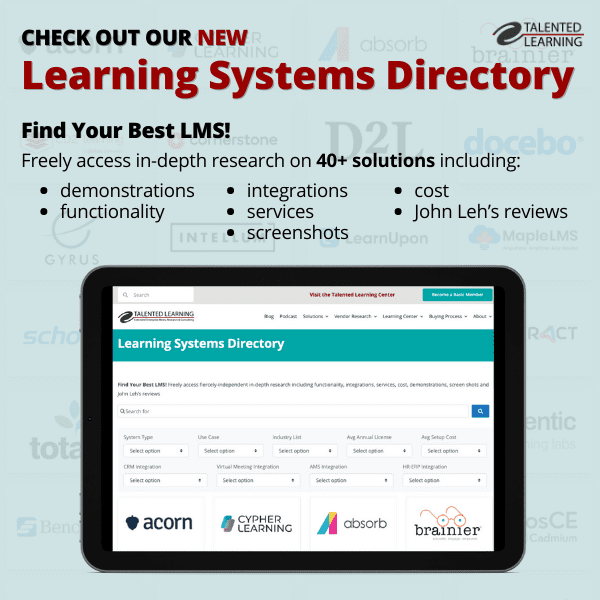
Want a better way to manage the business of learning? Find vendor profiles, reviews, case studies and more in our free Learning Systems Directory →
LMS Vendors: What’s Next for This Growing Market
All of these factors have led to a fragmentation of the corporate LMS market. There is now an LMS for every industry, use case and budget – from individuals to large-scale global corporations.
With better license models and the technical efficiency of the cloud, new LMS vendors have flooded the market. Many have chosen to target the extended enterprise market because buyers are independent decision makers who aren’t ruled by the HR hierarchy.
Together, these factors have created a perfect storm for fierce competition. Fun times ahead!
Thanks for reading!
Looking for the Best Solution Among LMS Vendors?
Make the most of your buying budget. Talk to an independent source you can trust. Schedule a free 30-minute consult below with me, John Leh:
*NOTE TO SALESPEOPLE: Want to sell us something? Please contact us via standard channels. Thanks!
Share This Post
About the Author: John Leh

Related Posts

Digital Video: 10 Ways to Experience Modern Learning Live and On-Demand
Nearly all vendors rely on integration with one or more third-party virtual online event applications such as GoToMeeting, Adobe Connect or Cisco WebEx.

How to Attract a Loyal Learning Audience, Even on a Tight Budget
Many low-cost marketing automation tools and marketing-savvy learning platforms now support specialized packaging, pre-scheduled content subscriptions, coupons, discounts, bundles, branded promotions and more.

The New Corporate Learning Ecosystem: Coexistence at Work
Recognizing the futility of direct competition, specialty LMS vendors learned to focus on a particular audience, industry or other factors where they now claim competence and fight for customers in that niche.

The Augmented LMS: New Life for Talent Management Learning?
Extended enterprise LMS stakeholders were proving that learning initiatives make a legitimate business impact by comparing trained vs. untrained audiences on metrics like sales volume, customer satisfaction, retention and lifetime value.

Associations: Should You Move to a New LMS for Continuing Education?
All four categories share much of the same core functionality -- but each type is also characterized by unique functionality, use case workflows and integrations that the others don't require.

Get Ready for a Season of Learning Tech Success! Webinar Series
A new season of free learning systems guidance is here and we saved you a front row seat! Don't miss this learning tech success series. Learn more and RSVP now

LMS Selection Success: Who Can You Trust?
To find the right learning platform, you need a clear understanding of your organization's current and anticipated usage, and more...

Custom Learning Experiences: Next Commercial Training Trend?
Under the hood, commercial LMSs must be tightly integrated with a full stack of robust, reliable, complementary technologies that support end-to-end business operations.

LMS Market Trends: Issues and Opportunities
Corporate learning organizations need to harness this just-in-time use of crowdsourced knowledge and integrate it with formal course content.




CASE STUDY DIRECTORY


FOLLOW US ON SOCIAL