

Long ago, I decided to hang a poster on my college room wall, featuring a quote from an unknown source:
“If you can’t beat them, join them — then beat them.”
Who knew that years later, this quote would become a battle cry for what I see happening in the LMS market?
Recently, the concept of corporate learning ecosystems has grown increasingly popular — and with good reason. Imagine creating a dynamic, intelligent learning infrastructure that engages your far-flung workforce, wherever those individuals may be. Imagine that your organization is informed in real-time about individual and program progress, as well as relevant business impact.
Now imagine accomplishing all of that without having to retire your existing talent management system of record. Sounds like a pipe dream, right? Not long ago, it was. So, what changed?
In a recent post, I outlined the emerging practice of LMS augmentation. It’s a fascinating trend we’ve been watching over the past few years — with many unforeseen twists.
As learning technology analysts, we’ve been following the rise of cloud-based learning systems, and the hundreds of developers who have entered the market with highly specialized LMS solutions.
Originally, many LMS specialists tried to compete head-to-head with the established giants of the talent management LMS world like Cornerstone, Saba, SumTotal, SAP/SuccessFactors, Oracle.
Even if these new little cloud vendors offered more elegant features, they were not built to run in large-scale enterprise settings, so the chance of gaining a foothold was slim.
Recognizing the futility of direct competition, specialty LMS vendors learned to focus on a particular audience, industry or other factors where they now claim competence and fight for customers in that niche. So where does augmentation fit in?
What’s new is that many of these systems now are able to stand alone OR complement a full-blown traditional talent management LMS. So rather than waging war on the giants, the specialist applications are working together in peaceful coexistence with established systems. This is most brilliant and sustainable strategy yet!
Four Pillars of LMS Augmentation
Wondering how can you extend and enhance your core talent LMS with dynamic, modern functionality? Want to know where you should look for reliable ways to augment your LMS? Below I’ve mapped key criteria and vendors in four categories — Learning Audience, Learning Experience, Learning Content and Learning Analytics:
1) Learning Audience
In corporations, audiences are not created equal. It may be considered mission-critical to educate some groups, while others are a low priority. Typically, groups tied closely to profit centers are considered essential to serve efficiently and effectively. That’s why the LMS purchasing decision often resides in the “for-profit” side of an organization.
These sponsors require learning solutions that drive revenue streams and improve or accelerate revenue-related processes. They usually have zero tolerance with HR-focused systems of record that haven’t successfully supported their unique needs.
Their position in the business gives them some leeway to “go rogue” if needed, to advance their learning programs. Examples include:
- Internal Sales Organizations
If you don’t empower your sales teams to sell, your business is nothing but an idea. But salespeople are notoriously busy and they don’t have time to sit in classrooms for hours.
They demand training that is timely, quick, mobile and social. And ideally, training should be designed to motivate them with built-in gamification that offers rewards and recognition.
- External Sales Organizations
Many companies rely on a mix of channel partners, retailers, distributors, franchises and contractors to sell products and services as an extension of their internal sales teams. These external partners have their own businesses to manage, so they value highly accessible training content and tools that focus on helping them succeed.
- Customers and Prospects
Education often plays a strategic role in driving awareness, interest, trial and purchase by targeted prospects. And a continuous customer onboarding process can turn a one-time transaction into repeat sales, purchase of complementary products and services, enthusiastic referrals and sustainable brand loyalty.
- Corporate Leadership
Leadership development is typically achieved by tapping into specialized third-party content. This content is often highly proprietary and blended (online/offline), so it is difficult to deploy on a corporate LMS. As a result, companies tend to invest in standalone content systems that must work together with the core LMS to coordinate scheduling, completion data and certifications.
2) Learning Experience
The one characteristic that both LMS administrators and learners desire most in a learning environment is usability. Through the years, traditional LMSs have lagged far behind — not only in user interface design, but also in underlying logic for search, content personalization and delivery, as well social, mobile and ecommerce functionality.
As a result, training programs suffered (along with the reputation of LMS providers). However, cloud LMS developers have dramatically improved the learning experience, so their applications look, feel and function like popular commercial websites such as Amazon and Netflix. For example:
- Learning Experience Platforms
Learning experience platforms add a new dimension to the learning process. Powered by artificial intelligence, they provide ongoing learning content recommendations based on a user’s past preferences, profile information, tags, subjects or social behavior.Companies like Claned, Degreed, EdCast and PathGather offer off-the-shelf solutions, while Extension Engine and Kineo create custom learning experiences. All of these work independently or in concert with an existing corporate LMS.
- Mobile Apps
Market momentum is surging for specialized mobile learning apps. They can be designed and developed to fit any audience interest, business need or subject matter. Apps from these vendors can run independently, or partially integrated with an existing LMS to share user and completion data across systems: Allego, CD2 Learning, Maestro, OnPoint Digital and RapidLD, as well as many Totara and Moodle partners.
3) Learning Content
Content has always been integral to an LMS. Previously, organizations would pay a single vendor (usually behemoth Skillsoft) for access to its massive, diverse content library, which could fulfill nearly any non-proprietary corporate learning need.
However — like everything else disrupted by the rise of cloud, mobile and social technologies — the way corporate employees learn has changed. Now, people prefer instant, on-demand access to visually rich learning resources in smaller, more practical chunks.
- Modern Learning Libraries
New digital content providers offer multi-format libraries that can stand alone or can easily be integrated with any LMS. For example: OpenSesame, BizLibrary, Grovo, Coursera, Lynda, EdX and instructor-based training providers such as Wilson Learning, DDI and Achieve Global.
- Virtual Classrooms
Adobe Connect, WebEx, GoToMeeting, Zoom, Skype are all standalone applications that commonly operate side-by-side with an LMS, sharing two-way registration and completion data.
- Video
Video is a broad term that encompasses everything from live video chat to screen sharing, and webinars to full digital video libraries. While most LMS vendors support direct uploads within their systems, they prefer embedded or linked videos from YouTube, Wistia, Vimeo or Brightcove. Or you can easily create your own fully mobile video training experiences with tools like Tokbox or Allego.
4) Learning Analytics
Every LMS can generate course statistics reports (registrations and completions), but where they fall short is in combining training data with other operational and business data to help organizations make smarter decisions. Here are some ways to augment your LMS to gain more powerful insights:
- Customer Relationship Management (CRM)
These systems help organizations strategically track, organize and analyze customer and prospect interactions — including training. Salesforce, Microsoft Dynamics, Oracle Fusion and SugarCRM are the most common CRMs integrated with learning platforms.
- Back Office Applications
Multiple LMS add-on tools can aggregate appropriate data to facilitate forecasting, automate scheduling, track and measure KPIs, and improve learning strategy and business processes. Noteworthy vendors focused on these capabilities include Training Orchestra, GP Strategies, Metrics That Matter, Google Analytics and Visier.
Conclusion
Gone are the days when one learning solution was expected to “do it all.” Above are 30+ stellar examples of “new breed” solutions you can mix-and-match to assemble the ideal learning technology “stack” for your organization. Sure, an all-in-one LMS can offer economies of scale, but weak usability and high price are working against you.
There’s a smarter game now. The stalemate between old-school talent management LMS software vs. new cloud learning solutions is entering a new phase. The battle lines are fuzzy. With “coexistence” as the new value proposition, cloud learning technology may just be more dangerous than ever.
“If you can’t beat them, join them — then beat them.”
Exciting times, indeed!
NEW RESOURCE:
Join the Talented Learning Center Community!
Want more education, advice, best practices, market research, collaboration and vendor ideas to help select, improve and manage your learning systems?
Find it all at our newly expanded and enhanced Talented Learning Center!
You’ll get unlimited access to our deep, growing library of resources – all focused on extended enterprise needs.
SEE FOR YOURSELF:
Share This Post
About the Author: John Leh

Related Posts
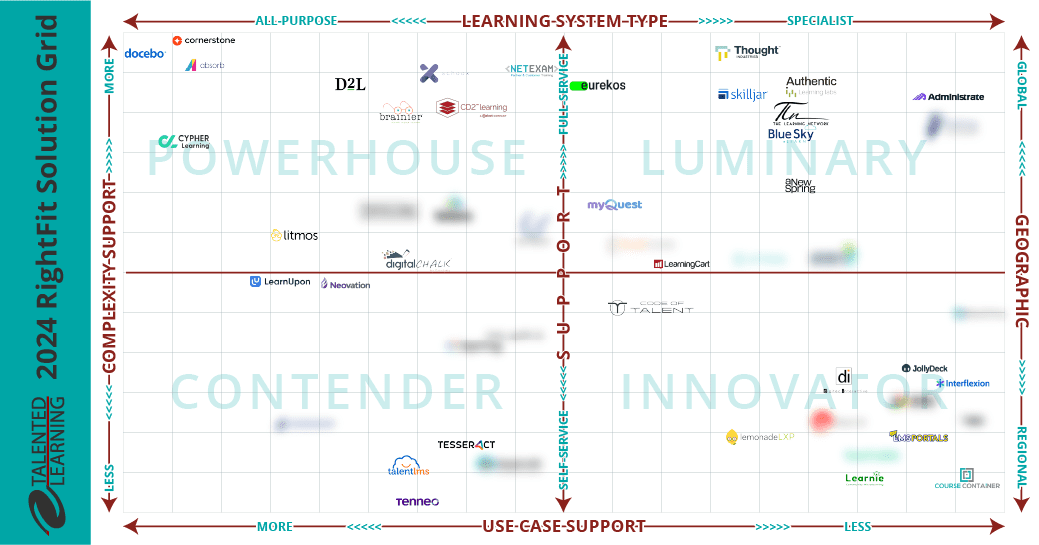
Which LMS is Best for You? New Shortlisting Tool for 2024
How can you find the best learning system for your business? Our LMS shortlisting tool can help. Learn about the 2024 RightFit Solution Grid. Free, reliable guidance based on our independent research

How to Build a Learning-Based Business: Executive Q&A Notes
Building and selling online courses may seem easy, but building a profitable learning-based business is far more complex. Find out what successful leaders say about running this kind of business

The Rewards of Community Building: Customer Ed Nugget 14
What role does community play in your customer relationships? Find out why community building is such a powerful force in customer education on this Customer Ed Nuggets episode

Benefits of Training Content Syndication: Customer Ed Nugget 13
If you educate customers online, why should you consider content syndication? Discover 10 compelling business benefits in this Customer Ed Nuggets episode

Top Marketing Skills to Master: Customer Ed Nugget 12
Successful customer education programs depend on professionals with expertise in multiple disciplines. Which marketing skills lead to the best results?

How to Measure and Improve Partner Training ROI
An educated channel is a successful channel. But how do you know if your educational programs are effective? Learn from an expert how to evaluate partner training ROI

Mistakes in Ongoing Customer Training: Customer Ed Nugget 11
Customer education doesn't stop with onboarding. It pays to invest in ongoing customer training. Learn which mistakes to avoid in this Customer Ed Nuggets episode

2024 Learning Systems Predictions: Top 15 LMS Trends
Which learning solutions trends will define the year ahead? Check these top 15 learning systems predictions from industry analyst and consultant, John Leh

9 Reasons to Replace Your LMS: Customer Ed Nugget 10
Want to improve the impact of your customer education programs? Find out reasons why it may be time to invest in a new learning system. Learn mor on this Customer Ed Nuggets podcast





CASE STUDY DIRECTORY


FOLLOW US ON SOCIAL