

Steer Clear of This Common LMS Selection Mistake
Are you looking for a new learning system to support an expanded training agenda? Many organizations are – especially in response to the COVID-19 pandemic, but need to avoid making one critical LMS selection mistake.
Only one month after countries locked-down in 2020, 63% of webinar attendees told us that they were already being expected to serve a broader learning audience mix – including customers, business partners and others outside their organization’s boundaries.

Clearly, this kind of shift requires a multitude of changes, not the least of which is the platform you use to support a more diverse population of learners. I know because, as an analyst and consultant focused on extended enterprise education, I help organizations understand why external audiences are unique and how that should influence their training technology stack.
With so much at stake, many people tell me they’re interested in best practices for choosing learning systems. Yet time after time, I see software buyers making one very costly LMS selection mistake.
It may seem insignificant, but this error can make your buying process far more complex and time-consuming. Even worse, it can play havoc with your business results.
So, what is this critical LMS selection mistake you should avoid?
Which learning system is best for you? Check the 2024 RightFit Solution Grid, based on our team’s independent research! Learn more and get your free copy!
Don’t Confuse Features with Requirements
Many learning systems vendors market their platforms by publishing a laundry list of features. Some even create massive scorecards comparing their features with competitive products.
Those lists may look impressive. But it doesn’t mean you should use them as buying tools. Why?
Trust me. Trying to evaluate every possible feature on those endless lists will only bog-down your purchasing process and waste your precious resources. In fact, it can create even more confusion by the time you’re done (assuming you actually make it through this mind-numbing exercise). And that’s only one reason why it’s such a costly LMS selection mistake!
What Should You Do Instead to Avoid This LMS Selection Mistake?
First, recognize that hundreds of systems are designed to support training, but many are unlikely to meet your organization’s specific needs and budget. So, your job is to zero-in quickly on the handful of systems that actually deserve your consideration.
Hundreds and hundreds of systems have the capacity to support digital learning programs, but no one has enough time to analyze and compare every potential option. But you can quickly filter-out irrelevant platforms if you start by clearly defining your key decision drivers – business, technical and other requirements. This framework makes it easier to focus exclusively on solutions that fit your unique needs and budget parameters.
How can you make this happen? The best organizations think broader than features and define their requirements through a five-part lens. Let’s walk through step-by-step…
5 Key LMS Requirements Categories
1) FUNCTIONAL REQUIREMENTS
The best way to define these requirements is by describing audience use cases. (For more details, see my recent post, “What’s Your Business Case for External Training?”)
For each scenario, describe the kind of content that learning participants will find useful. Under what circumstances will they want to find this content and consume it?
In other words, specify what learners want to accomplish, and how the system should respond throughout that process. Don’t include what people could potentially do. Instead, focus on the critical path.
As you document details for each scenario, don’t be surprised if hundreds of features that you may have assumed were critical “must-haves” become only ‘nice-to-have’ options. That’s the beauty of use cases. They focus your attention on what matters most.
Some of the most-requested capabilities for external training use cases include bulk-purchase ecommerce, personalization, content assignment and access, content feeds, user-generated content, microlearning, certification, collaboration and globalization.
2) TECHNICAL REQUIREMENTS
These requirements involve deployment models, integrations, customization needs, feature development, enhancements and security. To kickstart this process, research your existing infrastructure. For example:
STANDARDS
Is your architecture centered on key industry standards or regulations? Clarifying these dependencies with LMS vendors upfront can avoid a situation where your IT team must disqualify a candidate at the last minute. Be sure to ask about content, hosting environments, security, accessibility and Service Level Agreements (SLAs).
INTEGRATION
Will your LMS need to work seamlessly within your broader business ecosystem? This is important for most external training scenarios. And it’s why many extended enterprise LMS vendors have developed pre-built “connectors” to tie-in with many other business systems. This can dramatically simplify implementation and deployment.
If integrations are important to you, you’ll want to specify target systems. Also, for each touchpoint, determine the types of data that need to pass from one application to the other. Common integration examples include virtual live learning, CRM, content authoring, marketing automation, SSO and customer service apps.
The ideal approach is productized integration, but you may need to create a custom integration built with a vendor’s APIs. This approach comes with an extra financial and maintenance cost.
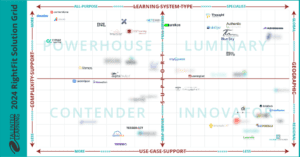
NEW FOR 2024
Which Learning Systems Are Your Best Fit?
Use our FREE RightFit Grid tool to build a shortlist based on our independent research. 50 leading learning systems mapped to common buyer requirements!
LEARN MORE AND GET YOUR FREE COPY…
3) PROFESSIONAL SERVICES REQUIREMENTS
The level of additional expertise and hands-on guidance needed to implement and manage an LMS can vary dramatically by vendor and purchasing organization. Some vendors design their platforms on a 100% self-service model. Others focus exclusively on customized solutions, including deployment and administration services. Most solutions fall somewhere in between.
It’s important to determine the level of assistance you’ll need and communicate these expectations to potential vendors, upfront. For instance, will you need a vendor implementation team, data and content migration services, integration services, custom content and marketing support? If so, you better make it clear!
4) ONGOING SYSTEM SUPPORT REQUIREMENTS
When LMS buyers become disgruntled with a vendor, what’s the #1 reason they’re unhappy? It’s not a lack of features or functionality. It is weak customer support after the initial implementation and launch.
Think beyond the day you deploy your system. What do you expect from the transition to your systems support group? This is where the frustration usually starts.
To avoid this, define your support requirements now. For example, do you require administrative and end-learner support, specific support hours, response and resolution guarantees? Are online communities, knowledge bases and user group meetings critical to your decision? Do you prefer chat, email, phone or text support?
5) CURRENT AND EXPECTED LMS USAGE PATTERNS
LMS pricing models vary widely, but they generally are based on the number of active learners or learner usage patterns. Purchasing too many or too few LMS licenses or the wrong license model for the way you do business is a recipe for unhappy vendor-buyer relationships. That’s why it pays to outline expectations in advance.
By thinking ahead about key usage factors, so you’ll be able to compare price quotes on an apples-to-apples basis. Also, with knowledge of your long-term business needs, vendors can offer pricing based on growth potential, rather than initial post-launch usage, alone.
Some key metrics include the number of learners who have logged-in, purchased or consumed content in a given time period, the number of potential learners, frequency of learner log-ins and specific usage patterns.
Conclusion
There is no sense evaluating any LMS until you clarify who will find value in using that system, as well as why, when and how they’re likely to use it.
Think carefully about the total package. This will help you focus on what matters most, so you don’t make the classic LMS selection mistake of getting sidetracked by interesting but unnecessary features.
After you document the 5 types of requirements needed for your learning system, you’ll have a blueprint that will make it easier for you to approach potential vendors and communicate your vision. You’ll also be able to more quickly and confidently qualify the best candidates and get accurate pricing for your specific use case scenarios.
This foundation can lead you to a strong shortlist of solution providers and ultimately help you choose the ideal vendor. I’ve seen this work in hundreds of situations, and I guarantee that you’ll not only avoid a costly LMS selection mistake – you’ll be rewarded with better business results.
Thanks for reading!
Need Help Finding the Best Training Business LMS?
Fill out the form below to request a complimentary consultation call with John Leh:
Share This Post
About the Author: John Leh

Related Posts
You’re Registered
Thank you! We look forward to having you join our free online expert panel: "Strategies for Riding the Next Wave of Training Transformation." Soon you'll receive a confirmation email from me (via GoToWebinar) with details [...]

Top Customer Education Tips From Industry Leaders
If you listen to The Talented Learning Show podcast, you know I close each episode with a similar question for every learning practitioner and technology innovator I interview...

Customer Education Systems: Top Integrations and Innovations
Customer education systems are, without a doubt, the fastest-growing segment of today's learning systems market. Find out why third-party integrations are adding value and which ones are most critical...

How Can Market Segmentation Drive Business Growth?
Every business strives to grow, but in a competitive environment, growing your business takes insight and creativity. One of the smartest ways to drive growth is through customer and market segmentation.

Training Content Fundamentals for Extended Enterprise Success
You create and design extended enterprise training in order to teach customers, partners, and contractors how to succeed with your products and services.

Meet The Talented Learning Center: What’s In It For You?
The Talented Learning Center is the world's only educational and research community centered on the learning systems marketplace.

Supply Chain Training: Mapping Your Ecosystem
Supply chain training isn't for the faint of heart; these partner networks are some of the most advanced ecosystems in the extended enterprise learning world.

Customer Success: Where Does Training Fit In?
Customer success is rapidly becoming a standard practice for businesses everywhere - especially for companies that want to gain a competitive advantage in volatile markets like software and technology.

Learning Strategy: Great Advice from Industry Leaders
These diverse disciplines must work in concert to ensure that your learning program is woven into your organization's broader ecosystem and workflows. It's not easy, but a strategic approach helps.





CASE STUDY DIRECTORY


FOLLOW US ON SOCIAL