

Early in 2014, I set out to answer a question I constantly hear as a learning systems selection consultant: “Should we use our employee LMS to educate external audiences?”
Back then, I didn’t definitively say “yes” or “no.” Instead, I advised decision-makers to proceed with caution before embracing a one-for-all LMS mindset. Why? Primarily because employee educational goals, interests and motivations don’t apply to extended enterprise learners.
Employees are captive LMS users. They are “known” by the system and they must comply with mandated training assignments. On the other hand, customers and business partners can’t be forced to engage in learning activities. An LMS often doesn’t “know” the identity of these users until they’re persuaded to register or buy. Even then, their participation is voluntary, not mandatory.
These extended LMS use cases translate into very different functional requirements than employee LMS requirements. The reverse is also true – many employee LMS features are unnecessary in extended enterprise applications.
There are other reasons why there’s no simple answer to the one-LMS-for-all question. For instance, decisions about extended enterprise learning usually come from business units, not HR or L&D, and these programs are often funded at different times.
Also, extended enterprise initiatives almost always serve many more external learners than employees. This makes a “license economies of scale” argument irrelevant.
For example, a software company with 1000 employees could serve 1 million customers. In this case, the customer education scope would blow employee LMS licensing out of the water.
Most importantly, in contrast with hard-to-measure employee education, extended enterprise learning programs are easy to measure. They contribute to bottom-line results and help companies gain a competitive advantage. Given that kind of executive exposure, business impact – not cost – is the key factor driving vendor selection.
Finally, from a practical and political perspective, choosing an extended enterprise LMS independent of HR or L&D is often easier than pursuing a one-LMS-for-all solution.
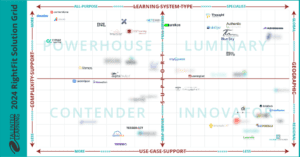
NEW FOR 2024
Which Learning Systems Are Your Best Fit?
Use our FREE RightFit Grid tool to build a shortlist based on our independent research. 50 leading learning systems mapped to common buyer requirements!
LEARN MORE AND GET YOUR FREE COPY…
Same Question, Different Day. What’s Changed?
Years after publishing my original post, I still hear that same question on a regular basis. And even though my answer remains the same, my perspective is much different. After all, some things have changed considerably:
• Extended enterprise learning is no longer a novel idea. Organizations of every size in every industry are proving that you can gain and sustain a competitive advantage by educating customers, channel partners, franchisees, developers, contractors and other external audiences.
• Learning systems innovation has continued to progress at a mind-blowing pace, along with new business technologies that integrate data and applications, expand their reach, accelerate their performance and add value in countless ways.
• During the past 5 years, I’ve reviewed over 200 learning systems and helped nearly 60 organizations choose their extended enterprise learning systems. Collectively, these organizations invest more than $15 million a year in licensing fees to run their systems. Now I’m even more confident about what works, what doesn’t – and why.
What do these changes mean for you if you’re wondering whether it’s wise to serve internal and external learning audiences with an employee LMS? Let’s dig deeper.
2 Buyer Categories: Which Profile Fits You?
In our work with learning systems buyers, we see two distinct extended enterprise purchasing profiles. Their objectives, priorities and requirements sometimes overlap, but mostly they’re unique:
• Corporate Extended Enterprise – These buyers are interested in serving any combination of employees, customers, channel sales representatives, distributors and other business partners. They’re mainly interested in using learning content to support their core business in strategic and measurable ways.
• Continuing Education – These buyers are professional associations, commercial training companies and entrepreneurial subject matter experts, representing virtually every industry and topic area. They’re interested in modern ecommerce-enabled “learning-as-a-business” systems because selling learning content is their business.
OK. Say you’re a corporate extended enterprise buyer. What’s your next move? Let’s briefly look at LMS options that can meet your needs.
So Many Learning Systems – So Little Time
We’re currently tracking more than 1000 business-oriented learning systems. But who has time to sort through such a massive, complex haystack in search of the ideal solution? It helps to assign vendors to several clearly defined categories. Unfortunately, that can be challenging, especially when developers add to the confusion.
We understand why LMS vendors want to differentiate their platforms. That’s smart marketing. But in recent years, creative positioning seems to have gone off the rails.
On one hand, most vendors now avoid the term “LMS” entirely, fearing that their solutions will seem outdated. Meanwhile, buyers grapple with countless variations on an LMS theme, wondering if there’s any functional difference, at all.
An LMS By Any Other Name…
So, what term should you use when looking for a system to support your organization’s learning needs? Here’s a peek at some of the descriptions we see in our travels:
Learning management system (LMS)
Learning experience platform (LXP/LEP)
Learning engagement platform
Learning optimization platform
Learner success platform
Holistic learning platform
Integrated learning platform
Unified learning system
Cloud LMS
Modern LMS
Next-generation online learning platform
Virtual learning environment
Adaptive learning system
Blended learning system
Personalized learning platform
Microlearning platform
Mobile LMS
Mobile training reinforcement system
Game-based mobile learning platform
Course development and delivery platform
Course management automation software
Digital learning platform
Elearning system
Elearning management system
On-demand training system
Training management systems
Workforce training software
Continuous learning platform
Lifelong learning platform
Upskilling platform
Professional development platform
Collaborative learning environment
Collaborative learning platform
Social learning platform
Employee knowledge platform
Knowledge and learning management system
Wisdom exchange platform
Whew. That’s a lot to digest, but it’s more about branding than substance. Let’s make this a bit easier…
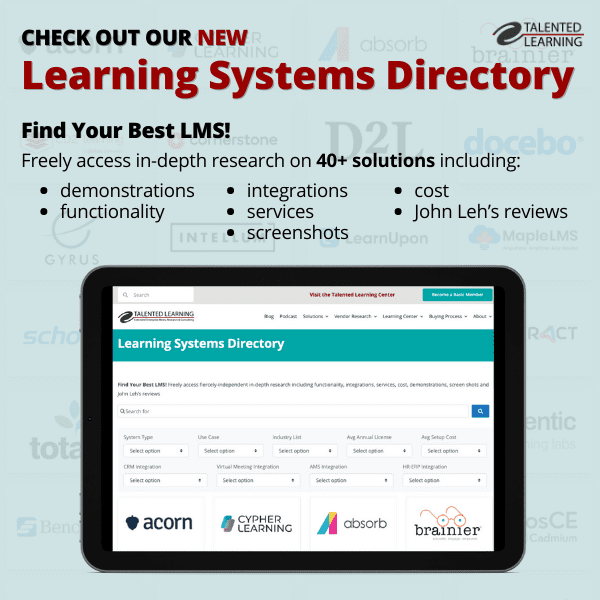
Want a better way to manage the business of learning? Find vendor profiles, reviews, case studies and more in our free Learning Systems Directory…
Our Quick Take: 3 Corporate Learning Systems Categories
To simplify the corporate extended enterprise learning landscape, we rely on three categories:
1) Employee/Talent Solutions
These systems focus on workforce onboarding, compliance and professional development. They rely heavily on HR/ERP platform integration (for example with Workday or SAP). Typically, they coordinate work objectives, learning paths, assessments, feedback, collaboration, hiring and performance reviews.
Examples in this group including Adobe Captivate Prime, BizLibrary, Bridge by Instructure, CrossKnowledge, Degreed, Gyrus, Lessonly, SuccessFactors and SumTotal.
These systems generally ignore extended enterprise needs, so they’re not recommended as “single source” learning systems to serve all audiences. However, they are solid employee solutions. So, if you already use one successfully for workforce learning, we typically wouldn’t recommend that you replace it.
2) Corporate Extended Enterprise Solutions
Traditionally, these systems were built with an “employee-first” mentality, but also offer functionality for external audiences. However, many of these platforms have been strengthening their extended enterprise capabilities in recent years.
For instance, it’s now common to see support for multiple domains, delegated administration, ecommerce, content sharing, CRM integration and robust analytics.
Examples in this group include Cornerstone OnDemand, Docebo, PeopleFluent NetDimensions, Saba, SAP Litmos, Schoox, TalentLMS, Totara and UpsideLMS.
These systems can effectively drive learning programs that target employees, customers, business partners or a combination of audiences. If you already have a system from this category and want to expand your reach, it may be possible.
3) Pure Extended Enterprise Solutions
These vendors ignore employee LMS needs. Instead, they focus 100% of their research, development, marketing, licensing strategy, professional services expertise and thought leadership on the advancement of targeted solutions for customer education, channel training and other extended enterprise learning needs.
Examples include BlueVolt, Community Brands, Learndot by ServiceRocket, LearnUpon, NetExam, Northpass, Skilljar and Thought Industries.
Vendors in this category consistently demonstrate why dedicated extended enterprise solutions are highly preferable and profitable – even for organizations with multiple learning platforms.
Conclusion
At the end of the day, the question remains: Should you use your employee LMS for extended enterprise learning?
Clearly, learning systems have evolved in all categories. Many vendors are able and willing to discuss the pros and cons of any scenario we’ve outlined above. But as a buyer, be prepared. You’ll probably receive radically different advice, depending on which vendors you contact and evaluate.
So, how can you put all that advice to good use? My two cents: Keep in mind that the most successful LMS choices are based on a business case that carefully considers a buyer’s functional and technical requirements, content realities and licensing preferences, as well as its organizational structure and context.
If you want to talk about how to build a stronger case for internal and external learning systems, send me a note at Talented@talentedlearning.com. I’m happy to help.
Thanks for reading!
Need Help Finding The Best Future-Friendly LMS For Your Organization?
Want expert assistance to find a specialized extended enterprise platform that truly fits your organization’s needs? We’re here to help! Submit the form below to schedule a free preliminary consultation at your convenience.
Share This Post
About the Author: John Leh

Related Posts

Top 10 LMS Demonstrators in the World
In my estimation they do most everything right -- prepare, understand business needs, know their solution at all levels, engage the audience, tell great stories and win.
Crowd Wisdom Review
The implementation team includes subject matter experts, project managers, learning technologists, project consultants, trainers, account executives, executive sponsors and data integration/migration specialists.

LMS Sales Stories: Dispatch from the Front Lines For Vendors
You can’t do too much research on your prospect, their business and their industry before and while engaging in the sales cycle -- the more you know, the better chance you differentiate from the competition.

The Important LMS Differences In Compliance, Continuing Ed and Selling CEUs
Individuals are ultimately responsible to know their own ongoing continuing education requirements, take the required training, maintain ongoing proof of completion and submit to appropriate accreditation body to maintain their license or certification.

Under the Hood of Complex CEU Management
With each incremental accrediting jurisdiction the problem compounds and becomes so complicated that many organizations can’t use a commercially available LMS to manage CEUs but rather are forced to cobble together spreadsheets, home-grown custom systems, specialized commercial CE trackers and manual processes to bridge the gap, connect the data and ensure compliance.
Intro to the Continuing Education Admin Nightmare
In the accounting industry, most accounting firms set up a National Association of State Boards of Accountancy (NASBA) license and grant continuing professional education (CPE) credit based on the NASBA standards, rather than maintain the complex CPE rules of each state

LinkedIn Learning and Workforce Development: Connecting Skills and Jobs
The emphasis on the bridging “Skills Gap” has put new life into workforce development programs globally -- and no matter what size of a population you’re targeting, in a modern world, an online platform and delivery option has to be considered – gone are the days of just meeting with a counselor to develop a plan and then sit in a classroom.

Buying a Learning System? 110+ LMS Acronyms You Should Know
I concluded that it will take too long to teach 700+ LMS vendors the new anti-acronym trick and the easiest path would be to create a living, one-sentence, non-techie dictionary of LMS acronyms for learning systems buyers.

LMS Review: Brightwave Tessello
Brightwave, with its innovative xAPI driven tessello learning system, focuses on managing the real-life balance of learning by doing (experiential), learning from others (social) and formal learning (old school).



CASE STUDY DIRECTORY


FOLLOW US ON SOCIAL