

When you sell and deliver instructional content — either as a primary source of revenue, or to complement your core mission — it’s important to rely on an LMS designed specifically for this purpose. We call this kind of system a training content business LMS. Others call it an online course platform.
Regardless, the use cases for a content business LMS differ from employee learning scenarios because the goal is always to monetize content. This requires consumer-grade B2C, B2B, and B2B2B e-commerce, along with unique functionality for reporting, notifications, dashboards, and delegated administration.
What Sets Training Content Business Goals Apart?
This segment of the commercial learning market includes organizations of all sizes with diverse agendas. You’ll find entrepreneurial subject matter experts, as well as large-scale continuing education providers, trade associations, NGOs, and all types of public-facing governmental agencies. But despite their differences, many of these organizations rely on a specialized content business LMS as a technology backbone to orchestrate their end-to-end online brand presence, outreach, and operations.
A strong content business learning system supports multiple use cases. For example:
- Grow Content Business Revenue
With this kind of system, you can drive content sales better than with a typical website or e-commerce storefront. Specifically, you can generate stronger demand through recurring revenue streams, as well as one-time transactions. - Build Member Communities
You can support people throughout their careers by combining best practice resources, professional learning communities, and job recruitment capabilities. - Facilitate Continuing Education
Relying on this kind of system, you can simplify the process of promoting and providing ongoing professional development to people in specific industries. - Manage Certifications
With training plans and certification paths, you can help individuals qualify for new positions, maintain desired credentials and achieve long-term career goals. - Support High Stakes Test Prep
You can accomplish this by combining instructional content with an assessment engine to prepare students for any important exam or certification process.
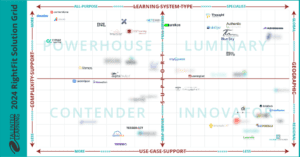
Which learning system is best for you? Check the 2024 RightFit Solution Grid, based on our team’s independent research! Learn more and get your free copy!
Measuring Training Content Business Success
For instructional content providers, growth comes from one or more core strategies. For instance, you can:
- Increase purchase volume or frequency among existing customers
- Expand your organization’s reach into new markets
- Create new training products and services that attract more customers
Smart content providers define specific, quantifiable business objectives. They measure actual performance as a benchmark. Then they continuously improve their offerings to achieve and exceed desired business outcomes. These are some of the most widely used metrics:
REVENUE
- Increase overall content sales to individuals or organizations
- Increase the number of ways to sell each piece of content
- Increase cross-selling and upselling to grow customer share of wallet
COST
- Decrease content development cost
- Decrease distribution cost by developing once and delivering unlimited times
- Expand the timeframe when any piece of content is valid
- Decrease the cost of entering or developing new markets
EFFICIENCY
- Increase prospect-to-customer conversion rates
- Compress conversion cycle timeframes
- Accelerate content creation speed
- Decrease the cost of interactions with customers or your business community
Best Training Content Business Platforms?
Compared with other LMS use cases, content business LMS requirements are often more comprehensive and complicated. So, which LMS companies are rising to this training content business challenge?
Check out our new 2023 Commerical LMS and Learning System Market Report for more detailed information about the top training content business platforms, as well as the best solutions for customer education, partner training, employee training, and extended enterprise learning.
Top Training Content Business LMS Cases
Our team is constantly researching, collecting, and cataloging representative case studies for all types of extended enterprise learning systems. Our Case Study Directory features more than 100 case studies, including these 7 stellar training content business examples:
CompTIA
LMS Vendor: BenchPrep
Computing Technology Industry Association (CompTIA) is a leading voice and advocate for the $4.8 trillion global information technology ecosystem and more than 35 million tech professionals. The organization helps IT specialists advance their careers through industry-recognized continuing education and certifications. With BenchPrep, CompTIA revamped its recertification program to increase revenue, reduce administrative burden, and elevate user engagement.
Advancing Pretrial Policy and Research
LMS Vendor: Extension Engine
The mission of Advancing Pretrial Policy and Research (APPR) is to support justice system professionals in achieving fair, just, and effective pretrial practices. APPR had already developed a successful in-person training model. Yet scaling this model was infeasible due to geographic constraints, the need for a significant time commitment, and the cost of consultants. Extension Engine guided APPR through its digital transformation process and built a custom learning experience to improve the U.S. pretrial process.
HIM Training Institute
LMS Vendor: CYPHER LEARNING
Health Information Management Training Institute (HIM Training Institute) provides online medical coding certification training. Since opening its doors in 2015, HIM Training Institute has educated medical coders who are work-ready and capable of realizing their career goals through solid technical skills training. Because the organization was already using MATRIX LMS for online learning when the Covid-19 pandemic shut down other medical coding training companies, HIM Training Institute kept on running.
McGraw Hill
LMS Vendor: BenchPrep
McGraw-Hill Education is a leading learning science company and publisher that delivers personalized learning experiences. The company needed to reassess its digital delivery options so its content could keep pace with competitors and meet its customers’ changing expectations. By relying on BenchPrep, McGraw-Hill Education increased online learning engagement by 10x and helped digitize its well-known test prep content.
New Teacher Center
LMS Vendor: Extension Engine
The New Teacher Center is a U.S. non-profit organization dedicated to strengthening the practice of beginning teachers. By digitally transforming its organization with online learning powered by Extension Engine, New Teacher Center now provides professional development in multiple ways to scale the organization’s reach and impact.
Industrial Training International
LMS Vendor: Thought Industries
Industrial Training International (ITI) is a worldwide leader in training professionals who operate cranes, use industrial rigging, and conduct load-handling activities around the globe. With the Thought Industries platform, ITI now offers a streamlined comprehensive learning portal that delivers meaningful business results. This online learning platform has enabled ITI to keep pace with learner expectations while growing the organization.
ABAC
LMS Vendor: Academy of Mine
ABAC is a continuing education and professional development organization that provides live webinar classes to professionals in numerous disciplines, including behavior analysts, social workers, psychologists, counselors, occupational therapists, speech and language pathologists, teachers, nurses, and parents. With Academy of Mine, ABAC streamlined business operations and improved student user experience by replacing a fragmented network of applications with a fully integrated, custom-built elearning platform.
NEW FOR 2024
Which Learning Systems Are Your Best Fit?
Use our FREE RightFit Grid tool to build a shortlist based on our independent research. 50 leading learning systems mapped to common buyer requirements!
LEARN MORE AND GET YOUR FREE COPY…
Conclusion
Buying an LMS for your instructional content business may seem overwhelming. But you can accelerate the process if you know where to look. These 7 examples are a smart way to learn quickly about key challenges, requirements, and vendors. We’ll continue to share stories that illustrate the most effective and innovative solutions, so if you’re not yet a TalentedLearning newsletter subscriber, sign-up now.
Thanks for reading!
Need Help Finding the Best Training Content Business LMS?
Fill out the form below to request a complimentary consultation call with John Leh:
Share This Post
About the Author: John Leh

Related Posts

Talented Learning’s Greatest Hits: 2017 Edition
Digital innovation is making it easier than ever to support commercial training strategies, so companies of every size and industry segment are discovering how learning programs can fuel growth and profitability.

18 Top Learning Systems Trends to Watch in 2018
Despite competitive pressure to keep price points lower, we expect licensing levels to continue drifting upwards, as vendors attempt to demonstrate value-add that differentiates their offerings.
2017 Talented Learning LMS Awards: Best of the Best
Customer activity such as a course purchase, renewal, webinar participation, or whitepaper download should trigger relevant content recommendations or delivery. Therefore, these systems must be tightly integrated with CRM software, marketing automation and survey platforms, social media, ecommerce tools, accounting, finance, customer support and other systems.

Continuing Education Providers: What’s Your Recipe for LMS Success?
Continuing education providers offer a broad spectrum of learning experiences -- from in-person classroom sessions, mentoring and on-the-job training to self-paced study in virtual and blended formats.

Salesforce Learning Solutions: AppExchange Buyers Guide
Nearly 12 years ago, the company launched the Salesforce AppExchange as a one-stop-shop for third-party solutions that extend and enhance the platform's core functionality.

Digital Video: 10 Ways to Experience Modern Learning Live and On-Demand
Nearly all vendors rely on integration with one or more third-party virtual online event applications such as GoToMeeting, Adobe Connect or Cisco WebEx.

How to Attract a Loyal Learning Audience, Even on a Tight Budget
Many low-cost marketing automation tools and marketing-savvy learning platforms now support specialized packaging, pre-scheduled content subscriptions, coupons, discounts, bundles, branded promotions and more.

The New Corporate Learning Ecosystem: Coexistence at Work
Recognizing the futility of direct competition, specialty LMS vendors learned to focus on a particular audience, industry or other factors where they now claim competence and fight for customers in that niche.

The Augmented LMS: New Life for Talent Management Learning?
Extended enterprise LMS stakeholders were proving that learning initiatives make a legitimate business impact by comparing trained vs. untrained audiences on metrics like sales volume, customer satisfaction, retention and lifetime value.



CASE STUDY DIRECTORY


FOLLOW US ON SOCIAL