

Historically, associations built educational content programming around live location-based events. That’s one reason why national conferences have become magnets for members seeking professional development and certification.
But content preferences are rapidly changing. And with the arrival of innovative virtual learning technologies like live-streaming and webcasting, many associations are racing to offer continuing education in a variety of new forms.
This shift to multiple modes makes sense. Investing incrementally to repurpose existing content can be a powerful and profitable way to reach new audiences and boost non-dues revenue.
Of course, no one can afford to sink unlimited resources into content programming. So how should organizations prioritize opportunities?
For straight answers, I asked three association industry leaders who are putting these multi-format methods into practice:
- Nora Murphy – Online Learning Manager at Public Responsibility in Medicine & Research (PRIM&R), a 4,000-member association that promotes ethical standards for those involved in biomedical, social science, and behavioral research oversight.
- Katie May Grier – Senior Learning and Data Analyst at North Carolina Association of CPAs (NCACPA), an organization devoted to ensuring competence, civic responsibility, and success among the state’s accounting professionals.
- Jessica Lane – Director of Client Success for Freestone LMS at Community Brands. Throughout her career, Jessica has collaborated with many of the company’s 13,000 association and non-profit clients as they developed and delivered successful learning programs.
Below are the top recommendations that surfaced during our discussion…
10 Tips to Improve Instructional Content Programming
1) Aim for a menu that meets learners on their terms
People want to consume content “anytime, anywhere” in a variety of ways. In fact, a recent survey says that individuals of all ages typically rely on an average of 5 different learning mediums over the course of a year.
This suggests that the more ways you can repurpose a single piece of content, the better. A broad selection of formats lets learners choose the options that fit their personal preferences, technical requirements and logistical circumstances.
For example, if you republish a webcast as an on-demand event and a self-paced SCORM program, those who couldn’t attend live can participate when it’s convenient for them. Since in-person and digital audiences aren’t likely to overlap, this kind of content repurposing helps you reach a much broader audience over time.
2) Let member interests guide your decisions
What attracts individuals to continuing education programs? Research reveals three key criteria:
- Relevant topics
- High-quality content
- Credible sources/sponsors
In other words, content programming variety alone isn’t enough to establish your organization as a “go-to” learning provider. Neither is leading-edge technology.
What matters most is access to learning experiences that are meaningful, compelling and worthy of an individual’s time and effort.
When you’re developing content, it helps to regularly ask, “What would our target member want?” Then move in that direction.
3) Choose place-based events wisely
We all know that in-person conferences and seminars and are relatively costly and time-consuming to produce. So it pays to schedule these events with care. Focus on three key factors:
- How urgent is the need to share this educational content? Is it a “hot” topic?
- Is this particular topic better suited to an in-person learning experience? For example, does it call for hands-on practice or coaching?
- For those who are unable to travel, will a place-based event increase access to the content?
To clarify the third point, consider this example from an organization that delivers its annual conference in-person and as a virtual meeting. In a post-conference survey, 90% of virtual attendees said they wouldn’t have attended at all if the virtual sessions had not been available.
4) Start small and double down on what works
Because so much is at stake with live events, it helps to test speakers and topics in low-risk, proof-of-concept scenarios.
For instance, a webinar is a great way to introduce a new subject matter expert because it’s a low-overhead format. If the webinar is a winner, you’ll feel more confident scheduling that speaker for future in-person events.
Or with niche topics, you may not attract enough attendees to justify a live location-based seminar. But if you feature the topic in an online session, you can boost attendance by marketing the event to a much broader audience.
In general, if a speaker is willing to be recorded, it’s worthwhile to offer that content online and repurpose it in whatever ways your budget and expertise allow.
5) Stay open to shifting preferences
Technology innovation continues to drive new ways to work, live and learn. Smart associations recognize this by building flexibility into their content strategy.
For example, one expert says her organization is seeing a clear decline in live location-based seminar attendance.
However, digital streaming capabilities have opened doors for many more people to participate online in real-time.
Furthermore, repackaging the seminar as an on-demand event further expands its reach and extends its lifespan, for only a relatively small additional production and delivery cost.
6) Use feedback to drive continuous improvement for content programming
The best organizations seek feedback early and often. Analysis of content-specific evaluations, broader annual surveys and website traffic data can help you pinpoint issues and prioritize improvements that truly reflect member interests.
Think of this as a co-creation process. Each time you ask for comments, new insights will surface to help you shape the next iteration of your course or content. Once respondents see that you value their opinions and apply their suggestions, they’re likely to share more feedback in the future.
7) Leverage relationships with subject matter experts
It pays to develop a strong pool of subject matter experts (SMEs) – not just as speakers and content creators, but also as strategic advisors. For example, SMEs can be an excellent source of ideas for long-range program planning.
In addition, SMEs can operate as an informal “early warning system” to identify upcoming industry changes, issues or trends that may require new or updated educational content. By empowering you to communicate with members in a way that is useful and forward-looking, SMEs can help you gain a competitive advantage.
8) Showcase speakers in their best light
When you onboard new speakers, take time to assess their strengths and weaknesses. This will help you choose a format that fits their presentation skills and personality.
Subject matter knowledge doesn’t guarantee speaking ability. And online presentations require an extra layer of confidence because there’s no direct audience contact.
To give inexperienced speakers more control, you may prefer to record sessions without an audience and rebroadcast the session during the live event time slot.
Some SMEs may only want to deliver self-paced on-demand content. Others may want to produce a full collection of webinar recordings. If the topic is relevant, find a way to use the content.
And if speakers are willing and able to push the envelope, don’t be afraid to experiment. Build on the formats they prefer and see where it leads.
9) Don’t let presentation plans drift off-topic
Many organizations schedule speakers months before the actual event. Over such a long timeframe, presentation topics can lose focus.
To keep speakers on track, try these tactics:
- Provide a slide template that reflects the established agenda
- Ask for an outline or an early copy of work-in-process slides
- Initiate several periodic “check-in” calls before the run-through
- Listen closely to the run-through to verify that all agenda points are addressed
- Be available for last-minute adjustments and coaching, if needed
10) Make consistency your secret weapon
Don’t underestimate the value of consistency when it comes to content programming. Members don’t like surprises. This applies to all the processes that support learning programs.
For example, when people register for an online event, if you send an immediate confirmation message and an email reminder 24-hours prior, this should be a standard routine for all events.
Or if you list each member’s registrations on a personalized web page, be sure that every event can be included. The goal is to make routine communication flow naturally.
Similarly, whenever members log-in to launch a presentation, the process should be effortless. Avoid time-consuming software downloads and the need to fiddle with browser settings. The path should feel simple, familiar and frictionless – always.
Conclusion
Advice from these learning practitioners confirms what I see and hear often as a learning systems consultant. Smart associations aren’t waiting for others to prove that multi-channel content programming works. They’re committed to staying ahead of the pack. And that requires constant testing and tuning.
What’s more, continuing education success isn’t about offering multiple content modes, per se. It’s about how these various modes add to your overall reach, compared with the cost of engaging the same audience through only one type of content.
I hope these tips inspire you to take your content programming to the next level. And I look forward to hearing what kind of outcomes you achieve.
Thanks for reading!
Want to learn more? Replay this on-demand webinar:
How to Build Successful Learning Experiences: Lessons From Non-Profits and Associations
Every association and non-profit organization is unique. Yet all share common goals – to engage, retain, inform and influence constituents. What exactly does it take to engage learners, support your brand and advance your mission?
Join John Leh, CEO and Lead Analyst at Talented Learning as he hosts a panel discussion with experts who have developed successful online education programs based on highly customized learning platforms:
- Stephen Flatman, VP Examinations, AICPA
- Seewan Eng, Sr. Director of Technology, New Teacher Center
- Edward Daciuk, Principal Learning Strategist, ExtensionEngine
You’ll learn:
- How to build a business case for moving in-person education online
- What it takes to engage learners in an online environment
- How to differentiate your organization through online learning
- When to consider a custom platform that supports high-end learning experiences
- Lessons learned in achieving internal buy-in, project momentum and organizational alignment.
Need Proven LMS Selection Guidance?
Looking for a learning platform that truly fits your organization’s needs? We’re here to help! Submit the form below to schedule a free preliminary consultation at your convenience.
Share This Post
About the Author: John Leh

Related Posts

ATD24 Expo: Join Our LMS AI Innovation Tour
What's special about ATD24, the annual ATD International Conference and Expo? Find out why Lead Analyst John Leh is closely watching all the learning systems action!

Top LMS Selection Speed Bumps: Customer Ed Nugget 18
If you're a customer education leader, sooner or later you'll need to choose a learning system. How can you avoid LMS selection speed bumps? Find out in this Customer Ed Nuggets podcast

CEdMA Conference Takeaways: Customer Ed Nugget 17
What's top-of-mind among customer education professionals these days? Join Analyst John Leh and industry leader Kristine Kukich as they compare notes from the recent CEdMA Conference

Why So Many LMS Vendors?
People ask us all the time, "Why are there so many learning systems?" Here, our Lead Analyst, John Leh, explains the factors that have led to an industry with so many LMS vendors...
The Future of Customer Education: Customer Ed Nugget 16
Customer education is rapidly evolving as organizations embrace new strategies and tech. What does this mean for the future of customer education? See what experts say on this Customer Ed Nuggets episode

Education Strategy Mistakes to Avoid: Customer Ed Nugget 15
What does it take to deliver a successful customer education program? It starts with a solid education strategy. Learn how to avoid common pitfalls on this Customer Ed Nuggets episode
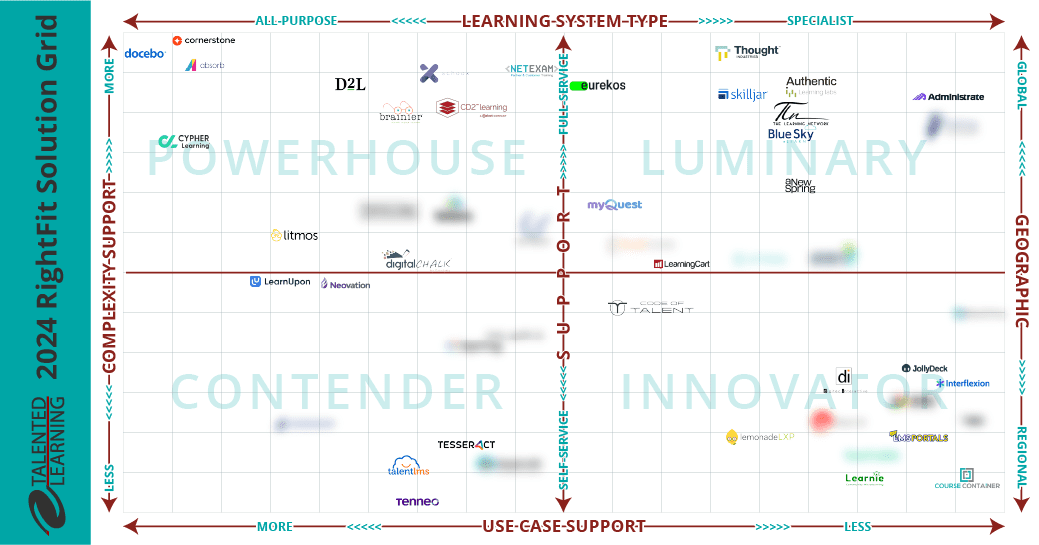
Which LMS is Best for You? New Shortlisting Tool for 2024
How can you find the best learning system for your business? Our LMS shortlisting tool can help. Learn about the 2024 RightFit Solution Grid. Free, reliable guidance based on our independent research

How to Build a Learning-Based Business: Executive Q&A Notes
Building and selling online courses may seem easy, but building a profitable learning-based business is far more complex. Find out what successful leaders say about running this kind of business

The Rewards of Community Building: Customer Ed Nugget 14
What role does community play in your customer relationships? Find out why community building is such a powerful force in customer education on this Customer Ed Nuggets episode



CASE STUDY DIRECTORY


FOLLOW US ON SOCIAL