

At Talented Learning, we help all kinds of organizations big and small find the right LMS for their needs. With more than 20 years combined in LMS sales and selection, I’ve been directly involved deals totally more than $150 million. But what factors make the LMS selection process more successful for some than others?
Through practical, front-line experience, I’ve identified the information and steps that are most effective in defining requirements and formulating a shortlist of highly qualified vendors for any type of business-oriented learning management scenario.
People often ask me, “What exactly should I expect from your LMS selection process and services?” The answer is easier to follow if we walk through a real-world example. So fasten your seatbelt and read on, as I share a story about the hyper-competitive nature of the LMS market, and the logic needed to identify, compare and choose the ideal solution.
LMS Selection Process: The Challenge
One of today’s hottest LMS market segments is continuing education. Associations, universities and commercial training companies are offering courses that help professionals of all types advance their work-related knowledge and skills. Recently, I completed an LMS selection project for a national association with this objective.
The association is dedicated to enabling and encouraging community service at the state and local level. Its “members” include approximately 1000 community service organizations. Each member organization has 5-150 employees, contractors and volunteers who need job-related training.
Within these organizations, individual knowledge and experience varies, as do learning needs and preferences for formal continuing education (CEU) credits, programs of study, books, courses, videos, files, templates, audio recordings, group discussions, expert forums, regional meetings, training/coaching telephone calls, and mini-nuggets of just-in-time performance support.
During the last decade, the association has accumulated a wealth of learning-related content in its LMS. However, finding the desired content type, format and size — on-demand — was a struggle. Learners who couldn’t locate desired content in the moment of need either abandoned the LMS or called the association for personalized assistance.
Find out how real-world companies are achieving more with learning systems that create business value. Get inspiration from dozens of success stories in our free LMS Case Study Directory…
LMS Selection Process: The Steps
The association decided to replace its inadequate open-source learning solution with a modern association-oriented LMS. Association LMSs are different from corporate or academic LMSs because they are designed to attract people who voluntarily pursue learning.
They’re built to find content, support mobile devices, gamification and social interactions. They must easily integrate with association management systems (AMS), ecommerce systems, single sign-on (SSO) technology, virtual classrooms, marketing automation tools, CRMs and event production systems.
So, we worked with the buyer to define requirements and identify four strong vendor matches. After verbally confirming requirements with each of the vendor candidates, we invited them to participate in our exclusive request for proposal (RFP) process.
All four vendors were qualified from an experience, functional, technical, service, and fiscal perspective so the association had to get serious to determine a winner. When all things are equal, price and subjective things like eagerness, attention to detail, understanding of business need, responsiveness, quality demonstrations and references will contribute to the decision process.
As is always the case, each vendor had strengths and weaknesses relative to the competition, so we fine-tuned the analysis during the final selection phase.
For each strength or weakness, we attempted to quantify incremental benefits in terms of potential revenue generation, cost reduction or improvement in learner experience. In other words, we used quantitative analysis to determine if extra non-critical features were worth the cost premium.
The answer emerged after we completed the following 4-step comparative LMS selection process:
Step 1: Compare Annual License Models
In addition to delivering training to member users, the association also sells courses to non-members, hoping the value of educational content will lead them to join.
This means they needed an LMS with a “usage-based” license model that lets them provide access and create learning records for many potential learners — both known and unknown — but charge the association only for learners who actually register or buy a course in an annual period.
We asked vendors to submit pricing for 15,000 “active” users/year so we could compare “apples-to-apples” bids, as illustrated below:

As you can see, among these comparable solutions the price difference between lowest and highest was $135,000, with an average bid of $143,750. Vendor 2 quickly emerged as the option to beat.
Step 2: Compare One-Time Implementation and Setup Pricing
For one-time setup, implementation and administrative training, we asked each vendor for a tailored implementation and setup package that included these elements:
- Full-service implementation process and services, including an upfront onsite workshop.
- Migration of 50 online courses, 10 years of discussion group forums and posts, and a digital document library with thousands of documents.
- Two-way integration with NetFORUM AMS — including data shared with the AMS for single sign-on, course. purchase/progress/completion and CEU credits earned — as well as detailed profile, organization, member status and other non-training data passed to the LMS to facilitate grouping, content recommendations, promotions and reporting.
- Integration with Google Analytics for tracking learner usage patterns and technical footprint.
- Integration with Adobe Connect so association administrators create a course once in the LMS, and it is automatically created in Adobe. Also, Adobe must share attendance and participation records with the LMS.
- A discretionary development account with 100 hours for potential enhancements.
- Virtual or onsite administrative training.
It is important to specify your needs as an LMS buyer, so vendors respond to your RFP with a complete solution price, rather than a base price with detailed scoping (and costs) to be determined. It’s foolish to delay scoping and pricing to the first step in implementation because you lose all buying leverage. Why needlessly put yourself at the mercy of any vendor? There’s no time like the sales process to get the best deal.
In this case, the four shortlist vendors provided the following one-time implementation and setup pricing:
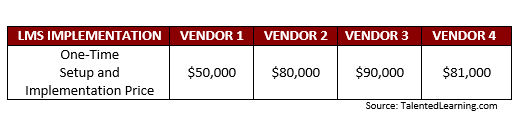
These one-time implementation bids averaged $75,250 with a $40,000 range from lowest to highest. This did not change the status of Vendor 2 as the price leader.
However, for the clearest financial comparison, it’s important to evaluate competing solutions in a 1st-year and 3rd-year total cost of ownership (TCO) time/cost horizon.
Step 3: Compare Total Cost of Ownership
Putting it all together, the chart below summarizes one-time setup and implementation costs, annual costs, and first-year and third-year total cost of ownership:

Among vendors that could meet or exceed all stated requirements, vendor 2 clearly was the most economical solution and it met all requirements. Unless there were compelling reasons to eliminate vendor 2, vendors 1, 3 and 4 needed to justify their premium (whether they realized it or not).
Was there measurable value in spending 2x or 3x for other solutions? Sizzle features are great, but are they $200,000 great? If not, the client would be wise to save the money and invest it in quality content development, promotion and other related needs. The next step revealed the answer.
Step 4: Demo Drilldown
Each vendor was invited to present its solution to association decision-makers in a virtual demonstration. As it turned out, vendor 2 was the most prepared, delivered the most compelling value proposition and tightest demonstration creating even more clear separation from the competition. Done deal.
All three higher price contenders displayed some innovation “sizzle” that swayed the selection team in the moment but never realistically. (I’ll discuss these demo performances in an upcoming blog post).
After the demos underscored the value of all four solutions, our rigorous upfront comparative analysis made it easy for the association to confidently choose a new LMS vendor. In this particular case, price and prudence won.
Want a better way to manage the business of learning? Find vendor profiles, reviews, case studies and more in our free Learning Systems Directory…
LMS Selection Process: The Takeaway
There are hundreds of viable LMS solutions in the market. Many will “work” for any given opportunity, just as many vehicles will “work” as your family car.
Sure, you can squeeze your family of four into a speedy, two-door coupe, but for daily errands and long-haul trips, the practicality and affordability of a minivan wins the day. It all depends on your needs.
Similarly, with LMS selection, it pays to define your requirements and spend time evaluating only qualified short-listed vendors. For companies that design, develop and sell learning systems, this is bad news.
The days of coasting to a victory based on product strengths and minimal sales effort are over. When competing against qualified specialists — or anybody for that matter — price, value, reputation and service matter.
Thanks for reading!
NEW FOR 2024
Which Learning Systems Are Your Best Fit?
Use our FREE RightFit Grid tool to build a shortlist based on our independent research. 50 leading learning systems mapped to common buyer requirements!
LEARN MORE AND GET YOUR FREE COPY…
Need Expert Guidance For Your LMS Selection Process?
Looking for a learning platform that truly fits your organization’s needs? Submit the form below to schedule a free preliminary consultation with Lead Analyst John Leh at your convenience…
Share This Post
About the Author: John Leh

Related Posts

LinkedIn Learning and Workforce Development: Connecting Skills and Jobs
The emphasis on the bridging “Skills Gap” has put new life into workforce development programs globally -- and no matter what size of a population you’re targeting, in a modern world, an online platform and delivery option has to be considered – gone are the days of just meeting with a counselor to develop a plan and then sit in a classroom.

Buying a Learning System? 110+ LMS Acronyms You Should Know
I concluded that it will take too long to teach 700+ LMS vendors the new anti-acronym trick and the easiest path would be to create a living, one-sentence, non-techie dictionary of LMS acronyms for learning systems buyers.

LMS Review: Brightwave Tessello
Brightwave, with its innovative xAPI driven tessello learning system, focuses on managing the real-life balance of learning by doing (experiential), learning from others (social) and formal learning (old school).

LinkedIn Outfoxes the Continuing Education World With Lynda.com Acquisition
By collecting skill endorsements and recommendations from your network and posting content, comments, presentations, awards, articles, certifications and other relevant data, you create a historical profile of credibility that other users recognize and value – and more so every day with a growing base of more than 610 million LinkedIn users in more than 200 countries.

15 Tips to Up Your Demo Game and Win Rate: For LMS Vendors
Many sales reps and solution architects take the demo step lightly because they have done the same presentation so many times that they think they have seen it all and know it all; as a result, they prep too little, make a vanilla impact with the customer and get lost in the herd of possible LMS solutions.

LMS Review: RISC VTA
This type of approach is consistent throughout the product and provides a lot of flexibility because you can approach an administrative problem from many angles to get, set and report on training the way you need it.

A Brief History of LMS Social Learning
Those learning and development organizations that did try to launch the social LMS components found quickly that making social learning successful is much more difficult than buying it and turning it on.

LMS Review: Gyrus Systems
GyrusAim is a global, enterprise-strength, administratively-focused LMS with core strengths of in-depth instructor led classroom (live or virtual) management, certification, role configuration and reporting.

What to Do While Waiting for LMS Budget Approval
If you can’t define and predictively measure how the purchase of an LMS is going to help your organization make or save money – way more money than the cost of the LMS – you aren't ready to buy a system.





CASE STUDY DIRECTORY


FOLLOW US ON SOCIAL