Podcast: Play in new window | Download
Subscribe: Apple Podcasts | Spotify | Amazon Music | Android | Youtube Music | RSS
EPISODE 92 – Action-First Learning

Dr. Karl Kapp, Professor, Commonwealth University
When Dr. Karl Kapp speaks, the instructional design world listens. That is why I’m thrilled he’s returning to The Talented Learning Show today.
As a respected professor, author and speaker, Karl is one of the most authoritative voices in adult learning design and technology. He is also known for translating theory into practice at numerous global organizations, where he has helped transform workplace learning and development.
If you’re a regular listener, you’ll recall that Karl and I previously explored several popular instructional strategies, including gamification and microlearning. And now, we’re turning our attention the topic of his newest book — Action-First Learning.
I’m sure he has some powerful insights and ideas to share. So, let’s get started…
ACTION-FIRST LEARNING — KEY TAKEAWAYS
- Action-first learning is an instructional philosophy based on behavioral methods that drive engagement. The concept is similar to active learning or problem-based learning. But action-first learning sparks interest and involvement right from the start of a learning experience.
- Practice and feedback play an integral role in action-first learning. But it’s difficult to support these elements at scale. This is where AI and other innovative technologies are stepping in to help organizations serve broader learning audiences.
- The benefits of action-first learning are significant. Rather than operating in isolation, it adds value by working in combination with methodologies like gamification and microlearning to promote behavior change.
ACTION-FIRST LEARNING — Q&A HIGHLIGHTS
Welcome back, Dr. Kapp. Your new book is all about action-first learning. Why this topic?
What happens first in instructional settings sets the tone. Those early moments are an opportunity to get learners thinking.
Imagine you’re teaching a class online or face-to-face. If you start by presenting passive information and then ask people to do an exercise, they’re not likely to be enthusiastic about it.
But, if you start with a robust decision-making scenario or another activity, it energizes people. They get engaged right away.
Makes sense…
Which learning system is best for you? Check the newest RightFit Solution Grid, based on our team’s rigorous independent research. Learn more and get your free copy!
Action-first learning also breaks down barriers. For example, you may think it’s a good idea to open a training session with a learning objective. So, you say, “I’m going to teach you five ways to sell…”
Immediately, a good salesperson may think, “Well, I know six ways to sell. This is a waste of my time.” And they’ll check out.
But instead, if you say, “Tell me how to sell this item to this person now,” there’s no time to process your request and dismiss it. They’ll respond by doing what they naturally do. That action spurs thinking and learning.
Right…
Also, if you design it right, they may do something incorrectly. For instance, if the salesperson can’t sell the item, they’ll think, “Hmm. There’s a gap in my knowledge. How can I fill this gap?”
Malcolm Knowles, the father of adult learning theory, said adults learn best when they know they don’t know something. So, if you ask people to take some kind action or make a decision that helps them realize, “Ooh, I don’t know this,” it opens their minds to learning.
These are concepts I explore in Action-First Learning.
Does action-first learning fly in the face of traditional instructional design models like ADDIE or SAM? Or is it complementary?
I think it’s complementary. ADDIE and SAM are basically methodologies for creating instruction. ADDIE focuses on the process of analysis, design and delivery. And SAM is about agile development.
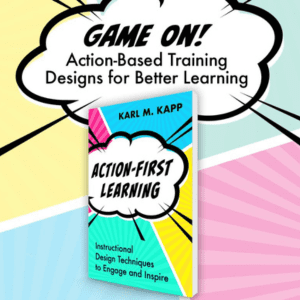
Buy Action-First Learning at Amazon.com
But I’ve always thought there’s a missing piece where we need to choose the right kind of design and delivery. That’s where action-first learning comes in. It’s more of a philosophy for what the instruction should be. So, it dovetails nicely with ADDIE and SAM.
I call this action-first learning, but there are a lot of similar terms: active learning, problem-based learning and so on. Often in the academic world — and sometimes in L&D — people say, “Technically, this isn’t problem-based learning or active learning. It should be this, this and this.”
It’s easy to get caught up in semantics. But that doesn’t really matter. What matters is getting learners to do something meaningful. It’s more important to think about how to design action into instruction.
So, rather than arguing over terms, I approached this as a philosophy, because there’s no wrong way to do it.
Find out how real-world companies are achieving more with learning systems that create business value. Get inspiration from dozens of success stories in our free LMS Case Study Directory…
On the technology side, there’s a big active learning trend, but it happens later in the cycle. I also see it with feedback during the learning process. How do you address that?
Feedback is incredibly important, and action does happen later in the process. But action first is the idea of letting learners make a mistake upfront and struggle — letting them become uncomfortable.
Often, we try to make the learner as comfortable as possible, and then we ask them to practice. But the practice isn’t realistic. It’s a perfect environment. And then when people get back to work, the situation is never perfect.
Instead, by throwing them in right away and challenging them to think about the elements of that instruction, they’re more attuned to mistakes they might make, what their assumptions are, which questions they should ask. Passive instruction often overlooks these things.
I see…
I’m a big believer in deliberate practice. But practice doesn’t make perfect. It is practice with specific, deliberate feedback that helps correct your mistakes.
So, when someone makes a mistake in an action-first learning situation, feedback is the remedy. It happens in the moment. That helps.
Buying or selling a customer-focused learning system? Get independent insights you can trust, with our in-depth analysis of 16 top solutions. Learn about our Customer LMS Buyer’s Guide
Mmhmm…
It’s a lot like telling kids, “The stove is hot. Don’t touch it.” But they still reach out their hand anyway, even though we’ve told them not to do it.
It’s human instinct. People try to do things to get direct feedback, so they’ll really understand. That’s the motivation behind action-first learning.
Of course, there are many ways to learn. But I think we’ve gone too far in the direction of simply feeding people information and not respecting the knowledge they bring to the table. Activities engage the mind and body more fully in a concept, rather than just sitting back and passively absorbing information.
And who gives the feedback? Of course, live feedback is great. But it doesn’t scale. AI makes this much easier, right?
Great question. Until recently, feedback was designed into a situation. Now, many of us are experimenting with AI.
For instance, I have a chatbot that does an entire branching sales conversation. I’ll say, “Hey, I need to sell elearning services, and I want you to role-play the client. How do I do that?” And the chatbot acts as the client throughout the whole thing, bringing up objections and so forth.
Then at the end I’ll say, “Okay, stop scenario. Now give me feedback on how well I sold you these services.” And the chatbot provides all my feedback.
It will point out specifics like, “This was a strong argument, but you didn’t counter it. And you did this, but you didn’t do this.” Increasingly, AI will be able to provide feedback, especially in online situations.
Join us in celebrating the best of the best in learning technology innovation! See our 2024 Learning Systems Award Winners…
No doubt…
Of course, AI isn’t perfect. But I can carry it around in my pocket. So, if I’m waiting in an office or I’m in line somewhere, I can click on my chatbot, have a conversation and get helpful feedback. Or I can pick it up later and try the conversation again.
It’s almost like a mentor with infinite patience and infinite ability to give me feedback.
I definitely see this as a trend. And in the book, every chapter includes what I call an “AI assist.” So, when we talk about developing card games, or escape rooms or AR/VR for learning, there’s a note saying, “If you want to design this in AI, here’s some guidance.”
Very cool. Could you talk about some real-world examples of action-first learning?
Sure. Let’s say a bank is delivering compliance training that teaches employees not to accept bribes. Instead of starting with a learning objective and talking about why bribes are bad and so forth, people just log in and see this statement:
“Your boss has come into your office and accused a coworker of embezzling $10,000. What will you do?”
So, right away, people are forced to act. They have to get involved.
Sure…
Or, say you create an online training module where employees must sort key concepts into three piles. The categories are big security breaches, no breaches and possible breaches. And people need to make decisions, even before you tell them what a breach is, how it works and so forth.
This means they must actively consider what a security breach is. And if they aren’t sure if something is a breach, they’ll be more attuned to that particular concept because they were uncertain.
Research shows that the mind works harder to make a decision when we’re not sure of the answer. When we are confident and knowledgeable about answers, we don’t grow. We grow by studying things we don’t know, or by making decisions we don’t know how to make.

Which Learning Systems Are Best For You?
Use our FREE RightFit Grid to build a shortlist based on our independent research. Compare 60 top learning systems, mapped to common buyer requirements…
LEARN MORE AND GET YOUR FREE COPY NOW…
Interesting. As an expert at gamification and microlearning, how do you see these methods playing into action-first learning?
Originally, I wanted to name this book Beyond Gamification. That’s because gamification has become focused on leaderboards, badges and points. But the default is often very passive, like getting points for logging in or watching a video.
That’s not really effective. No one plays a game just for those things. They play for the challenge or for other reasons.
So, I want people who design instruction to think about what’s next. How can they get a learner involved in a situation? Let’s push the limit. Let’s make people learn by doing. Learning by doing is nothing new, but it has been pushed to the back burner.
Also, in an age when we can get information anywhere, where is the behavior change? Where is the performance improvement? That comes from actively doing things, not being passive.
Good point…
As for microlearning, you can always inject it into different situations to help with pre-learning and post-learning. But you can make it more interesting and effective.
For example, the book talks about educational cliffhangers and seeking information to solve mysteries. I’m amazed that some of the biggest online communities focus on solving real-life crimes.
People enjoy figuring things out inductively and deductively. So, why is that absent from training? That was another driver.
Also, I think our world has gone too short with everything. Too bite-sized. There’s a lot of value in marinating in-depth on a subject and really thinking about strategy. We’re losing some of that.
All types of learning have many applications, including gamification and microlearning. But let’s not forget that deeper learning has a real impact.
As you know, I’ve been in the field for a while. So, I’m condensing what I’ve learned over the years into these methodologies people can use to create much more impactful training.
Excellent. So, for people who want to get started with this philosophy, what do you recommend? …
…For complete answers to this and more questions about action-first learning, listen to this entire podcast on Apple Podcasts, on Spotify, on Amazon, or right here on our site.
Watch This Podcast on YouTube
Find Out More About Action-First Learning
Want more details about action-first learning methods?
- Buy the book at Amazon, at Barnes & Noble, at the ATD Bookstore or from other leading online booksellers.
- Follow Dr. Kapp on LinkedIn or join his community for instructional design professionals, the L&D Mentor Academy.
Need an LMS that supports action-first learning? Let’s talk.
As an independent learning tech expert, I’m prepared to help you choose the best solution for your organization’s needs. For a free 30-minute consult with me, John Leh, Lead Analyst at Talented Learning, schedule a call below…
*NOTE TO SALESPEOPLE: Want to sell us something? Please contact us via standard channels. Thanks!
About the Author: John Leh