Podcast: Play in new window | Download
Subscribe: Apple Podcasts | Spotify | Amazon Music | Android | Youtube Music | RSS
WELCOME TO EPISODE 3 OF THE TALENTED LEARNING SHOW!
To learn more about this podcast series or to explore our full collection of episodes visit The Talented Learning Show main page.
EPISODE 3: Gamification and Learning in Business
Today, we’re honored to speak with one of the world’s foremost experts and innovators in the field of gamification and learning design – Dr. Karl Kapp.
Dr. Kapp comes with a long and impressive list of professional credentials, including his role as Professor of Instructional Technology and Director of Interactive Technologies at Bloomsburg University. He also has authored nine books and developed multiple online courses for LinkedIn Learning.
But hands-down, Dr. Kapp is best known as a tremendously entertaining and thought-provoking speaker at industry conferences, where he helps participants discover how to leverage game-oriented techniques and technologies to develop more effective learning experiences.
In this interview, Dr. Kapp and I discuss how organizations can use gamification techniques and technologies to enhance learning and improve business performance.
HIGHLIGHTS: Gamification and Learning in Business
Gamification. Game-Based Learning. Simulations. These terms are increasingly popular. But how do they apply to extended enterprise learning scenarios?
There is a huge opportunity to attract external audiences. You can draw people in and build loyalty by thoughtfully applying these three gamification and learning elements:
1. Game-Based Learning
Think of game-based learning as a self-contained space. There is a clear beginning-middle-end to the game, and when it is over, you move on.
2. Gamification
Here, you use game elements in a non-game environment to extend engagement. For example, you may have a work-related app that you interact with periodically. Over time, you’ll want to accumulate points for completing specific tasks within your work setting.
This continues outside of a defined game space. But gamification and learning need to move beyond just points, badges and leaderboards. Things like feedback loops, the opportunity to explore, the freedom to fail, a sense of mystery, or an open loop. These things can be highly effective at pulling people into your content.
3. Simulations
Although simulations may include game elements, they tend to have a more realistic feel than games or gamification. Simulations can be very effective in business environments, where organizations can use these techniques to engage people and also add business value.
Find out how real-world companies are achieving more with learning systems that create business value. Get inspiration from dozens of success stories in our free LMS Case Study Directory…
What kind of simulations work well in business?
Here are three examples:
1. Call Center Skills Development
We developed a really successful simulation that taught people how to handle incoming calls and deal with the demands of a stressful call center environment. We analyzed common issues, created a “good-better-best” rubric for responses, and then prerecorded effective conversations.
The simulation recorded learner responses to each step in a scenario and awarded points based on how well they responded as they moved through the decision tree. Because conversations were recorded online, we could review them with learners and provide essential feedback.
What people miss about simulations – and online learning in general – is the level of analytics that you can apply to make it more effective. It’s not just being able to include analytics, but being able to tie the analytics back to remediation.
A key to gamified instruction or simulations is error diagnosis. We should step back and ask, “Why are people making mistakes? Is it an error of commission or omission? Is it a mistake of knowledge? Or something else?”
2. Physician Training
Simulations create a safe environment that can help people in high-risk, high-powered professions open themselves to learning. For example, I like to joke that physicians know everything, so how can they learn anything?
But let’s say a medical center wants to improve its accuracy in diagnosing patient illnesses. They can analyze the most commonly misdiagnosed conditions. Then they can develop a game or simulation that leads physicians down a path to discover when they don’t know something. Those “ah ha” moments are teachable moments, because adults learn best when they realize they don’t know something.
3. Sales Training
Also, we recently completed a fascinating project for a large biotech company, where we created a simulation that increased sales by 12%. We broke down the sales model into various pieces, and based upon the decisions sales reps make at various points in the game, we can spot specific weaknesses and focus on those areas.
Games and simulations let you create adaptive instruction, so you don’t have to train everyone in the entire sales process if it isn’t necessary. This approach is much more efficient and effective than trying to teach everyone everything. You know, one-size-fits-all doesn’t work with hats – or learning, either.
In a sales environment, it’s easy to translate that 12% increase in revenues into a real dollar value and see that it dwarfs the cost of developing the learning content. What does it actually take to put effective gamification systems in place?
It’s a process:

Buy The Gamification of Learning and Instruction at Amazon.com
- Identify the specific behaviors you want to drive or change, and investigate what motivates your audience.
- Analyze other approaches. Would they be more effective than games or gamification? Have they been tried? How well did they work? Why?
- Determine the appropriate level, timing and frequency of engagement. A retail associate may be able to engage while on the sales floor, but a physician’s day is so packed, you’ll need to schedule accordingly.
- Decide if peers should be involved. Do you want learners to compare their performance with others, or with their own standards and past performance?
- Clarify what I call the core dynamic – in other words, how players win the game.
- Specify metrics that tie to performance.
- Finally, create a pilot program and test it to be sure the game or simulation actually accomplishes what you intend.
Which learning system is right for you? Check our RightFit Solution Grid, based on our team’s independent research! Learn more and get your free copy!
From a tech perspective, is it best to first look at an LMS platform, or authoring tools or some other class of tools?
The kind of tools you choose should depend on your content strategy. I divide gamification into two types:
- Structural Gamification – Built around the content, but the content itself doesn’t change.
- Content Gamification – Where the content changes to be more game-like.
Many LMSs have implemented points, badges and leaderboards in some way. But often that functionality is bolted on, so it’s very limited and it’s not tied to individual pieces of content. You pass a course or take a quiz and you get a badge. But that’s not a very robust version of gamification.
Then there are pure gamification platforms that let you add content. Usually, the approach is based on microlearning, so it’s not a content deep-dive. But you can add content and information, and the reporting and game elements are more robust.
There are also a few platforms built from the ground up as a gamified LMS.
And then there are tools like Lectora, Captivate, Storyline and iSpring. They let you add gamification points and those kinds of elements to the content itself.
For anyone just getting started with gamification in learning, what do you recommend they do first?
Start by playing games! To think effectively about gamification, you need to develop some game literacy. You may know Monopoly or Stratego, but that’s a very narrow scope. You want exposure to lots of different game dynamics, mechanics and elements. For example, try Catan, Pandemic, Forbidden Island…
Then look at various gamification platforms. They all approach it differently. And they all have freely available demos. You don’t need to try them all – just pick four or five. Then think about how they might apply to your organization’s needs.
There are also many books, resources, courses and conferences with excellent information to guide your research…
For complete answers to all questions, listen to this entire episode, follow this podcast on Apple, or Spotify, or Amazon. Or TUNE IN RIGHT NOW ON OUR SITE.
More Resources: Gamification and Learning in Business
BUY THE BOOK AT AMAZON.COM
Want to learn more about gamification and learning systems? Read our post: LMS Gamification: Are We Having Fun Yet?
For more insights and advice on gamification and learning in business from Dr. Kapp, visit his website karlkapp.com.
Or buy his latest book at Amazon.com:
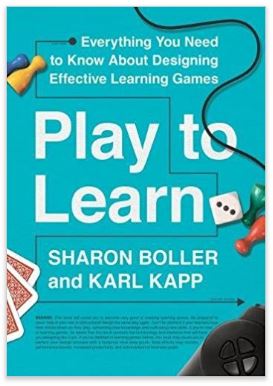
Play to Learn: Everything You Need to Know About Designing Effective Learning Games (with Sharon Boller)
Join Us For More Episodes
If you don’t yet follow The Talented Learning Show, tune-in with the method you prefer:
- Subscribe to our weekly newsletter for an email alert whenever we drop a new episode
- Follow us on your favorite channel: Apple | Spotify | Amazon | YouTube Music or wherever you tune in to podcasts.
- Get RSS Updates.
Thanks for listening!
Need Better Tools to Support Gamification and Learning? Let’s Talk
As an independent learning tech expert, I can help you choose the best tool for your needs. Schedule a free initial consultation call with me, John Leh, Lead Analyst at Talented Learning, on the calendar below..
*NOTE: Salespeople, please DO NOT book a call if you want to sell me something. You’ll be wasting a free spot others need, so I won’t stay on the call. Instead, contact me through normal channels. Thanks.
About the Author: John Leh