

Love it or hate it, you have to admit that life in the learning technology “lane” is never dull or slow. Just when you think your organization is catching up with the ever-changing status quo, you take a breath, look around and — whoosh — you’re behind the curve again.
Sometimes all this energy feels more like trying to catch a tiger by the tail. But case after case demonstrates that a state-of-the-art learning infrastructure leads to a demonstrable business advantage. Your learning organization can’t pull over and smell the flowers if you want to win your competitive race. (It also means that independent learning technology consultants like me are enjoying pretty good job security these days.)
For example, consider the association segment of the LMS industry. Only a few years ago I was writing about how smart associations were adopting LMS technology as a foundation for continuing education programs. But since then innovation has erupted all around and leading-edge associations are now embracing a full “tech stack” approach to differentiate and comparatively sell more content.
We see these member-based organizations creating comprehensive professional development ecosystems by connecting AMS, CRM and LMS platforms, content authoring/LCMS, SSO, ecommerce, fulfillment, proctoring, social media and email marketing to analytics applications to create CE selling machines. This integrated, modular infrastructure makes it possible for associations to compete head-to-head with sophisticated commercial training companies for a heftier share of the continuing education market. Whoosh! (Doppler Effect)
Does this mean your association should part ways with your current learning management system? Maybe. Probably, if it has been a few years since your purchase. Before you take the leap though, let’s look at findings from our research and experiences in helping dozens of future-minded organizations select a modern LMS that fits their needs.
The Modern Association LMS: Why Here And Now?
The LMS landscape is comprised of four primary “solution” categories — corporate, continuing education, academic and association. All four categories share much of the same core functionality — but each type is also characterized by unique functionality, use case workflows and integrations that the others don’t require.
Until a few years ago when association LMSs were introduced, member-based organizations had to get by with solutions that were designed for corporate or academic use. However, the logic behind those systems doesn’t align with typical continuing education scenarios. Here’s the primary difference — association members can’t be “forced” to engage in learning. Their involvement in continuing education is voluntary (not compulsory) and very different from “captive” corporate employee compliance and training scenarios.
Over the last five years, cloud computing and integration technology advances have enabled association LMS vendors to develop solutions that uniquely support professional development in member-based organizations. Everything from voluntary learner functional requirements, consumer-based interface, technical integrations, professional services to make you successful, end-learner support, content development services and even pricing models have been tailored to association needs and usage scenarios.
Most importantly, the rise of association LMSs has been a catalyst that prompted organizations to convert their industry knowledge into all types of digital education content for members. In many organizations, the sale of accredited continuing education online content has eclipsed annual and regional meetings — and even membership dues — as the core revenue pillar.
10 Ways a New Association LMS Can Turbo-Charge Continuing Education
So, who should consider a new association learning “tech stack” — and why? Well, clearly if you are still hobbling along with an outdated employee-focused or custom-built LMS, you’re slipping behind. It probably shows in declining member satisfaction and member investment in your continuing education programs.
Even if you’ve already implemented a first-generation association LMS, you may be ready to replace it with a shiny, modern association learning solution. It’s not only because shiny technology is necessarily better (it is), but these broader reasons are worth considering also.
1) Cloud DNA
Association LMSs are all built in the cloud, eliminating the need for heavy direct IT commitment, involvement and expense. This overcomes obstacles in the purchasing process as well as in customization, systems integration, deployment and support.
2) Content Accessibility
Association LMSs provide a centralized learning environment with a unified interface for all certification and learning activities, including content from conferences, workshops, seminars, webinars and more. This simplifies the process of finding and consuming learning content when and where members want access to it.
3) “Customer” Focus
Association LMSs are designed first and foremost to help you generate revenues by selling continuing education content to members and non-members, alike. All features are designed to help organizations attract and retain learning “customers” (rather than enforcing mandatory compliance training among “employees”). Don’t settle for a database looking LMS! Your CE buyers won’t.
4) AMS On Board
Association LMSs not only understand the AMS environment, but often come with popular productized AMS (NetFORUM, iMIS, YourMembership, etc.) integrations. This eliminates the former “custom” integration cost and allows all associations to continue to leverage their ongoing significant investment in AMS capabilities such as member management, catalog capabilities, single sign-on, ecommerce and robust activity tracking tools in the learning environment. Whoosh again.
5) Content Creation “Plus”
Association LMSs provide content upload and authoring directly within the LMS, simplifying the process of authoring but increasing the level of interactivity, gamification and social interaction. This means that resource challenged associations can create high production value content with less time and money.
6) Powerful Search
Association LMSs have modern catalog and search capability and product “tiles”, similar to Best Buy, Netflix or Amazon. This lets associations create unlimited search widgets (star ratings, media, cost, length, topic, instructor, location, CE type, etc.) while helping learners quickly navigate through hundreds, thousands or tens of thousands of content choices. Finally, your members will be able to find, access and use your resources when they need them.
7) Intelligent eCommerce
Association LMSs include ecommerce support for individuals, organizations and resell licensing. This lets your association easily optimize pricing and distribution through multiple channels, so you can sell the same content in various ways, maximizing revenue and profit margins for each piece of content. Association ecommerce makes traditional LMS shopping cart commerce look like a Model T.
8) Social Strength
Association LMSs have strong internal social learning capabilities and also tie into enterprise social network platforms like Higher Logic to inject social interactions, collaboration, mentoring, leaderboards, badges and community forums into the learning environment – everywhere. Every association has a mandate to provide networking and collaboration and association LMSs enable this common mission. The social strength of the membership is the key advantage associations need to accentuate to outdistance commercial CE providers lacking the social anchor.
9) Member-Minded Pricing
Association LMSs have lower price points and licensing models that are better suited to member-based organizations. Associations pay for actual usage of the LMS, but maintain unlimited records for all active and potential members, worldwide. Associations get the benefit of access to all tools and technology bundled into the full “tech stack,” but at a lower total cost than a traditional, one-dimensional LMS.
10) Actionable Analysis
Association LMSs make it possible to measure the impact of continuing education programs on overall engagement and operational goals. With sophisticated reporting and AMS/LMS data sharing, you can monitor, analyze and improve learning adoption, behavior and financial performance and outpace your competition.
Conclusion
Don’t upgrade to a modern association LMS simply because you like the “new car smell.” Instead, consider the measurable, incremental business benefits of making a switch. Here are some questions to ask:
Are you selling too much content now? Is your current system robust and reliable enough to support the level of revenues you need from continuing education? Does it provide the insight you need to make better decisions for your programs? Is it sophisticated enough to drive membership expansion in the future? Can you do all of this for less money, time and effort than competitors? If so, keep riding, if not, pull over at the next association LMS dealer.
The truth is, no association can afford to manage continuing education with a non-profit mentality. For-profit training companies, well-funded emerging content providers, big-brand academic institutions and subject matter experts in your field all are targeting the very same learners. There isn’t time to waste. Whoosh!
Thanks for reading!
Need an LMS to Help Drive Continuing Education? Let’s Talk…
For independent selection advice you can trust, schedule a free 30-minute phone consult with Talented Learning Founder and Lead Analyst, John Leh:
*NOTE TO SALESPEOPLE: Want to sell us something? Please contact us via standard channels. Thanks!
Share This Post
About the Author: John Leh

Related Posts

LMS Integration: The Learning Ecosystem
Google Analytics tracks a visitor’s access device, browser, previous website, pages visited, time spent on the page, next site visited, language, IP, precise geographic location, age and much more.

LMS Implementation Pricing: Take 2
One of the biggest mistakes LMS buyers make is not defining the level of help and support they will need to successfully implement and support their LMS.

Introducing the LMS Almanac: Corporate Edition 2016
The LMS Almanac defines corporate LMS market trends, types of corporate LMSs, business uses, feature and functions, hosting models, license models, service and support models, return on investment and provides real-life examples of all.

Public LMS Pricing: Proof You Can Overpay
It is foolish to pay more than you have to and get nothing in return but it is impossible to know if you are overpaying if you first don't define your LMS requirements.

Shrinking LMS Implementation Fees Drive Market Expansion
Making sure your LMS selection team is on the same page in regards to implementation/configuration needs will allow a buying organization to quickly disqualify many vendor options without the labor of investing a ton of time.

LMS License Models: What in the World is Going On?
Associations, training companies, corporate channel, customer and other extended enterprise buyers can create any number – hundreds of thousands even – of active ongoing accounts but a buying organization only pays for active usage.
Top Social Learning LMS Features
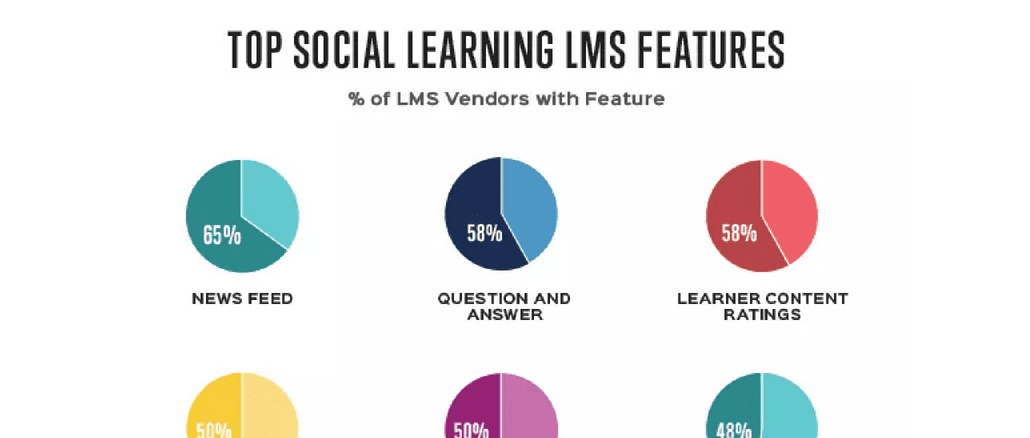
Common logic was flawed -- assuming training professionals and subject matter experts (SMEs) would regularly visit these social "spaces" and interact, keeping content fresh and learner engagement high.

2016 LMS Market Trends, Observations and Predictions
The behemoth TM providers such as Oracle or SuccessFactors devalued the LMS when they incorporated their LMSs into broader HR software suites and took their foot off the innovation accelerator.

Talented Learning: Greatest Hits of 2015
I concluded that it will take too long to teach 600+ LMS vendors the new anti-acronym trick and the easiest path would be to create a living, non-techie dictionary that decodes common acronyms for LMS buyers.





CASE STUDY DIRECTORY


FOLLOW US ON SOCIAL