

At Talented Learning, an independent learning tech market research and consulting firm, we recently compiled an obnoxious 85 question survey detailing over 450 points of LMS business, market and functional data. We collected statistically significant hard data about the global LMS market providing us unparalleled and unique insight into what LMS buyers are buying today.
Most other analysts’ surveys and resulting data are the output of sending out a blast email request to 100,000 HR professions and drawing conclusions from the few hundred responses from those who have too much time on their hands and dated LMS expertise.

REPLAY THIS ON-DEMAND WEBINAR
We took the much tougher path and went to the LMS vendors one by one to get the best, most accurate and timely data. Seventy LMS vendors of all types have graciously filled it out so far.
Vendors are out on the front lines winning and losing every day. They always know what is selling and what is not. When vendors lose two or three sales opportunities because of the same lacking feature, it magically shows up on their product roadmap. The functionality that exists in the collective LMS community illustrates what buyers are buying.
Our survey was designed to allow us to measure and report on the popularity and scope of every LMS feature we have identified in our intensive LMS research. With the survey data we can now look at any feature or feature set and filter by LMS vendor type, vendor, business use of LMS, industry, hosting model, licensing model, region, language and many others. To say that analyzing this survey data has further brought out the mad, mad scientist in me is an understatement.
The 2015 Mobile LMS
Today, let’s discuss what we learned about the 2015 mobile LMS capabilities and buyer preferences.
Somewhat of a surprise on the high side, 90.8% of LMS vendors say that mobile delivery is a “critical” requirement for their LMS buyers. How to accomplish mobile delivery has been the big question we wanted to answer though.
Over the last few years, I’ve read and written chronicles of conjecture about what mobile strategy is winning in the LMS industry — mobile responsiveness or mobile apps. According to the data, the answer is both with the most progressive LMS vendors being fully mobile responsive for all users and also providing mobile apps that provide incremental capabilities.
Mobile Responsive Design
A mobile responsive LMS “senses” the user device and automatically optimizes the text, graphics and menus to display perfectly without zooming, scrolling or downloads on any modern browser. With a mobile responsive strategy a vendor can develop one LMS that clients can use on all devices including smartphones, tablets, laptops and desktops. This approach is simple for vendors, buyers and knocks most technical challenges out of the equation. Learners have 100% of the functionality accessing the LMS from a mobile device, but not a smidge more. Here are some key stats from the survey:

My assessment: Full mobile responsive design is the first goal of most vendors. New vendors entering the LMS market start with 100% mobile responsive for every type of LMS users. Older vendors that were born before the mobile age are retrofitting first the learner then the admin interfaces to be responsive. The most progressive vendors are fully mobile responsive for all users while providing apps that provide incremental capabilities not available in the core LMS.
Mobile LMS Apps
At first, most LMS mobile apps replicate varying portions of the vendor’s core LMS functionality in a mobile friendly interface. Vendors typically start with learner, then manager and finally administrator functionality. Over time, the mobile functionality expands into the innovative and cool mobile only features.
Touch, swiping, offline content, location awareness, phone, camera and texting can be incorporated into various aspects of the learning process and automatically recorded in the core LMS. On the downside, apps need to be downloaded and periodically updated by every individual who wants to use them adding a substantial technical challenge and support cost for buying organizations to deploy. Vendors also have incremental costs to develop and maintain a “second” LMS.
Here are some key statistics about the types of mobile apps available:
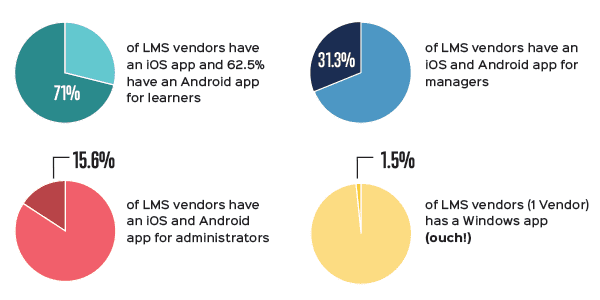
My Assessment: Mobile apps are not as popular as responsive design in the industry. A full 20% more vendors employ a responsive design vs. app for end users. Due to the additional costs and technical challenges, if mobile apps are not providing incremental features to the core LMS, they are an unnecessary headache. However, the mobile only features are really cool, innovative and have some great application in the training world.
Cool Mobile App Features
Here are some mobile LMS features that are only available via apps that exist today in the industry:
- Receive and send text (SMS) notifications, registration approvals, private messages
- Switch devices without disrupting content, bookmarks or progress tracking
- Download SCORM and other content to device for offline use — and sync results back to LMS
- On-the-job training or observation checklists
- Informal learning tracking (xAPI)
- Scan and QR codes for content access
- Mobile codes for facility access or ability to start a vehicle/piece of machinery based on active certification
- “Presence Sensing” for live seminar/class attendance check in and check out
- In class polling, evaluations and teacher analytics
- Mobile drag and drop content creation/assembly/authoring
- Augmented reality of app use (via phone, Google Glass, tablet) to recognize products or equipment and assist user by launching relevant performance support, social or formal learning
Conclusion
Five years ago, LMS vendors like most software companies, struggled with mobile and what to do. New vendors went right to mobile responsive and older vendors dabbled in apps because retrofitting mobile responsive is difficult and expensive. In 2015, LMS vendors have it figured out and use varying combinations of responsive and mobile apps. Mobile responsive is practical. Mobile apps are innovative. The best strategy is a fully mobile responsive LMS with apps as a bonus. That’s where the data says it is going.
Thanks for reading!
Want to learn more? Replay this on-demand webinar:
How to Build Successful Learning Experiences: Lessons From Non-Profits and Associations
REPLAY THE ON-DEMAND WEBINAR
Every association and non-profit organization is unique. Yet all share common goals – to engage, retain, inform and influence constituents. What exactly does it take to engage learners, support your brand and advance your mission?
Join John Leh, CEO and Lead Analyst at Talented Learning as he hosts a panel discussion with experts who have developed successful online education programs based on highly customized learning platforms:
- Stephen Flatman, VP Examinations, AICPA
- Seewan Eng, Sr. Director of Technology, New Teacher Center
- Edward Daciuk, Principal Learning Strategist, ExtensionEngine
You’ll learn:
- How to build a business case for moving in-person education online
- What it takes to engage learners in an online environment
- How to differentiate your organization through online learning
- When to consider a custom platform that supports high-end learning experiences
- Lessons learned in achieving internal buy-in, project momentum and organizational alignment.
Need Proven LMS Selection Guidance?
Looking for a learning platform that truly fits your organization’s needs? We’re here to help! Submit the form below to schedule a free preliminary consultation at your convenience.
Share This Post
About the Author: John Leh

Related Posts

How to Syndicate Learning Content: Customer Ed Nugget 19
Content syndication can be highly beneficial for customer education programs. But exactly how do you syndicate learning content? Find out on this Customer Ed Nuggets mini podcast

How Smart Organizations Measure Learning: A Strategic Approach
During the pandemic, the learning function took on a more strategic business role. What did this teach L&D leaders about how to measure learning more successfully?

Docebo CEO Alessio Artuffo Talks LMS Trends
What LMS trends are top-of-mind among learning tech innovators? Docebo CEO, Alessio Artuffo, talks with our Lead Analyst, John Leh

ATD24 Expo: Join Our LMS AI Innovation Tour
What's special about ATD24, the annual ATD International Conference and Expo? Find out why Lead Analyst John Leh is closely watching all the learning systems action!

Top LMS Selection Speed Bumps: Customer Ed Nugget 18
If you're a customer education leader, sooner or later you'll need to choose a learning system. How can you avoid LMS selection speed bumps? Find out in this Customer Ed Nuggets podcast

CEdMA Conference Takeaways: Customer Ed Nugget 17
What's top-of-mind among customer education professionals these days? Join Analyst John Leh and industry leader Kristine Kukich as they compare notes from the recent CEdMA Conference

Why So Many LMS Vendors?
People ask us all the time, "Why are there so many learning systems?" Here, our Lead Analyst, John Leh, explains the factors that have led to an industry with so many LMS vendors...

The Future of Customer Education: Customer Ed Nugget 16
Customer education is rapidly evolving as organizations embrace new strategies and tech. What does this mean for the future of customer education? See what experts say on this Customer Ed Nuggets episode

Education Strategy Mistakes to Avoid: Customer Ed Nugget 15
What does it take to deliver a successful customer education program? It starts with a solid education strategy. Learn how to avoid common pitfalls on this Customer Ed Nuggets episode




CASE STUDY DIRECTORY


FOLLOW US ON SOCIAL