
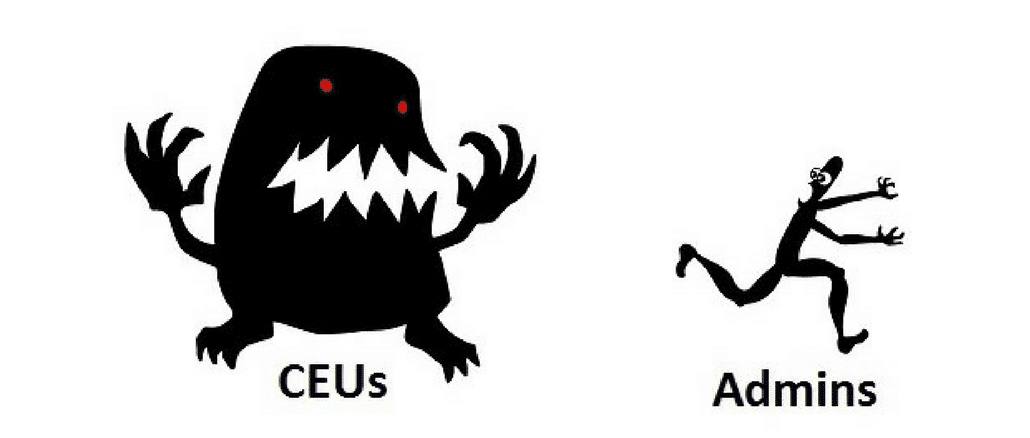
In the previous phase of my career as LMS sales guy, I did a lot of work with associations and continuing education providers. I thought I’d seen and heard it all with respect to continuing education administration, but nothing compares with the past 6 months.
I’ve just finished helping five separate national member-based organizations in five industries (legal, medical, financial, transportation and in the public sector) as they defined their LMS requirements, evaluated appropriate solutions and selected the best LMS for their unique needs. What struck me was how similarly – yet differently – each industry approaches continuing education and their related learning technology requirements.
In my mission to understand which solutions are best for continuing education admin, I have reviewed more than 80 LMS solutions in the last 18 months. LMS providers old and new will readily tell you that their systems can track continuing education units (CEU) or credits. However, the continuing education capability, suitability and experience of the LMS vendors varies widely. Continuing education functionality is a big area of LMS vendor differentiation and an easy place for a buyer to make a poor selection decision if you are not careful.
In the coming months I’m going to dig deep into defining the continuing education industry, learning technology requirements and identifying the specialized LMS vendors that can meet the challenge. If you are in the continuing education or extended enterprise world, you are going to love it, for the rest, I’ll try and make it interesting.
What is Continuing Education and CEU?
Continuing education is broadly defined as training provided to adults after they have left the formal education process. It can be informal like taking a Lynda.com course online or completing a MOOC or more formal like earning your Project Management Professional certificate or maintaining a professional degree or educational certificate.
In 1970, the International Association for Continuing Education (IACET), accredited by the American National Standards Institute, set the standard for continuing education units (CEU) and quantified 1 CEU = 10 hours of learning. However, with the evolution of self-paced elearning, many industries have simplified to 1 CEU = 1 hour of study. Though in some industries like accounting and legal 1 CEU = 50 minutes of instruction.
How Big Is the Continuing Education Market?
According to a U.S. Census Bureau report published in 2014, there are 46 million U.S. adults (25% of adult population) that hold educational credentials other than formal college degrees and are thus engaged in formal continuing education activities. This number does not include the millions upon millions of adults consuming continuing education for non-certificate purposes. If each of those 46 million learners is required to take 10 hours of continuing education a year (conservative estimate) that translates to almost a half a billion hours of content consumed per year!
A 2015 report from the Georgetown University Center on Education and the Workforce titled “College Is Just the Beginning” asserts certifications, apprenticeships, and other workforce training comprise $47 billion of annual U.S. spending on formal training.
By comparison, Josh Bersin, Principal of Bersin by Deloitte estimates the LMS market to be around $2.5 billion in a 2014 Forbes article. Seems like the LMS market should be taking a bigger piece of the $47 Billion CE pie but I have found the complex continuing education functional and business workflow requirements are tough to meet for 90% of vendors and are a nightmare to manage manually. Here are some examples:
The Continuing Education Admin Nightmare for Accountants
Accounting firms, accountants and providers of CPEs (CEUs for accountants) need an LMS that manages a complex set of CEU conditions.
What it takes to maintain a professional license or certification, however, is unique from state to state. For example, in Alaska, certified public accountants must complete four hours of instruction on Alaska-specific ethics, statutes and regulations. In Ohio, the ethics requirement is three hours. If you are an accountant licensed in both states then the administrative challenges multiply. If you manage continuing education for an accounting firm with accountants in 25 states who are licensed in multiple states, you are a saint.
In the accounting industry, most accounting firms set up a National Association of State Boards of Accountancy (NASBA) license and grant continuing professional education (CPE) credit based on the NASBA standards, rather than maintain the complex CPE rules of each state.
LearnLive Technologies, which is a compliance software application owned by Thomson Reuters, automatically maps NASBA CPE credit to each state jurisdiction. An LMS that can regularly feed the NASBA CPE credits a learner earns plays a critical role in helping organizations automate the steps of mapping and reporting of CPE renewal compliance.
A key for training directors is having an LMS that includes the ability to easily integrate with any other software in an organization’s ecosystem including CPE mapping tools, practice management software, human resource information system, single sign-on, CEU tracking in another system, surveys and assessment engines. The LMS will then share data with these systems eliminating manual administrative intervention.
The Even Worse Nightmare for Continuing Medical Education
Healthcare continuing medical education takes it to a new level. There are only a handful of different types of accountants but hundreds of types of doctors, nurses, surgeons, dentists, pharmacists and technical staff that have need mandatory continuing medical education (CME) to satisfy their maintenance of credit (MOC) requirements for each specialty or certificate they hold.
Within each state, the requirements for each medical specialty also varies. CME and CPE (pharmacists) are among the most complex from a management perspective. Licensing, regulations, accreditations, tracking and management challenges are a herculean administrative task. At hospitals, entire departments are formed to manage the maze of healthcare continuing education. It’s no less complicated for the certifying organizations that have to sort out which CE to accept from other entities.
In healthcare, there is not one system that tracks all CME for everyone, so depending on how ingenious organizations are, there is a wide disparity on the amount of manual administration time and money required.
Conclusion
The complexities of CEU challenge even the best LMS vendors. To truly manage CLE or continuing education for accountants, doctors or lawyers, an LMS should do more than award a single CEU value and single CEU type. Instead, the LMS should offer a potentially unlimited number of CEU values and CEU types per curriculum record. The CEU value and CEU type that a user earns must be based on where the learner is licensed to truly help all concerned.
Better managing the complexities of professional continuing education requires centralizing CE processes and integration with other systems and a serious look at all your business processes. An end state for everyone touching professional CE would be knowing in real-time the total amount and type of credits needed and a historical record of what’s been learned.
Thanks for reading!
Want to Learn More? Replay Our On-Demand Webinar:
Best Practices in Managing Complex CEUs
Do you struggle with the headache of managing and selling continuing education? Don’t worry — so do thousands of others. But it doesn’t have to be that way. Join John Leh, CEO of Talented Learning and Bill Snowdon, CTO of eLogic Learning outline the business and technical challenges facing organizations that manage or sell continuing education. In this session you will learn:
• Statistics and size of continuing education market
• Professions requiring most continuing education
• Today’s tools and technologies for managing CEUs, CMEs, CLEs and more
• Levels of CEU support from LMS solutions
• Question and Answer session
Need Proven LMS Selection Guidance?
Looking for a learning platform that truly fits your organization’s needs? We’re here to help! Submit the form below to schedule a free preliminary consultation at your convenience.
Share This Post
About the Author: John Leh

Related Posts

Internal or External Training: Where Should Companies Invest?
If your organization must choose between internal or external training, which should you prioritize? Here's what to consider as you weigh the trade-offs...

Top Customer Education Tech Trends: Customer Ed Nugget 26
Customer education tech stacks are changing rapidly, as organizations embrace AI and more. Which trends matter most? Find out in this Customer Ed Nuggets mini-podcast...

Practical Assessments: How to Ensure People Apply What They Learn
Learning isn’t just about knowing — it’s about doing. That's why practical assessments are so vital. Find out how your organization can succeed at this approach

How Automated Personalization Transforms Customer Education
Personalized customer education is powerful stuff. But until now, personalization has been complex and costly to deliver at scale. Here's how automation helps...

How AI and Video Boost Skill Verification: Customer Ed Nugget 25
AI is transforming all aspects of customer and partner education, including video-based skill verification. What are the benefits? Find out in this Customer Ed Nuggets mini-podcast...

Education-Led Growth: How Companies Win When Customers Learn
Many companies offer some form of customer education. But what happens when you commit fully to an education-led growth strategy? See what recent research says...

5 Strategies to Scale Customer Training With an LMS
How can you successfully scale customer training — and why does this matter? Check these proven ways to drive engagement and retention with help from an LMS

5 Data Privacy Factors to Consider When Buying an LMS
Cybersecurity has become a major issue for organizations everywhere. How can learning systems buyers ensure that the LMS they choose will protect data privacy?

Customer Education Content Strategies: Customer Ed Nugget 24
Great customer education drives product engagement, adoption and retention. Which content strategies work best? Find proven ideas in this mini-podcast...




CASE STUDY DIRECTORY


FOLLOW US ON SOCIAL