

EDITOR’S NOTE: Because extended enterprise learning involves multiple disciplines and perspectives, we sometimes invite experts from learning technology companies to share their insights. Today, Seth Johnson, VP of Customer Experience at LearnUpon, outlines an effective way to show the business impact of learning.
During the pandemic, many learning leaders found an unexpected seat at the executive table. Suddenly faced with urgent business issues, savvy CEOs realized that learning could help solve some of their thorniest challenges. Soon, L&D leaders were deeply involved in highly strategic conversations. This eye-opening experience caused them to rethink the way organizations measure learning.
On the upside, it confirmed what L&D professionals have always known, yet seldom expressed — learning programs exist to drive business results. But given this goal, how can organizations measure learning more effectively? Let’s take a closer look…
What Matters Now? Showing Meaningful Results
These days, the L&D spotlight is bright — but it’s also hot. The stakes are higher than ever. There’s never been a more important time to show tangible, relevant outcomes. But how?
The days of vanity metrics are over. Reports based on course enrollment and completion rates, or learner satisfaction and engagement ratings simply don’t cut it anymore. Even statistics that track knowledge gains fall short.
Instead, smart organizations view learning as a means to an end — and business objectives are that “end.” This is why it’s vital to measure learning in terms of its impact on these objectives. To succeed, L&D leaders must embrace the perspective, capabilities, and habits that align learning with business priorities.
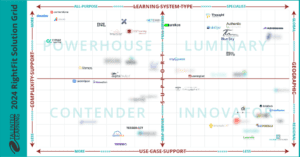
Which learning system is best for you? Check the 2024 RightFit Solution Grid, based on our team’s independent research! Learn more and get your free copy!
What L&D Leaders Say About Measuring Learning
Key insights from our recent “State of Learning Report” underscore how things stand. For example, nearly two-thirds of learning leaders (61%) told us their 2023 budget was larger than in previous years. This suggests that senior executives recognize the strategic importance of learning and are willing to invest more heavily in its benefits. However, they expect to see a significant, quantifiable return on investment.
L&D leaders have clearly gotten the memo. In fact, 77% say one of their top three priorities is “demonstrating the impact of learning programs on business goals and growth expectations.”
Meanwhile, several past priorities are losing steam:
- “Building a strong culture of learning,” was a favorite just a few years ago. Today, only 17% of leaders say it’s still high on their list.
- “Engaging learners” fares even worse, with a nod from only 4% of respondents.
- At the bottom, right behind engagement, only 3% say they’re focused on increasing the importance of their learning team’s role in the organization. This shift isn’t surprising. After all, many L&D teams have already achieved this goal. Now, they’re dealing with the (mostly favorable) consequences.
What the Business Needs From L&D
If you’re an L&D leader, you know why your learning programs exist. But that’s not enough. Do you consistently discuss them with others across the company, so they understand the “why” of learning, too?
Your executive peers, team managers, and individual contributors need to know why learning matters to your organization. In a world where time is precious, people won’t spend time on learning unless they know it will help them achieve the outcomes they’re accountable for delivering.
This doesn’t mean they’re selfishly thinking, “What’s in it for me?” Most members of today’s workforce operate in a more nuanced, enlightened way. They continuously weigh the value of every item on their to-do list — including learning. Questions like these help them make smart tradeoffs: “Is this activity a good use of my time? Will it help me achieve my goals, so I can help the organization advance its agenda?”
The challenge for L&D is to answer these questions in a coherent, convincing way. It’s our job to connect every learning activity we want people to complete with tangible business objectives that matter. Why? Employees often hear about these objectives from executives and line managers. And they care because the organization uses this agenda as a bar to measure performance.
People want to succeed as individuals. They want the company to be successful, too. By linking these two things, we motivate people to develop the right knowledge and skills, and apply them in productive ways.
Let’s explore this process…
Find out how real-world companies are achieving more with learning systems that create business value. Get inspiration from dozens of success stories in our free LMS Case Study Directory…
How to Measure Learning: 3 Key Steps
Step 1: To Clarify Your Strategy, Build a Logic Bridge
Start by answering these questions about any learning program:
- When someone completes the program, what will they know?
- With this knowledge, what will the learner be able to do?
- When the learner does this, what will change about the way they perform?
- When multiple people change their performance, how will the results affect specific business objectives?
Next, combine these four answers to build a “logic bridge”:
- In this program, learners will learn [this].
- Because they know this, they will be able to do [this].
- Because they do this, they will perform better [in this way].
- The aggregate effect of this improved performance on [this key objective] will be [this].
This exercise can clarify your thinking about the business value of any learning endeavor. It will help you translate tacit ideas about the program’s benefits into an explicit framework. You might spot logic gaps that you can fill to improve the program’s impact. But when you’re done, you’ll have a strategic brief to share in different ways with different audiences.
Of course, to operationalize this logic bridge, you’ll need data.
Step 2: To Find Useful Data, Start Where You Are
In business, people often shy away from measuring things because gathering and analyzing data seems hard. This mindset about data mostly comes from university courses, or books and articles we’ve read as professionals. Too often, these resources feature sweeping, carefully constructed, statistically staggering presentations of data-based decision making and conclusions.
The scope, quality, and rigor of these study-quality data exercises is daunting. And unfortunately, many L&D leaders assume it’s the norm. Instead, we should view it as a gold standard. It’s technically correct, perhaps, but impractical and unnecessary for the average organization.
For data that shows a connection between a learning program and business results, start where you are! All data can be learning data. Your organization is probably already gathering data that can show the impact of learning on objectives. Your task is to use the logic bridge you’ve defined as a guide. First, consider the desired outcome, and make a list of data points that could support each part of the bridge.
Then and ask yourself two more questions:
- What data will best support each pier of this logic bridge? (In other words, what data will indicate that participants did learn [this] and now they’re now doing [that]?)
- Where am I likely to find this data?
You may find you need a data point or two that your organization doesn’t currently track. If so, think about the simplest possible way to begin gathering this data. Forms as a simple survey tool, with spreadsheets to analyze responses? Not a bad place to start.
Don’t wait for funds to buy a new tool or gain access to business intelligence consultants. These resources may help you get the data collection process “right.” But inaction will only delay your progress. It’s fine to start simple and prove the value of gathering data. The tools and support will follow.
Step 3: To Draw Others In, Become a Storyteller
With a logic bridge that connects your learning program with business objectives, and sufficient data to hold it up, you’re ready for the next step. This is about communicating the value of your program to a variety of audiences across the organization. You’ll need a compelling story to help others understand why learning matters and why they should spend some of their precious time on it. Fundamentally, this is an exercise in storytelling.
Storytelling has always been one of the most underrated business skills. But it’s critical if you want to improve your influence and impact across your organization. You’ll need to explain why learning matters in a concise, compelling way. For each audience, focus on answering these three questions:
- What will I learn?
- Among the problems that are relevant to me, what is this program meant to solve?
- If I complete this program, how will it pay off for me personally, and how will the organization benefit?
By relying on your logic bridge, you can craft a story that answers these questions for a wide range of audiences: executives, line managers, and individual contributors alike. The key is to acknowledge the effort required to complete the learning program. Then paint a vision of a future state that makes their effort a worthwhile investment, rather than a box-ticking exercise.
NEW FOR 2024
Which Learning Systems Are Your Best Fit?
Use our FREE RightFit Grid tool to build a shortlist based on our independent research. 50 leading learning systems mapped to common buyer requirements!
LEARN MORE AND GET YOUR FREE COPY…
To Prove and Improve Results, Measure Learning Iteratively
Defining and discussing the business impact of learning requires measurement skills that L&D leaders may need to develop. But this effort pays off by positioning learning as a strategic business function. Over time, L&D’s organizational influence will grow, which in turn will unlock additional resources for even more learning initiatives. This virtuous cycle is a powerful way for L&D to succeed by helping individuals and the business succeed.
In a world full of increasingly complex challenges, companies need the kind of advantage this process provides. Today’s economic climate is fraught with uncertainty. To compete, organizations must attract and retain valued customers and employees. By focusing on the right goals and outcomes, learning programs can make a more significant difference.
It all begins with leaders who are willing and able to measure learning effectively. Define a logic bridge, apply the right data, and develop compelling stories that map to relevant business objectives. Then share those stories with the right audiences.
Share This Post
About the Author: Seth Johnson

Related Posts

Want to Sell More Content? Put More Lines in the Water
Learn how to sell more content, maximize ROI for every online course you create and boost overall profit. Check these tips from John Leh...

Online Courses are Golden: Can an LMS Help Your Business Cash In?
Corporations, associations, public institutions – as well as solopreneurs and subject matter experts who've never designed or delivered training in their lives – all are creating and selling online content at an unprecedented pace.

Is Your LMS License Model Misaligned? How to Avoid Costly Mistakes
With a registration model, usage calculations can be based on any of several metrics: how many users log into the LMS, register for an instructor-led class or webinar, buy content or earn a certification.

The LMS Meets 2017: Top 15 Learning Tech Predictions
The problem with the global employee learning solutions market is that the big, boring talent management LMSs we just mentioned are the standard for managing enterprise-wide learning complexity.

Which Learning Technology Blogs Should You Follow? Try These…
When you want advice you can trust from learning tech blogs, where do you go? If you dismiss LMS vendor content, it's time to take a closer look. Here's why.

Best LMS? 2016 Talented Learning LMS Vendor Awards
These "all purpose" LMS platforms are used to deliver, support and measure online and classroom training programs for any combination of employees, channel partners, dealers, franchisees, customers, business prospects and others.

How Does the LMS Selection Process Work? This Case Illustrates
The LMS selection process isn't always easy or straightforward. To understand what works, check this slice of life from John Leh's life as LMS buying consultant

LMS Technology Trends: Why Focus Is The Next Big Thing
Among LMS technology trends to watch, I think there will be more innovation in mobile, social, badges and certification, as well as capabilities that attract new users and facilitate training content commerce.

Channel Learning and Business Success: Can Your LMS Connect the Dots?
One of the best things about being a learning technology analyst is that I get to meet so many smart, passionate people who are pushing the boundaries of the LMS and business success as we know it. Every day [...]




CASE STUDY DIRECTORY


FOLLOW US ON SOCIAL