

EDITOR’S NOTE: Because extended enterprise learning involves multiple disciplines, we sometimes ask other experts to share their insights with our readers. Today we feature market share growth guidance from Laura Patterson, President of VisionEdge Marketing.
Laura is widely recognized as an authority in marketing measurement and performance, content management, marketing operations and data analytics. Business-minded learning professionals will find her guidance practical, relevant and useful.
If there is a market for whatever you sell, sooner or later you’ll face competition. Long-term success depends on how well you can get ahead of the pack and stay there. One way to determine how you compare at any point in time is to measure your market share.
Your revenues may be growing at a rapid pace, but that’s not enough to gain the competitive perspective you need. Even if you’re meeting or exceeding performance goals, if you aren’t growing as fast as your strongest competitors – or the category as a whole – your relative position will eventually decline. So it’s wise to keep a finger on your market share pulse.
To measure this, you’ll want to answer three related questions:
- How fast is the overall category growing?
- How fast are your major competitors growing?
- How does your market share compare with your strongest competitors?
Market Share Measures Competitiveness
Here’s why these questions matter: Market share is one of the most valuable metrics you can use to quantify and evaluate the effectiveness of your business initiatives within a broader competitive context. It is a key performance indicator, along with other metrics such as customer lifetime value, brand preference, product adoption rate and category ownership.
If You’re Not Keeping Pace, You’re Falling Behind
Growth is getting more difficult to sustain in the face of dynamic markets, digital disruption and rising customer expectations. New strong, aggressive competitors enter the marketplace every day. If you can’t keep up or increase the distance between you and your competitors, you’re destined to lose ground.
In their book, The Three Tensions: Winning the Struggle to Perform Without Compromise, Dominic Dodd and Ken Favaro note that 80% of executives think their product stands out against the competition – yet only 8% of their customers agree. Market share is a reality check that reveals how your offer stacks up against the competition, so you know if you’re on the fast track, or you’re actually falling back.
 Calculating Market Share
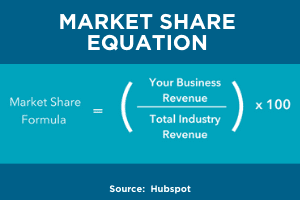
HubSpot offers a simple equation for calculating market share. For a specific time interval, divide your total sales revenue by total industry revenue. Then multiply that result by 100.
For example, if your monthly revenue is $1 million and the total industry revenue is $100 million, your market share is:
$1 million/$10 million) x 100 = 10%
The Basics of Market Share Growth
Every competitive athlete knows that success comes from mastering the basics. The same holds true for businesses in a competitive environment. To grow market share, first focus on these marketing essentials:
- A customer-centered solution
- A solid go-to-market strategy
- Strong differentiation
- Continuous innovation
- Data-driven insights (especially competitive intelligence)
- Rigorous performance measurement
Steps for Growing Market Share
Once the basics are in place, you’ll be prepared to make your move:
1) Create a Growth Plan
Businesses that plan for growth are more successful than those that leave it to chance. For instance, one study found a direct correlation between planning and business performance. And another study found that when planning is a priority, new ventures grow 30% faster than others.
What should you include in your plan? Good growth roadmaps are specific. So take time to develop a clear path.
Specify the level of revenue growth you expect in a particular timeframe and the implications of this growth on market share. Include when, why, how and where you intend to expand market share, as well as the market segments you’re targeting.
Be sure to address key drivers and dependencies by considering the factors that shape your offering, such as your product and services mix, customer personas, competitive scenarios, distribution channels, partnerships and more. For example, our Circle of Traction methodology is one proven, systematic approach to market growth.
2) Align for Growth
According to Fred Smith, Chairman of Federal Express, “Alignment is the essence of management.” That’s great advice for any business, but especially for those who want to expand market share. Be sure your people, processes, strategy and technology are aligned and have the capacity to support your growth plan.
Research by LSA Global has found that, when strategy, culture and talent are in alignment, businesses grow revenue 58% faster, they’re 72% more profitable, and their customer retention rate is more than 2x higher than others.
But keep in mind that alignment extends beyond your culture and employees. It should be central to everything you do. To understand your level of alignment, consider these questions:
-
- How well do the solutions and services you provide fit what your customers want to buy?
- How well do daily decisions and actions fit your company’s strategic direction?
3) Build Your Growth Engine
Aligning the tires on your car is important, of course. But without an engine under the hood, you won’t go anywhere. A market share growth engine is no different. It generates the power needed to propel your company forward.
The components of your growth engine – Product, Service, Marketing, Sales – are the strategic core. Working together, they can help you identify and optimize your most attractive growth opportunities.
For example, you may find that the strongest growth potential comes from selling more of your current products and services to existing customers. Or it may come from expanding into new markets or developing new business models. Or your best bet may be to bring new products to market ahead of competitors.
The possibilities are limited only by your organization’s strategy and resources. But keep in mind that some routes tend to be more effective at driving growth than others. In fact, McKinsey found that growing companies are 56% more likely to build value through new products or innovative business models than through other avenues.
To grow successfully, these organizations expertly leverage data and analytics, and have well-defined processes to support innovation, collaboration, portfolio management, product lifecycle, customer experience, performance management and so forth.
For example, it’s important to understand the customer journey – including product and touchpoint preferences. With a growth engine fueled by sound data and analytics practices, you can have confidence in whatever growth strategy you choose.
These insights can help you implement processes and allocate resources that will make the most of your growth investments, and help you adjust whenever the time is right.
Getting Started
Gaining market share takes a disciplined, deliberate approach to building your growth initiatives and capabilities. For best results, prepare to add and fine-tune resources and processes on a regular basis, so they’ll produce optimal value over time.
If you’re not sure how you stack up against the competition, start by conducting a benchmark study. This can help you make realistic assumptions about your ability to gain market share. It can also help you establish reasonable growth targets.
For more advice on how to calibrate your current market share – or how to determine your best growth options – an independent industry expert or marketing strategist can help you move forward.
EDITOR’S NOTE: This has been adapted, with permission, from a post published on the VisionEdge Marketing blog.
Share This Post
About the Author: Laura Patterson

Related Posts

How To Measure Customer Learning ROI
As you pursue each new program, you can predict and then demonstrate actual improvements in customer experience, loyalty, revenues and/or profitability.

Five LMS Categories: A 2014 Snapshot
They all have experienced professional services groups to help transition vendors off their current solution, migrate the historical data and content, configure the new system, train the administrators, build content and provide ongoing support.

Are You Getting Fleeced By Your LMS Vendor?
If you're spending time regularly deactivating users so you don’t have to pay incremental license fees, you are definitely paying too much for your learning platform.

Skillsoft Acquires SumTotal: Crazy or Genius?
LMS vendors were never threatened by Skillsoft’s Skillport LMS but now with the SumTotal LMS, it’s a different story.

A Cloud LMS By Any Other Name
Cloud LMSs are the most exciting group in the LMS industry because they are newer; this group is not as technically and functionally advanced as standalone LMSs and HR/talent suite LMSs, however, they have their foot on the accelerator and are making progress at a faster clip than the rest of the industry.

Take a Walk on the Wild Side of Measurable Training
They are experts at endless and varying topics and their job is to teach it, but they don’t teach employees though – just everyone else including external sales and distribution channels, customers, members, dealers, agents and the public at large.

Top 10 Association LMS Case Studies
nternational Parking Institute utilizes Docebo to train, certify, measure and report on learning for parking professionals from member organizations in every industry globally.

The Hidden Cost of Qualifying LMS Vendors Yourself
There are new buzzwords out there since the last time you paid attention like Gamification, Social Learning, Mobile Learning, Cloud, SaaS, Tin Can, NextGen, Talent Suite and extended enterprise LMS and you are not sure what it all means and how it applies to you.

10 Reasons Not to Buy a Talent Suite LMS
Organizations continue to purchase standalone LMS systems every day and rarely consider more than one HR or talent suite LMS products as the starting point.





CASE STUDY DIRECTORY


FOLLOW US ON SOCIAL