

Customer education systems are, without a doubt, the fastest-growing segment of today’s learning systems market. This is happening for multiple reasons, which I’ve discussed several times in the past. But today, let’s focus on a key related question:
Why are so many companies choosing specialized customer education systems, rather than relying on their employee-oriented learning management system?
Most large and medium-sized companies have had the same employee-focused LMS for years. Once this kind of system is in place, switching tends to happen very infrequently.
For example, a merger or acquisition may force a change. Or as an organization evolves, it must leave behind a system that lacks essential functionality. Or sometimes when a company grows, its LMS pricing model becomes too costly, compared with alternatives.
What Makes Customer Education Systems Unique?
The infrastructure needed for employee learning programs is often far less complex than the typical customer education ecosystem. Most employee LMS deployments include only a few integrations – connections with the corporate HR system, a Single Sign-On tool and perhaps content libraries from third-party providers like OpenSesame, Skillsoft or LinkedIn Learning. But with customer education systems, it’s not uncommon to see at least 10 or 15 unique integration touchpoints.
Do you want more information and analysis on the top 40 learning systems in the world? Buy our 2023 Corporate Learning Systems Market Update report – now available through the 2nd half of this year at a 50% discount!
Although it’s possible to train customers with an employee-focused LMS, this usually is not the best choice. It’s not only because serving a customer audience requires many more integrations, but also because this kind of training directly contributes to business results such as product adoption and retention.
For many companies, customer education is a key differentiator, and measuring success drives the need for even more advanced capabilities. This means they can’t afford to skimp on an ecosystem that delivers a sub-par customer experience.
The Integration/Innovation Connection
Lately, we’re seeing a new and interesting development in the customer education systems space. Increasingly, integration is accelerating LMS innovation, and this is creating an even wider gap between employee and customer education systems.
What is that about? Let me explain.
Often, large or medium-sized organizations use multiple non-training enterprise software solutions that must be integrated with any LMS. But just as often, we find organizations with scattered non-training software solutions that are not enterprise-class or particularly strategic. Investing in a new customer education system is an opportunity to bring these outlier systems into the broader ecosystem, or to consider LMS functionality that can replace these systems entirely.
Replacing these systems yields multiple benefits: improved user experience, economies of scale, simplified contracts, reduced support requirements and lower total cost. As a result, customer education systems providers are developing more and more native functionality that isn’t training-specific but can be used instead of fractured corporate systems. Genius.
Top Integrations and Innovations
Below is an overview of the top specialized integrations that customer education systems vendors also increasingly offer natively within their learning platforms:
1) CRM – Combine a customer relationship management system with a learning management system and you’ve created the most measurable training platform in history. By sharing common audiences, user experiences and data, this kind of integration gives organizations unprecedented visibility into the value of training.
User actions within the LMS can trigger related CRM actions (such as sending a personalized email, promotion or prompt). Similarly, actions recorded in the CRM (such as becoming a new client, viewing a web page or watching a demo) can trigger actions in the LMS (such as assigning a specific role, group or training content).
The most common CRM integrations involve Salesforce.com, HubSpot and Microsoft Dynamics. Plus, numerous customer education systems now offer “CRM-light” capabilities, especially those who serve the small business market.
2) Single Sign-On – SSO automatically logs people into an LMS behind the scenes, while they’re already logged into a corporate network and are using other authorized applications. Of course, supporting customers with SSO is trickier, because customers are often using multiple SSOs across a large, complex ecosystem.
The most common corporate SSO integration include Azure, OneLogin, Auth0, okta, Clever, idaptive/CyberArk and Salesforce SSO. Social media SSO is also widely used, especially through Facebook, Instagram and Google.
Customer education systems often need to support multiple SSOs simultaneously. Therefore, this is a hotbed of differentiation, compared with traditional employee LMSs that only support one SSO per deployment.
3) Customer Support – This kind of integration connects training content with support requests, agent calls and operations workflows. Think of service reps receiving real-time instructional content while on a call or chat, so they can quickly and confidently answer a customer question. Alternatively, the CSR can proactively push relevant training content to a customer in the moment of need or as a follow-up action.
The most popular target platforms for these integrations include Salesforce Service Cloud, Totango, Gainsight and Zendesk. Similar to CRM functionality, some of these capabilities are making their way directly into LMS platforms designed for customer-facing support and sales employees.
4) Remote Content – One of the biggest customer education operational challenges is when large customer organizations already have an employee LMS in place, and they resist sending employees to random non-integrated supplier platforms for training. Handing over your instructional content to customers is one solution, but then you’re unable to maintain that content, track learner behaviors and enforce licenses. No more.
With remote content solutions such as Rustici, Course Container or proprietary solutions from LMS providers, you can distribute content “packages” that call back to a central repository and serve content within the user’s learning environment. This makes it easy to manage updates and licensing while providing access to reports in the customer’s LMS as well as your own.
5) Marketing and Sales Automation – Most LMS platforms include at least a basic email notification system. However, no LMS comes close to the sophistication of dedicated marketing automation platforms such HubSpot, Intercomm, Eloqua and Marketo.
Since the customer education function is often rooted in marketing departments where these platforms are already heavily used, it’s fairly easy to integrate these tools so you can personalize messages, enroll/disenroll learners in campaigns, and send promotions based on a learner’s LMS behavior.
However, in some customer education systems, native notification functionality is even more sophisticated, with capabilities that closely emulate leading marketing automation solutions.
6) In-App Delivery – It’s common for software companies to deliver training within the product interface, while a customer is actively engaged. Embedded instructional content is ideal for customer education, where the mission is to drive product trial, use and adoption.
For example, when customers are confused about how a feature works, they can search a help file or launch a relevant how-to video. Inventive customer education system vendors are linking these environments through custom APIs, QR codes and LMS extensions.
Do you want more information and analysis on the top 40 learning systems in the world? Buy our 2023 Corporate Learning Systems Market Update report – now available through the 2nd half of this year at a 50% discount!
7) Knowledge Bases – Nearly every software provider has developed some sort of knowledge base capability that catalogs questions and answers from across a user community, so customers can quickly research and resolve common challenges. These forums can be fully asynchronous, or moderated by live customer service employees or customer “experts.”
In the past, customer education content and knowledge bases were managed by different teams. As a result, these solutions weren’t integrated. But that is changing, as federated search and systems integration are becoming a standard. Also, some customer education systems are taking this a step further with native knowledge base capabilities.
8) Virtual Meetings – Many vendors support some level of integration with popular third-party virtual classroom tools like GoTo Meeting, Adobe Connect or WebEx. Virtual classrooms, webinars, webcasts and online meetings are all loosely synonymous terms. Through integration, when administrators schedule a training event in the LMS, it is automatically scheduled in the third-party virtual meeting tool as well.
At the time of the session, learners can enter the live event through the LMS without ever knowing that a separate virtual tool is being used. The virtual meeting tool tracks and sends attendance, attention, notes, chat and other session data to the LMS.
Although this is not a new trend, many LMS providers include native virtual tools as part of their solution, eliminating the need for integration.
9) eCommerce Storefronts – In the past, it was common for LMS providers to integrate with ecommerce providers such as Shopify and Magento to deliver a higher-end storefront experience. This was especially desirable when an organization was selling training or non-training items from an existing system.
Now, many customer education systems have fully internalized these capabilities and are uniquely exceptional at selling training to organizations and individuals. This includes CMS-type ability to build and customize unique pages and display products, as well as broad support for purchasing and payment.
10) Social Learning – Customer education organizations often look to commercial social networks to enhance the learning experience with crowdsourced questions and answers, user-generated content, community forums and more.
Integration with Facebook, Instagram, LinkedIn, Twitter, Higher Logic, Slack and Microsoft Teams is now common in customer education systems. Integration points are via Single Sign-On with access to feeds, tweets, groups and communities.
All of these capabilities are also now available natively in some customer-focused systems. This offers many advantages – stronger privacy, monitoring, automation, gamification, reporting and more.
Conclusion
As a long-time customer training advocate, I find that customer education systems are endlessly fascinating. Lately, this is especially true, as the customer learning world is bursting with innovative energy. But the pace and direction of innovation is so swift and expansive that keeping up with all the action can be tough. The challenge for LMS buyers is to weigh integration versus ever-expanding native capabilities.
Customer education systems vendors have learned to differentiate themselves from LMS generalists and employee LMS specialists by continuously expanding their core capabilities, or offering productized integrations, or both. As a result, they’re rising to meet the ever-evolving needs of a dynamic customer education market. With no end in sight, I advise buyers to expect continued momentum.
Thanks for reading!
Need Help Buying a Great Customer Education System?
Take the next step toward a learning system that fits your business needs. Submit the form below for a free preliminary discussion with our lead analyst, John Leh.
Share This Post
About the Author: John Leh

Related Posts

4 Corporate LMS Flavors: Which Do You Choose?
Extended enterprise learning is defined as any type of education a corporation provides to external audiences – including customers, prospects, channel partners such as dealers, franchisees, distributors and others.

10 Tips to Boost Sales: For LMS Vendors
Inexplicably, vendors make the most prose mistakes in these two areas of their proposals, yet these are the sections that every executive spends the most time reviewing.

LMS Integration: The Learning Ecosystem
Google Analytics tracks a visitor’s access device, browser, previous website, pages visited, time spent on the page, next site visited, language, IP, precise geographic location, age and much more.

LMS Implementation Pricing: Take 2
One of the biggest mistakes LMS buyers make is not defining the level of help and support they will need to successfully implement and support their LMS.

Introducing the LMS Almanac: Corporate Edition 2016
The LMS Almanac defines corporate LMS market trends, types of corporate LMSs, business uses, feature and functions, hosting models, license models, service and support models, return on investment and provides real-life examples of all.

Public LMS Pricing: Proof You Can Overpay
It is foolish to pay more than you have to and get nothing in return but it is impossible to know if you are overpaying if you first don't define your LMS requirements.

Shrinking LMS Implementation Fees Drive Market Expansion
Making sure your LMS selection team is on the same page in regards to implementation/configuration needs will allow a buying organization to quickly disqualify many vendor options without the labor of investing a ton of time.

LMS License Models: What in the World is Going On?
Associations, training companies, corporate channel, customer and other extended enterprise buyers can create any number – hundreds of thousands even – of active ongoing accounts but a buying organization only pays for active usage.
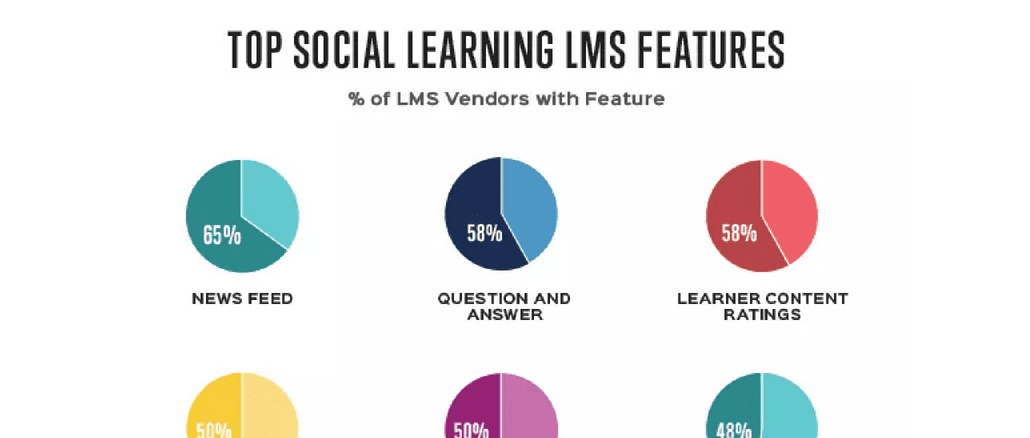
Top Social Learning LMS Features
Common logic was flawed -- assuming training professionals and subject matter experts (SMEs) would regularly visit these social "spaces" and interact, keeping content fresh and learner engagement high.





CASE STUDY DIRECTORY


FOLLOW US ON SOCIAL