

If you’re a continuing education provider, I bet you know just how sweet the market is. By some estimates, continuing education (CE) represents a whopping $47 billion of formal training spending in the U.S. alone. Of course, it also attracts a broad spectrum of continuing education providers. Associations, commercial training companies, academic institutions, and subject matter experts everywhere are competing for their slice of today’s lucrative CE pie.
With all this competition, you need more than good content to succeed as a continuing education provider. It also requires the right technology mix to support every aspect of the learning experience. From my perspective as an instructional technology analyst, that includes at least a baker’s dozen must-haves for your learning management system.
If you want to dig right into my “LMS essentials” for continuing education providers, feel free to jump to the list below. But if you rather start with some context, here’s a quick look at some key terms.
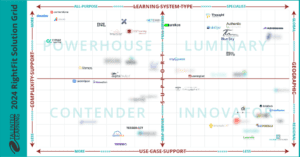
Which learning system is best for you? Check the 2024 RightFit Solution Grid, based on our team’s independent research! Learn more and get your free copy!
Continuing Education 101
Think of continuing education as any learning activities that people pursue after completing secondary school or college. It may involve a formal training curriculum (for example, when studying for a professional certification) or it may be entirely voluntary (for example, when developing skills for personal enrichment or professional advancement).
Continuing education providers offer a broad spectrum of learning experiences — from in-person classroom sessions, mentoring and on-the-job training to self-paced study in virtual and blended formats. Content can be sold directly to individuals, or to continuing education providers who, in turn, serve individual learners.
Often, successful CE content completion is rewarded with credits that recipients can apply toward professional license requirements. Although some organizations provide CE content and manage credits for their employees, responsibility typically rests with individuals — not their employers.
What Role Does an LMS Play in Continuing Education?
To support CE at scale, sophisticated technology is necessary. But rather than developing a complex system from scratch, most continuing education providers rely on a specialized platform to create, manage and sell content. This is typically a Continuing Education LMS (CE LMS) — which is different from learning platforms used in corporate training environments.
Both kinds of LMS are designed to manage content and learner-related information. However, compared with corporate learning, continuing education presents additional requirements.
A CE LMS must be designed for voluntary learning scenarios (rather than mandatory compliance training). It must also be tightly integrated with a full stack of robust, reliable, complementary technologies that facilitate end-to-end business operations — such as AMS, CRM, email marketing, advertising, ecommerce, social, accounting, analytics and customer service applications.
Find out how real-world companies are achieving more with learning systems that create business value. Get inspiration from dozens of success stories in our free LMS Case Study Directory…
The “Secret” Recipe for Continuing Education LMS Success
So, what exactly, should you bake into your continuing education infrastructure? In most learning technology circles, the following list of ingredients is a closely guarded family secret. If you take time to understand these elements and combine them in a way that appeals to your learning audience, I’m confident you’ll see successful results:
1) State-of-the-Art User Interface
As with any modern digital business environment, CE success begins and ends with user experience design. It’s fruitless to try selling content to voluntary learners if your interface looks, feels, and works like an Excel spreadsheet (or worse). Learners want to be presented and find content easily, scientifically and immediately. Customer-facing functions need to have the same seamless visual appeal and mobile capacity of the mainstream content providers such as YouTube, Netflix, and Amazon. Anything less may not convince learners to invest their time and money with you.
2) Individual Ecommerce
Discounts, coupons, and promotional pricing can dramatically improve your sales – especially when those capabilities are tightly integrated with shopping cart and checkout capabilities. Also, look for the ability to provide free content with payment gates and “free trial” access prior to purchase. These features can make the difference between a fly-by prospect and a customer conversion.
3) Organization Ecommerce
In the context of continuing education, ecommerce is much more than a single LMS feature. Serving organizations with many learners is a great way for continuing education providers to expand content sales exponentially. Strong organizational ecommerce capabilities support the process of buying in bulk within the LMS and automate processes for identifying and uploading learner records, assigning content to learners, notifying them, and providing them with easy access to content. Also, don’t ignore the backend. Look for a solution that provides administrator-level dashboards, notifications and status reports.
4) Social Learning
More than threaded discussions, social learning now includes real-time activities within a course, class, or any content item, as well as broader social interaction at the LMS platform level. Intra-class social activities include peer-to-peer communication and group collaboration forums, assignment submissions, feedback and coaching interactions with instructors, as well as interactive evaluation and grading tools. Platforms should also include support for multiple social activities — including “following” learners, identifying experts and mentors, subscribing to user content channels, and liking/sharing/commenting on content.
5) Gamification
Where social learning stops gamification begins – again at both the content and LMS platform level. Intra-content gaming capabilities should include the ability to author content with learning games like flashcards, matching or within content where learners compete against one another based on cumulative points, questions answered, time-to-completion or highest grades. At the platform level, gamification should include leaderboards and contests that award content, cash or other prizes. Open Badges or Credly integration is a way for learners to store and display their credits and achievements in a universally portable format.
6) CE Management
Providing learners with an easy way to report and claim credits is paramount. At a basic level, CE management systems should include the ability to assign standard credits (CEUs) for course completions, but this quickly gets complicated. Many CE LMSs let organizations define credit types (such as CLE or CME) and rules (1 hour = 1 CEU), assign multiple credit types to a course, and assign credit dynamically based on a learner’s license type, location, or other demographic data. More sophisticated capabilities let learners upload completed content from third-party CE providers, centralize CEU management and automate status reporting to accreditation bodies.
7) Easy Integration With Other Technology
The CE LMS is part of an ecosystem of related applications – association management system (AMS), ecommerce, content development, website, marketing automation, email platform, social, customer support, and more – that must work together as one. Sometimes the LMS provides all these capabilities, but most often, multiple third-party, best-in-class, non-training applications are expected to operate seamlessly. Many integrations are now automated – provided as LMS features – including data sharing with popular applications such as Abila netFORUM, iMIS, Salesforce, Zoom, WebEx, Shopify, Marketo, Freshbooks, WordPress, Twitter, ZenDesk and more.
8) Usage-Based License Model
CE content sellers should always choose an LMS license based on actual usage or unlimited usage – not on a concept of “named users” (a model typically found with LMS solutions in corporate or academic settings). Usage-based license fees tie pricing to actual log-ins, content registrations, purchases or content completions. This volume-based metric much more closely fits the business model of continuing education providers.
9) Mobile Content Delivery
No longer optional for a few years, the ability to deliver all content via mobile devices is now a critical requirement. Many CE LMSs offer mobile “responsive” design for the learner interface and sometimes for administration. However, we increasingly see custom mobile apps delivering highly personalized, premium learning experiences and integrating offline content, text messages and the ability to go from device to device in content and pick up where you left off.
10) Globalization
U.S.-based associations and other CE providers are striving to extend their brands globally. This strategy is too complex and costly to try with homegrown functionality, but it is within reach if you choose an LMS designed to deliver content globally. Relevant features include language localization, global commerce, taxation and enhanced security, as well as options for local deployment and multi-language content management and administration.
11) Content Creation and Content Management
The best CE LMSs offer strong content creation and content management tools. You’ll want the ability to upload and manage disparate pieces of digital content and assemble them into training plans and paths. Progressive CE platform providers are migrating to a quasi-website/course concept, where the content assumes a modern web feel and is easy to edit, but all the tracking and reporting you expect from an LMS are also there in force.
12) Test Creation and Test Prep Tools
When studying for SAT, MCAT, LSAT and other academic entrance exams or professional certifications, people often buy test preparation courses from continuing education providers who guarantee that these programs will lead to a passing score. If you’re in this camp, you’ll want a system that includes the ability to create question banks tied to a skill, competency or topic. You’ll also need to serve questions randomly and strategically to learners in practice exams and simulated exam environments.
13) Video Capabilities
One of today’s hottest learning trends involves on-demand delivery of short, relevant video “bursts” at the moment learners need information or learning reinforcement. Your CE LMS should support this through integrations with Wistia, YouTube, Vimeo, and Brightcove – where video is stored and integrated into learning environments via content or video libraries, a la Netflix. Look for smart related features, such as interactive transcripts that let learners quickly skim and search captions to pinpoint video content of interest, as well as the integration of assessment questions and social functionality. Support for live streaming video events and instructional sessions is also on the rise.
NEW FOR 2024
Which Learning Systems Are Your Best Fit?
Use our FREE RightFit Grid tool to build a shortlist based on our independent research. 50 leading learning systems mapped to common buyer requirements!
LEARN MORE AND GET YOUR FREE COPY…
Conclusion: CE Learning Technology is on Fire!
Not long ago, it was acceptable for continuing education providers to post content online in any format or context — and it showed. But a new standard of excellence has emerged, thanks to the efforts of multiple innovators in the CE LMS space. Now, marrying state-of-the-art learning content with ecommerce capabilities is not only possible, it’s expected. And this functionality, combined with the ability to integrate business systems and third-party applications, is shaping a strong future for the highly competitive CE market.
The above ingredients in varying combinations are the new face of continuing education commerce. Although you may find other learning platforms that offer some of these ingredients, only CE LMSs are designed to support all of them well.
The innovation continues…
Thanks for reading!
Need Help Buying the Best LMS for the Audiences Your Serve?
Take the next step toward a learning system that fits your organization’s unique needs. Submit the form below for a free preliminary consultation with our lead analyst, John Leh:
Share This Post
About the Author: John Leh

Related Posts
LMS Review: TalentLMS
Like most LMSs born in the last 3 years, the TalentLMS is fully mobile responsive so that any type of user can access it from smartphones, tablets and laptops without plugins or downloads and without any panning, scrolling or zooming.

Top 10 LMS Predictions of 2015
A responsive LMS “senses” the user device and automatically optimizes the text, graphics and menus to display perfectly without zooming, scrolling or downloads.

Define Your LMS Requirements Like a Pro
Don't regret your next LMS choice. If you define your LMS requirements like a pro, you're likely to find the best solution for you at the best price. Here's how...

It’s Time to Change the Channel (Your Sales Channel)
The only way to gain and keep mindshare among your channel reps is to provide them the knowledge, support and motivation to sell your products and services easier than competitive offerings.

How To Measure Customer Learning ROI
As you pursue each new program, you can predict and then demonstrate actual improvements in customer experience, loyalty, revenues and/or profitability.

Five LMS Categories: A 2014 Snapshot
They all have experienced professional services groups to help transition vendors off their current solution, migrate the historical data and content, configure the new system, train the administrators, build content and provide ongoing support.

Are You Getting Fleeced By Your LMS Vendor?
If you're spending time regularly deactivating users so you don’t have to pay incremental license fees, you are definitely paying too much for your learning platform.

Skillsoft Acquires SumTotal: Crazy or Genius?
LMS vendors were never threatened by Skillsoft’s Skillport LMS but now with the SumTotal LMS, it’s a different story.

A Cloud LMS By Any Other Name
Cloud LMSs are the most exciting group in the LMS industry because they are newer; this group is not as technically and functionally advanced as standalone LMSs and HR/talent suite LMSs, however, they have their foot on the accelerator and are making progress at a faster clip than the rest of the industry.





CASE STUDY DIRECTORY


FOLLOW US ON SOCIAL