

Do you think “social” learning functionality was invented with the rise of social media? Think again.
Social features were built into learning management systems (LMS) long before social media (as we know it today) was invented. In the 1990s, threaded discussions, coffee groups, collaboration centers, forums, FAQs and chat clogged-up a seldom-used “tab” in every major LMS. We used to say in the LMS sales business, “Extend learning beyond the classroom.” Or, “Let your baby boomers share their knowledge before they retire.”
Training and development leaders and instructional designers loved the idea of social learning. Setting the business case aside, it was easy to dream blissful holistic learning theory dreams. The possibilities were endless and so were the starting spots. Many times after the purchase of the additional cost, social learning LMS module, C-level executives started asking the L&D folks about the following:
- How much time is all this going to take away from work?
- Do we have the bandwidth (personnel or technical) for this?
- What are we really getting out of this?
- Why are we doing this?
- What happens if we do nothing for now?
Because there were no concrete, measurable answers (except for the last question), many organizations chose to do nothing. Those learning and development organizations that did try to launch the social LMS components found quickly that making social learning successful is much more difficult than buying it and turning it on.
Content: The LMS Social Learning Problem
Content was, is and always will be the problem and the solution for any social learning effort. At first, organizations decided that the learning and development professionals and subject matter experts would be the suppliers of the content but as any blogger could tell them, producing regular content – that is interesting – is extremely difficult. I’ve yet to figure it out.
Compounding the not-fresh-enough, not -engaging-enough content problem, many organizations turned on the LMS social learning features for all types of users making every social learning forum or community seem extremely barren despite their best minimal efforts. The first time a learner visited a community and there was nothing new an alarm went off and it sounded something like “Whoop. I knew this was a dumb idea! Whoop.” Few learners returned to hear the alarm a third time.
And just like that learners stopped visiting, content creation dwindled, online discussions became dated and social learning died a quiet and quick death in most organizations. RIP social learning. Get to work everyone.
Out goes the 1990’s and the first five years of the new millennium with the LMS industry sitting on the potential of Facebook and Twitter billions yet never aware of it and believing they failed. Social learning was the right idea at the wrong time and opportunity turned away unanswered.
Social Media – Enter Upstage Left
In the 2000’s, while LMSs were selling social learning castles in the sky, the new social media companies like Facebook, Twitter, YouTube and LinkedIn built them in the cloud. Social media is online software that allows users to create and share content to their personal network of users.
Videos, tutorials, articles, podcasts, pictures, text, web pages, eBooks, PDFs, Office documents and much more can be shared with everyone, groups, friends or individuals in your network. With a newsfeed you can monitor easily what is being shared in your network, like it, learn it, save it, ignore it or forward it.
Social media worked so well because it solved the historical content conundrum by enabling and encouraging the users to create and propagate content. That’s it. Instead of the organization shouldering all the content creation, the community was now the main contributor. Once you have a community with a constant supply of fresh content, users visit more and more often. I had to delete Facebook from my smartphone for just this reason.
The Rebirth of LMS Social Learning
Since 2010, new and progressive cloud LMS providers have been integrating the best of social media features with social learning and guess what – it’s working. Organizations are finally able to create sustainable communities using their LMS. The long-promised benefits of holistic formal/informal learning are beginning to be realized. (Generations of instructional designers everywhere can take a well deserved, long time coming “I told you so” deep breath.)
Here are five of my favorite LMS social learning/social media enhancements that I’ve found in the industry after formally reviewing 72 LMSs in the last year:
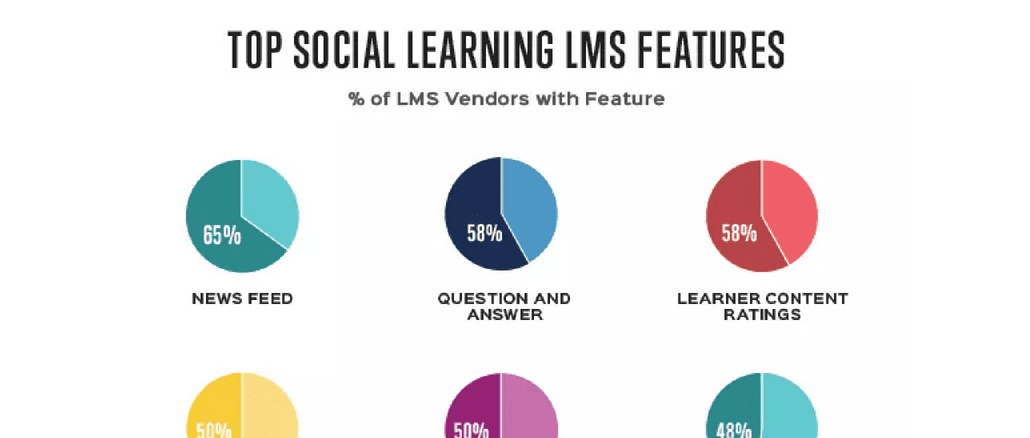
1. Integrated Social Interface – Learners now have shareable user profiles with pictures, resumes, news feeds, group memberships, posting, sharing, liking and rating capabilities. The learner LMS homepage looks like Facebook. Upcoming training, notifications, catalog, news stream and dashboards are just panels you can turn off, on or rearrange. Social learning now has a front seat in the LMS as well as the online content.
2. Content Curation – In LMS, curation is a fancy word that means taking the best user-generated content and elevating it to featured content, formal content and sharing it more broadly. Content curation is an easy way for an organization to find and distribute great content and eliminate poor content. For example, having your customers share projects, templates or workarounds they developed with your software product has broad appeal to other customers as well as internal product development and marketing teams.
3. Gamification — The integration of gamification into the social learning experience is another recent advancement. LMS gamification includes contests and games overarching all content in the LMS and is used to motivate and encourage learners. Learners are awarded points for using the LMS, taking content and participating in social learning. As points accumulate, users earn new levels, badges and distinctions that are displayed on their profile, leaderboards and social news streams. Learners can also earn tangible rewards such as gift cards or discount coupons.
4. xAPI (Tin Can) – xAPI is a communication standard that allows for the tracking and reporting of informal or formal learning activities that a user does outside of the LMS portal. Using the new xAPI, cutting-edge LMSs are providing learners the ability to record external learning activities they completed, conferences attended, websites visited, books read, videos watched and MOOCs completed on their user profile, transcript and share to their social learning networks if they want.
5. Mobile Performance Support – The best LMSs have created learner apps that take the LMS and social networks out into the field via mobile devices. If a channel partner needs help selling a complicated product, they can access the internal network of solution architects to help real time. Or a maintenance engineer can take a picture of an unknown product malfunction and distribute to other engineers for diagnostic advice.
Conclusion
There is no longer a demarcation line between social learning, traditional learning, gaming, compliance and performance support in the modern LMS. You don’t go to another tab, window or even your laptop to collaborate. It’s hard to say where the social learning starts and formal learning stops in the new LMSs. It doesn’t matter. It’s just learning. Welcome to 2015.
Thanks for reading!
WANT TO LEARN MORE? JOIN OUR MAY LIVE WEBINAR:
How to Drive Online Learning at Scale: Corporate Market Strategies for Associations
Selling online learning content to individuals is challenging enough. But selling that same content in bulk through corporate customers or partners can be even more demanding. The business models are fundamentally different. Plus, business-to-business relationships require specialized content management functionality.
What does it take to succeed?
Join John Leh, CEO and Lead Analyst at Talented Learning, as he hosts a live virtual panel with experts who have developed and managed profitable B2B online education programs:
- William Hold, Chief Development Officer, The National Alliance for Insurance Education and Research
- Linda Bowers, CTO, WBT Systems
In this dynamic one-hour roundtable, you’ll learn how to:
- Build a viable business model for bulk sales
- Develop effective pricing and marketing strategies
- Compare tradeoffs of selling through sales reps versus online channels
- Delegate content administration, reporting and user provisioning
- Integrate core learning systems with CRM platforms and other operational applications
- Achieve internal buy-in, drive project momentum and maintain organizational alignment
All live webinar attendees will receive 1 credit toward a Certified Association Executive (CAE) credential application or renewal.
Need Proven LMS Selection Guidance?
Looking for a learning platform that truly fits your organization’s needs? We’re here to help! Submit the form below to schedule a free preliminary consultation at your convenience.
Share This Post
About the Author: John Leh

Related Posts

LMS License Models: What in the World is Going On?
Associations, training companies, corporate channel, customer and other extended enterprise buyers can create any number – hundreds of thousands even – of active ongoing accounts but a buying organization only pays for active usage.
Top Social Learning LMS Features
Common logic was flawed -- assuming training professionals and subject matter experts (SMEs) would regularly visit these social "spaces" and interact, keeping content fresh and learner engagement high.

2016 LMS Market Trends, Observations and Predictions
The behemoth TM providers such as Oracle or SuccessFactors devalued the LMS when they incorporated their LMSs into broader HR software suites and took their foot off the innovation accelerator.

Talented Learning: Greatest Hits of 2015
I concluded that it will take too long to teach 600+ LMS vendors the new anti-acronym trick and the easiest path would be to create a living, non-techie dictionary that decodes common acronyms for LMS buyers.

Mobile LMS: The Facts
At Talented Learning, an independent learning tech market research and consulting firm, we recently compiled an obnoxious 85 question survey detailing over 450 points of LMS business, market and functional data. We collected statistically significant [...]
2015 Talented Learning LMS Vendor Award Recipients
Learning management systems didn’t die. They evolved, and today we recognize them. Brief LMS History Corporate LMSs were invented almost 30 years ago to manage and report on the training and compliance of their employees [...]

Customer Training: 5 Reasons to Put Them “In the Know”
Consider creating training modules which are, in effect, focus group vehicles. Introduce your customers to the product ideas you are considering through online training, and leverage embedded surveys, quizzes, social media, and mobile enablement technologies to have conversations with your customers.

LMS eCommerce: B2C and B2B Feature Sets
My best recommendation is to fully develop your business model, LMS use case scenarios and resulting requirements before engaging LMS vendors so you can find the best-qualified options to drive your online learning business.

Salesforce.com + LMS = Measurable Training Bliss
Integrating training workflows and data with customer and sales-related data elevates training from a cost center to a profit center, because it helps prove the business value of learning.




CASE STUDY DIRECTORY


FOLLOW US ON SOCIAL