

EDITOR’S NOTE: Because extended enterprise learning involves multiple disciplines, we sometimes ask other experts to share their insights. Today we feature advice from Daniel Newman, Principal Analyst at Futurum Research and CEO of Broadsuite Media Group. In addition to his expertise with AI as a service, Daniel is an author, speaker, blogger and educator who works with leading technology brands to help businesses around the world embrace the benefits of digital transformation.
Artificial Intelligence = Real Promise and Perils
By now, we’ve all seen our share of artificial intelligence hype. But AI is not just another passing fad. In fact, it’s rapidly becoming the world’s most significant economic opportunity. Some sources say that by 2030 AI could elevate global GDP 14% – from $14 to $15 trillion. That’s not chump change.
However, there’s a big difference between recognizing that AI is the future of business and actually implementing it successfully. That latter part – AI adoption – is where too many organizations seem to be getting stuck.
Last year, I outlined the most common reasons why AI fails to reach its potential:
- Lack of infrastructure
- Data issues
- Lack of expert talent
- Weak vision at the top
- Underinvestment
- A discouraging learning curve
Of course, no one said that digital transformation would be easy – especially when it comes to implementation. However, for those who are willing to work through the kinks, the pay-off is real.
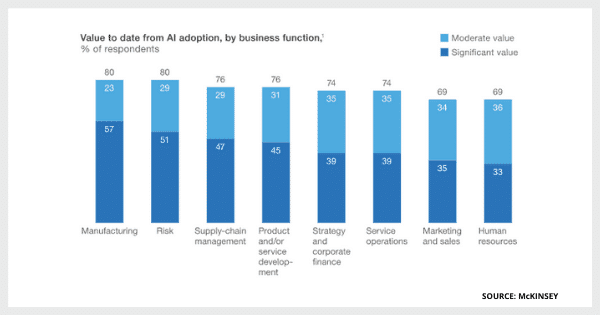
For instance, 78% of organizations recently surveyed by McKinsey say that AI investments have generated significant or moderate business value. But what about the rest of us? Fortunately, there’s a light at the end of the AI adoption tunnel. It’s called AI as a Service (or AIaaS). And in my opinion, it’s ready to break-out this year.
Why It’s Time for AI as a Service
Combining the Software-as-a-Service (SaaS) business model with AI services can bring the power of artificial intelligence to the masses without a hefty price tag. So, will it finally take hold in 2020? That’s my hope – and not just because it could lead more companies to greater efficiencies and customer insights.
In my opinion, the future of digital transformation itself depends on the democratization of advances like AI. In other words, artificial intelligence is no longer just nice-to-have – it’s a necessity.
Already, AI advances are racing ahead, with technologies like 5G and blockchain paving the way for other innovations like the Internet of Things, real-time analytics and more. And although some areas are lagging (Hello, speech recognition?), AI is breaking new ground every day.
Of course, all this innovation means nothing if companies aren’t able to apply it in their daily operations. And that’s exactly what AI-as-a-Service is about – making critical new technology widely accessible to organizations large and small, not just those with deep pockets.
Who’s Leading the Way?
Amazon, Google, IBM and Microsoft are major players in the AI-as-a-Service race. Through large public cloud infrastructure and AI platforms, these vendors offer AIaaS to help companies transform everything from marketing, customer service and business performance analytics, to supply chain optimization, robotic process automation and predictive maintenance. The opportunities touch virtually every industry.
While technologists have been talking about AI-as-a-Service for several years, I think it’s finally ready to surge. Here’s why:
1) Demand is growing
The secret is out. Business leaders realize that AI is fueling market disruption around the world. They see how AI is creating value for their competitors and they know they need AI to meet growing customer expectations.
The global AI-as-a-Service market is projected to reach $6-7 billion by 2023. I think this estimate is low. Once AI is more highly available, we’ll see it popping up in business applications everywhere. And that’s exactly where we’re headed, especially in areas like AI-powered customer service.
2) The ecosystem is expanding
Optimized AI requires an extensive partner ecosystem. Businesses rely on vendors to build apps based on a compatible infrastructure. This means underlying technologies must speak a common language that enables partner applications to work together toward common goals.
As more solution providers enter the AI space, more businesses from every industry are able to find solutions that fit their specific use cases. This will encourage global adoption, which in turn will make AIaaS even more popular.
4) Business users are catching up
The legacy systems era is finally coming to an end. Most companies understand that it’s time to move forward, and are moving to solutions based on modern technologies.
As organizations look to leverage next-generation solutions, AI offers the type of efficiencies they want through improved processes, data management and storage as well as cloud-based apps. On every front, “AI-as-a-Service” will soon be the new standard for what we call “service.”
5) Small companies require it
AI-as-a-service allows for advanced infrastructure at minimal cost. This is exactly what small and mid-sized businesses around the world need to compete against tech giants. In that respect, AI-as-a-Service is their best hope.
Basically, AIaaS lets companies use the power of AI without having to procure the expertise to manage it. That’s a huge workaround at a time when AI experts are in short supply and competitive pressure continues to rise.
What Should Businesses Expect Next?
As AI-as-a-service becomes more popular, it will no doubt become more attractive to hackers and other “bad guys.” This will create complex security issues that can’t be ignored.
Still, there’s no smarter way for today’s businesses to begin harnessing the power of advances like machine learning, deep learning and natural language processing – even if it’s only to test the waters to see which new technologies are worth a larger, long-term investment.
Absolutely, digital transformation is hard. It isn’t always successful. But AI-as-a-Service definitely improves the odds of success for many more organizations, worldwide. And that’s why I believe it will be a big game-changer this year and beyond.
Editor’s Note: This post is adapted, with permission, from articles that were originally published on Forbes.
Share This Post
About the Author: Daniel Newman

Related Posts

LMS Review: Adobe Captivate Prime
Adobe wisely assumes that potential customers need a successful 30-day trial to seriously consider a purchase and "self-service" setup tutorials are essential to a strong start.

Global Learning Platforms: Top 10 LMS Buying Challenges
Every LMS buyer faces challenges, but it's especially rough choosing among global learning platforms. Why? What should you know?

Global LMS Functionality: Do You Speak the Language?
Basic global LMS functionality is good for standard employee training, but platforms quickly hit the wall when multiple regional offices need to administer, teach and learn.

What’s Hot In Learning Technology? Summer Webinar Series
At any moment, employees, partners or customers somewhere in the world need access to relevant learning content that helps them perform more effectively; is your LMS ready?

5 Must-Have LMS Integrations for Commercial Training Companies
Employee learning platforms were created to support mandatory compliance training and talent development, and they must provide a learning experience that feels convenient, comfortable, personalized and trustworthy.

LMS Innovation: Where’s the Value?
It's still early, but perhaps one of the most interesting opportunities is coming from the association space, where gamification and digital badges are being used to help bridge the skills gap.

Continuing Education: Will You Sell More CEUs With an LMS?
CEU training providers need a learning platform that helps manage all facets of this complex business, and modern LMS providers are beginning to respond with flexible, sophisticated business solutions.

The LMS Sandbox: How to Play For Keeps
The "traditional LMS" is a loose term associated with learning platforms that require a mandatory, formal setup/implementation process.

How Associations Bridge the Skills Gap With Digital Badges
Unlike a paper-based certification, a digital badge is embedded with relevant “metadata” such as the badge title, description, date earned, issuer, recipient, expiration date and even specific details about the work submitted by the recipient.





CASE STUDY DIRECTORY


FOLLOW US ON SOCIAL