

Guest post by Gauri Reyes, a frequent contributor to the Daily Mindflash blog
Online training is an effective way to arm your business partners and value-added resellers with knowledge. It’s scalable – you can train thousands at once while retaining your own corporate brand in the training materials.
A highly trained, extended sales force can increase your revenue through increased sales of your products and services. Plus, you can sell your online training courses directly to your partners and resellers, should you choose to do so.
When creating an online training program for your resellers and other business partners, it’s important to keep in mind that this audience is different from employees. Be sure to consider these factors:
1) Company Culture Counts
Your partners and resellers are effectively an extension of your sales force. As they are often in front of your end customers and are effectively representing your products and services, expose them to your company culture, norms, behaviors, values, beliefs, and vision.
The more you align your culture with theirs, at least when it comes to reselling your products and services, the more you can ensure a unified, positive experience to the end customer.
2) Opportunity Registration & Dispute Resolution
If you work with multiple channel partners, there are likely to be instances when several of these organizations could potentially compete for the same opportunity with the same end customer. Channel conflict is part of business life. It’s your responsibility to anticipate issues and create an infrastructure that minimizes issues.
Avoid sticky situations and reduce inter-reseller conflict with educational resources that cover these topics. For example, you’ll want to clarify the rules of engagement, how to register customer opportunities and how to resolve disputes when two or more partners claim the right to call upon a customer.
3) Ask for a Performance Check
It’s important that partners are prepared to represent your brand in the marketplace. Many companies require resellers to prove that they’re ready to work with customers. You can stipulate that partner reps complete a predefined series of learning modules or a minimum set of courses before they are permitted to resell your products and services.
Training-based certifications and accreditation help give partners the official stamp of approval that says they’re qualified to sell on your behalf. You may also want to ask partners to complete a “homework assignment” to prove that they’re ready to hit the ground running.
For example, ask reps to present a product pitch to you to prove their sales-readiness. They can submit this on a video through your learning system, so you can evaluate, score and preserve the content and track their performance over time.
4) Position Top Producers as SMEs
If you have certified or named partners who have shown loyalty and dedication to your company by achieving a target sales number or other goals, consider positioning them as the “lead team” in your reseller rewards structure.
You can provide incentives for excellent performance. For example, wholesale discounts, financial rewards and other perks can provide motivation to stay ahead of the pack.
It can also be effective when these top producers operate as subject matter experts (SMEs) for other resellers. When possible, you may also want to ask these SMEs to create “expert” online training modules that you can add to your repertoire of reseller training content.
5) Ping Partners About Their Training Needs
Are you gathering regular feedback from partners about how you can help them better understand your products and services? What do they need from you to effectively partner with you? What existing training content should be updated to reflect the rapidly changing marketplace?
In addition to phone, email and face-to-face conversations, utilize your LMS as another method to gather ideas and opinions. Incorporate online quizzes and surveys in your online training and open up two-way communication through online collaboration tools to ensure that your training content is compelling and it truly enables partners to sell your product and services effectively.
6) Reduce Churn Rate
Process efficiency is imperative, both internally and externally. Look for ways to streamline communication and reduce the need for lengthy conversations, questions, and problem-solving sessions. Comb through the list of partners’ frequently asked questions and create training content that addresses these issues.
Provide clear instructions about who to contact when, how to escalate issues, how and who to engage with specific types of questions, and where to find needed information on your website. Weave all these points into engaging, informative training and you’ve got a module that addresses an essential and practical business need.
7) Celebrate Compliance
Ideally, every one of your partners will complete online training, resulting in 100% compliance. And once they achieve that 100% level, they need to maintain it.
Special incentives help increase training completion rates. For example, many organizations offer formal certifications, continuing education credits and even digital badges. Many even sweeten the pot with awards, giveaways and other rewards, volume discounts and other extra incentives.
Consider adding an instructional module that covers these perks. This ensures that all your partners are aware of the value of participation in learning programs and completion of recommended learning paths.
8) Clarify Positioning and Messaging
It’s essential that you communicate core product positioning and messaging to your partners throughout their learning experience.
You will also want to develop training content that specifically equips partners to communicate accurately and effectively on your behalf. This should also include guidelines for who to target and how to qualify ideal prospects, so your partners can successfully sell your products and services.
You may also want to contrast what to do and say with what not to do an say. This type of training content is likely to require frequent updates, so be sure to schedule content review and revision cycles into your partner training program plan.
9) Your Products and Services
Sensational training centered on your products and services is the crux of any partner or reseller training program. Yet product training is often the most boringly delivered training content of all.
Still, without sufficient product knowledge, (at least functional if not technical), partners or resellers will not be able to consistently deliver effective sales presentations in the field. Pull out all the stops to create unforgettable online training on your products and services.
10) Reduce, Reuse, Recycle: Create an “Evergreen” Training Program
Part of the value-add of online training is the ability to reuse content. If you view your partners and resellers as an extension of your workforce, chances are that a significant portion of your online training for your internal employees can be repurposed for your partners and resellers.
Conversely, partner and reseller training (training on products, internal escalation paths and dispute resolution, and company culture, as examples) could be reused for internal employees. Also, portions of your partner and reseller training might be appropriate for your end customers.
If you’ve created excellent training content for one group, maximize its value by repurposing that content for other groups. But remember that each audience has it’s own unique perspective, so some customization and fine-tuning are likely to be required. Regardless, the value of repurposing is tremendous, so keep this in mind when designing and implementing your broader content strategy.
Need Proven LMS Selection Guidance?
Looking for a learning platform that truly fits your organization’s needs? We’re here to help! Submit the form below to schedule a free preliminary consultation at your convenience.
Share This Post
About the Author: Gauri Reyes

Related Posts

Vendor Management: Insider Tips for LMS Selection Success
When choosing a learning platform, what does effective vendor management look like? For great results, try these expert tips...

How to Design Digital Training for Mixed Tech Skill Levels
Each of us has a unique level of comfort with technology. How can you design digital training that meets everyone's needs?
6 Shortlisting Tools for Better LMS Selection Results: Customer Ed Nugget 33
Are you buying a learning system for customer education? Find out about shortlisting tools that lead to faster, better decisions...

Building a Customer Academy for Education-Led Growth
Customer education can play a critical role in building more profitable relationships. How can a well-designed customer academy help?

5 Priorities for Education-Led Growth Success
Which factors drive education-led growth success? Find out what new research says about how extended enterprise learning is evolving...

Product Documentation Isn’t Training. So Why Do We Treat It That Way?
Do you think product documentation is enough to train your customers? You're not alone. But here's why you should rethink that strategy
6 LMS Requirements Categories: Customer Ed Nugget 32
When you need a customer education platform, where should you start? Find out why it helps to focus on 6 core LMS requirements categories on this mini-podcast....

Customer LMS Statistics: 42 Benchmarks For Business Buyers
Choosing a platform for customer education can be daunting. So, if you're planning to invest in a new system, what customer LMS statistics should you keep in mind?

Download 2026 RightFit Grid – Build Your Best LMS Shortlist
How can you find the best learning system for your needs? Start with reliable research. Compare 80 top solutions with our LMS shortlist tool, new for 2026




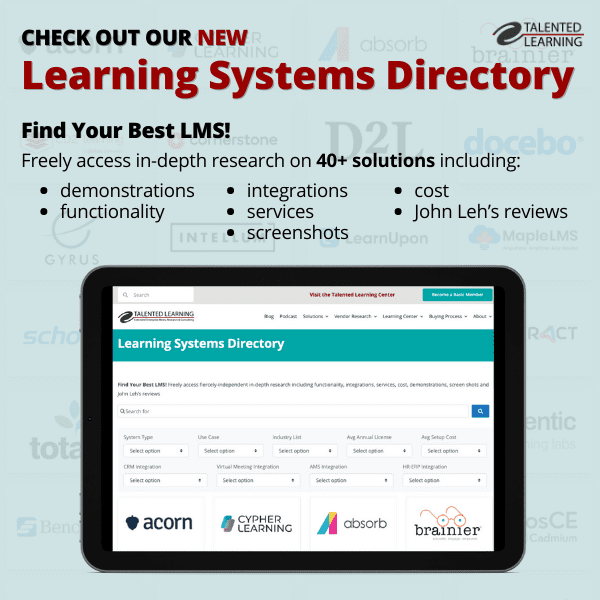
CASE STUDY DIRECTORY


FOLLOW US ON SOCIAL