

EDITOR’S NOTE: Because enterprise learning involves multiple disciplines and perspectives, we regularly invite experts from across the community to share their insights. Today, teacher and educational technologist Greta Baldanzi clarifies the role of the modern learning ecosystem.
Technical Integration is Vital, But a Mature Learning Ecosystem Needs More
Your learning management system is not a learning ecosystem. Neither is your LMS plus an LXP. You could even add an AI-powered recommendation engine, a skills layer, an analytics dashboard, and a talent marketplace. But that won’t necessarily turn it into a learning ecosystem.
By combining these tools, you can build a powerful learning technology stack. It may be highly integrated. Data may move smoothly from one system to another. Recommendations may update in real time, and learner profiles may become progressively richer.
This kind of technical continuity is impressive, but it is not the same as learning systems coherence.
Why does this distinction matter? Because the term “learning ecosystem” is becoming an attractive label. Increasingly, organizations use it to describe collections of interconnected learning technologies. Yet, connectivity alone says very little about whether those technologies form a coherent learning environment. What’s more, it doesn’t tell us if the data and interpretations remain meaningful, proportionate, and governable as they move between systems.
So, the question is not simply: Are our systems connected?
Instead, we need to ask: What happens to meaning when information moves across our systems?
Don’t miss what’s happening at the leading edge of enterprise learning technology! Get our weekly email brief. SUBSCRIBE →
Platform, Environment, Ecosystem: 3 Different Things
An LMS is a platform. It is an infrastructure designed to perform particular functions. It can deliver content, manage enrollments, record completions, administer assessments, and generate reports.
The learner, however, does not experience an infrastructure. The learner experiences an environment.
That environment includes whatever activities are presented, choices are available, recommendations are received, feedback is generated, and constraints are imposed, as well as the ways in which previous actions shape what is possible next.
An ecosystem is something else again.
Inside a Learning Ecosystem
An ecosystem is the dynamic set of relationships among platforms, people, purposes, rules, data, interpretations, and real-world consequences. This broader view aligns with the UNESCO Institute for Lifelong Learning, which describes learning ecosystems as interconnected — spanning diverse learning content, places, sources, and technologies.
This distinction changes how we should think about ecosystem maturity.
A mature ecosystem does not necessarily include the most technologies, the largest quantity of data, or the highest level of automation. Instead, it is where the relationships among all of these components come together effectively through deliberate design.
2026 OFFICE HOURS: If you’re buying a learning system, why not choose with confidence? Join analyst John Leh for this free webinar series just for LMS buyers. SAVE YOUR SEAT →
What Happens When Seamless Data Produces Discontinuous Meaning?
Consider this plausible sequence. The pattern is not merely hypothetical: The Information Systems Journal documents a 2025 Johnson & Johnson case study where an AI-enabled platform inferred employee skill proficiency from digital traces, and then used the results for talent development and strategic workforce planning:
- An employee completes a course in an LMS.
- That completion becomes part of an activity history used by an LXP.
- The LXP recommends further content related to the same topic.
- Repeated interactions contribute to a skills profile.
- A skills engine associates those traces with a capability.
- Eventually, a talent system uses that capability to suggest a role, project, or development pathway.
From a technical perspective, this seems like an exemplary integration. Data has travelled seamlessly through the architecture. But look closer at what happens semantically:
“Completed this activity” can gradually become “Is interested in this topic.” Next, “Is developing this skill” becomes “possesses this skill,” and eventually, “May be ready for this role.”
Each of these steps seems reasonable. None is automatically unreasonable. But the claims are not the same. The technical object may have remained continuous, while its meaning repeatedly changed.
This is where a learning technology stack can begin to masquerade as a mature learning ecosystem. And it opens the door to disconnected experiences.
The Missing Link
Interoperability ensures that information can move across digital systems. However, it does not ensure that every transformation of that information is educationally justified.
Open standards such as 1EdTech’s LTI and Caliper specifications enable course, user, and learning-activity data exchange across tools and platforms. Technical interoperability tells us whether systems can exchange data. But it does not tell us whether they should also exchange the meaning behind the data.
Similarly, a systematic review of learning analytics data integration distinguishes technical and semantic interoperability, noting that shared data meaning typically receives less emphasis.
Find out how organizations achieve more with learning systems that create business value. Get inspired by dozens of success stories we’ve collected for our LMS Case Study Directory. CHECK IT OUT →
More Integration Demands More Responsibility
Maturity narratives typically suggest that isolated tools are rudimentary, while integrated systems are advanced. But that’s only part of the story.
Integration removes boundaries between systems, but those boundaries sometimes make context changes visible. When systems become deeply connected, an observation made for one purpose can quietly become evidence for another:
- A completion record created for compliance may feed a recommendation engine.
- An interaction captured to personalize content may influence a skill inference.
- A skill inference may later contribute to a decision about development or opportunity.
The more seamless the architecture becomes, the easier it is to overlook these transitions. So, this means learning ecosystem maturity should not be measured only by how efficiently data travels within it, but also by whether any changes in meaning remain visible, governable, contestable, and revisable.
Celebrate the best in learning tech innovation! Check our annual LMS Award recipients, featuring 60+ solutions in 6 categories. SEE ALL WINNERS →
A Quick Maturity Test
Managers do not need to start by asking how many platforms they own. A better diagnostic examines what happens between these systems. The following tool can help.
Don’t think of this as a universal maturity model. Instead, consider it a practical framework to examine what happens between various components in a learning stack:
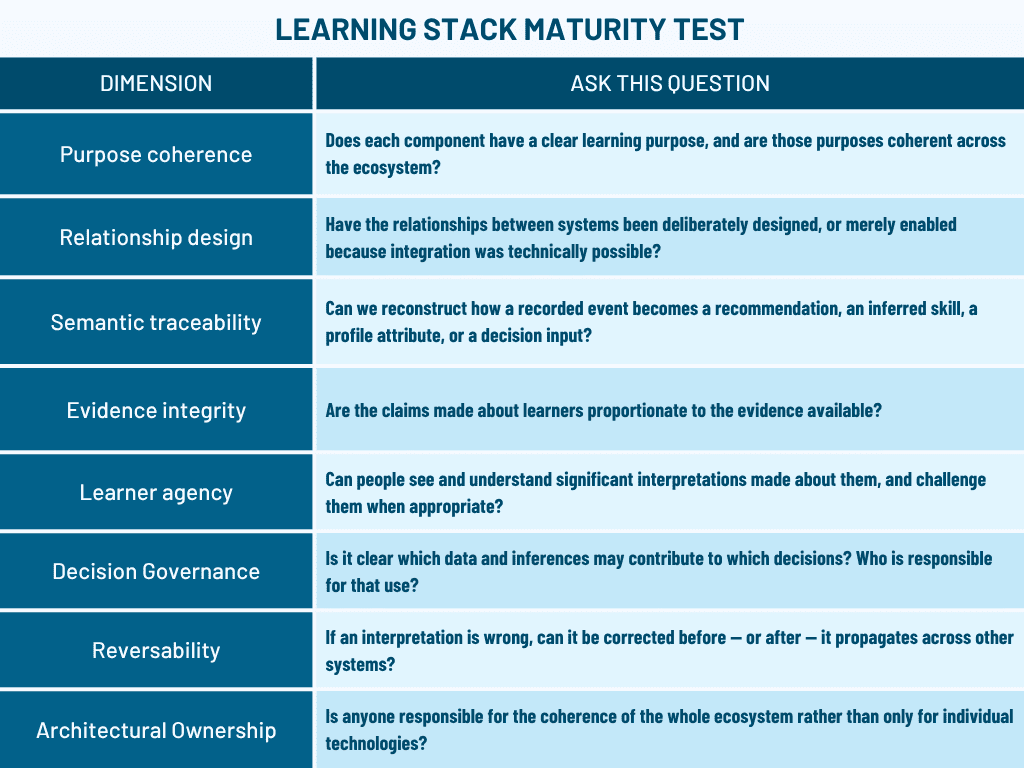
For each of the 8 dimensions above, apply this simple 4-level scale:
0 = Tool Accumulation: Technologies coexist but are largely designed and managed independently.
1 = Technical Integration: Systems exchange data reliably, but the educational meaning of those exchanges is rarely examined.
2 = Coordinated learning environment: Technologies and learner experiences are intentionally aligned around common purposes.
3 = Governed learning ecosystem: Relationships, data transformations, inferences, responsibilities, and consequences are deliberately designed and remain visible and revisable.
Here is the most important point to keep in mind:
The highest maturity level does not require the largest technology stack. And the most technologically sophisticated learning stack may not be the most mature learning ecosystem.
In other words, an organization using relatively few systems with clear purpose, careful evidence rules, and explicit governance may have a more mature ecosystem than an organization running an LMS, LXP, skills cloud, AI assistant, analytics platform, and talent marketplace with little oversight of what happens between them.
2026 OFFICE HOURS: If you’re buying a learning system, why not choose with confidence? Join analyst John Leh for this free webinar series just for LMS buyers. SAVE YOUR SEAT →
The Missing Link: A Learning Ecosystem Architect
To achieve a high level of maturity, someone (or some function) must look beyond the individual components in a tech stack. This is the role of the learning ecosystem architect.
The architect’s object of design is not the LMS. Nor is it the LXP, the AI assistant, or the skills platform. Instead, the architect focuses on the relationship between platforms, people, purposes, data, and decisions.
This does not necessarily mean your organization must create a new job title. The architect function may sit with one person, a cross-functional team, or a shared governance structure involving L&D, HR, IT, data, and AI specialists.
What matters is that the function exists. This emphasis on cross-functional accountability is consistent with NIST’s AI Risk Management Framework, which treats governance as a cross-cutting function and calls for clearly defined AI oversight roles and responsibilities.
Without it, you can design each component perfectly for its local purpose without recognizing that the overall ecosystem is incoherent:
- The LMS team may optimize completion.
- The LXP may optimize discovery and engagement.
- The recommendation engine may optimize relevance.
- The skills system may optimize inference.
- The talent platform may optimize matching.
Every component may be working exactly as intended. Yet, they all contribute to an architecture where nobody is responsible for asking whether the meaning created by one system remains valid when another system uses it.
This is the question a learning ecosystem architect must keep asking.
Not merely: Can these systems exchange this information? But: Should they? For what purpose? Under which interpretation? With what evidence? And with what consequences if the interpretation is wrong?
Don’t miss what’s happening at the leading edge of enterprise learning technology! Get our weekly email brief. SUBSCRIBE →
The Bottom Line on Learning Ecosystem Maturity
Mature architecture is not the ability to connect everything. It is the ability to decide what you should connect, why you should connect it, what meaning should survive the connection, and where human judgment must remain.
So, is your LMS part of a learning ecosystem?
Perhaps. But the answer depends less on what you have connected to it than whether someone is designing the right relationships around it.
An ecosystem does not emerge just because you connect multiple technologies. It emerges when we thoughtfully and intentionally design those relationships. This is the work of a learning ecosystem architect.
Where does your organization sit on the 0–3 maturity scale? And who owns the architecture across your learning stack?
Need to Improve Your Learning Ecosystem? Let’s Talk…
For independent advice you can trust, schedule a free 30-minute phone consult with Talented Learning Founder and Lead Analyst, John Leh:
Share This Post
About the Author: Greta Baldanzi

Related Posts

6 LMS Requirements Categories: Customer Ed Nugget 32
When you need a customer education platform, where should you start? Find out why it helps to focus on 6 core LMS requirements categories on this mini-podcast....

Customer LMS Statistics: 42 Benchmarks For Business Buyers
Choosing a platform for customer education can be daunting. So, if you're planning to invest in a new system, what customer LMS statistics should you keep in mind?

Download 2026 RightFit Grid – Build Your Best LMS Shortlist
How can you find the best learning system for your needs? Start with reliable research. Compare 80 top solutions with our LMS shortlist tool, new for 2026

Should You Renew Your LMS? Navigating 4 Decision “Gates”
If your organization uses one or more learning platforms, you'll eventually need to renew your LMS contract. But first, what should you do? Try this...

Running Training as a Profit Center: How Does an LMS Help?
What can a learning platform do to help drive training revenue and growth? LMS innovator Nick Eriksen suggests focusing on these factors...
How to Find the Best LMS for Your Needs: Customer Ed Nugget 31
When it's time for a new or replacement platform for customer education, how can you find the best LMS for your business? Find out on this Customer Ed Nugget episode...

AI in Corporate Training: What to Expect From Your LMS
AI is making a huge impact on enterprise systems, including LMS platforms. But what does that mean for the future of corporate training? An LMS innovator digs deeper...

Need to Build Workforce AI Skills? Try These Go-To Training Methods
Organizations everywhere are scrambling to develop key workforce AI skills. But which training methods actually work? 13 business leaders share their best advice here...

How Do You Drive AI Adoption? 12 Proven Strategies
Which learning strategies are improving workforce AI adoption? Find how a dozen business leaders are making a positive impact



CASE STUDY DIRECTORY


FOLLOW US ON SOCIAL