
How Learning System Licensing Works
The learning system license is the recurring software fee that gives an organization access to a platform and its included capabilities. The concept is simple. The pricing is not.
There is no standard industry unit for licensing a learning system. Vendors may charge for the number of people with access, the number who actually use the system, a defined enterprise population, a transaction or consumption metric, or a combination of several approaches. Two vendors can support the same learner population and still use completely different calculations.
The best license model is the one that fits how the audience actually learns and how the organization expects usage to change. A predictable employee population may fit a named user model well. A customer or association program with a very large population and sporadic usage may be better aligned with active or consumption pricing. The learning system type and use case usually point toward the models worth considering.
Before comparing rates, buyers need to understand what is being counted, when it is counted, what functionality is included and how the price changes as usage grows.
LMS License Models
Named User
Named licensing charges for a defined population that has access to the system. Vendors may also use terms such as registered user, licensed user or seat.
How it works: The organization licenses a set number of users, whether every person trains regularly or not.
Best fit: Predictable populations with consistent participation, especially employee learning and regulated training.
Risks and watch-outs: Dormant or infrequent learners can still consume paid capacity. Buyers should understand whether inactive accounts can be removed or recycled and how contractors or seasonal populations are treated.
Typical use cases: Employee learning, compliance,
Questions to ask vendors: Who counts as a licensed user? Can licenses be reassigned? When does an account stop counting?
Active User
Active user licensing charges when learners actually use the system during a defined period.
How it works: Vendors may count monthly active users, annual active users, rolling active users or other activity-based measures. Some models count logins, others count course launches, enrollments, completions or other events. Concurrent pricing is a related variation based on the number of people using the system at the same time.
Best fit: Large populations where only a portion of eligible learners participate during a given period.
Risks and watch-outs: The word active is not standardized. The same 5,000 active users can mean very different things across vendors. Peak usage and overage rules also matter.
Typical use cases: Customer education, partner learning, associations and extended enterprise.
Questions to ask vendors: What event makes a learner active? What is the measurement period? What happens when usage exceeds the contracted amount?
Enterprise
Enterprise licensing provides broad access for a defined organization, business unit, audience or population, sometimes marketed as unlimited use.
How it works: The vendor establishes a fixed or tiered enterprise fee within agreed boundaries. Those boundaries may include employees, domains, business units, portals, revenue, geography or other limits.
Best fit: Organizations that want predictable cost and expect broad adoption or fluctuating participation.
Risks and watch-outs: Unlimited rarely means there are no boundaries. Buyers should identify what can still trigger additional fees, including new audiences, brands, portals, modules or major changes in scale.
Typical use cases: Large employee populations, multi-audience programs and enterprise standardization.
Questions to ask vendors: What is actually unlimited? Which audiences are covered? What events can change the enterprise fee?
Consumption
Consumption pricing charges for what is used, delivered, processed or sold rather than simply counting licensed people.
How it works: The unit may be registrations, enrollments, transactions, purchases, course consumption, credits, usage volume or another measurable activity. Some commercial learning models also connect fees to revenue or business performance. Emerging outcome-based models go further by linking technology economics to measurable value created by the learning program. Credits and usage are especially common in AI pricing.
Best fit: Programs where learning activity closely follows business volume or where audience size is much larger than actual participation.
Risks and watch-outs: Cost can be less predictable when activity spikes. Buyers should understand the unit, thresholds, overages and whether the metric is easy to forecast and audit.
Typical use cases: Commercial training, customer education, certification, ecommerce and usage-driven external learning.
Questions to ask vendors: What exactly is consumed? How is it measured? Are there minimums, credits or overage rates?
Hybrid
Hybrid pricing combines two or more license approaches.
How it works: A vendor might charge a platform fee plus active users, an enterprise fee plus transactions, or named users for employees and active users for customers. Modules, portals, AI and support can add additional recurring charges.
Best fit: Organizations serving multiple audiences or operating business models that do not fit one simple metric.
Risks and watch-outs: Hybrid models can fit the business well but become difficult to compare. Buyers need to identify every meter and model each one over the expected operating scenario.
Typical use cases: Extended enterprise, multi-audience ecosystems, global programs and commercial learning operations.
Questions to ask vendors: Which pricing components are fixed? Which are variable? How does each component change with growth?
How Vendors Package the License
License models explain how access is measured. Packaging determines what the buyer receives for that fee.
Some vendors take a broad platform approach and include most major capabilities in the core subscription. Others use a modular strategy with separate pricing for capabilities such as AI, advanced analytics, ecommerce, skills, content, extended enterprise functionality or specialized products acquired over time. Smaller items can be packaged separately too, such as sandbox environments, storage or video hosting limits and additional brands.
Neither approach is automatically better. All-inclusive packaging can make budgeting simpler but may mean the buyer is paying for capabilities it does not need. Modular pricing can align spending more closely with requirements, but important functionality can be missed during budgeting if the buyer has not defined requirements clearly.
The same principle applies to audiences and portals. Supporting employees, customers and partners does not inherently require three licenses. One vendor may support all audiences inside the core platform while another may package additional portals, brands or external learning capabilities separately.
This is why pricing should follow the business case, audiences, use cases and requirements. Buyers need to know what they actually need before they can tell whether a vendor’s packaging is economical.
Volume Bands, Growth and Overages
The quoted rate today is only one point on a vendor’s pricing curve.
Vendors build volume bands differently. One may be very aggressive at 2,500 active learners but reduce rates only modestly as usage grows. Another may have a higher entry point and much stronger volume discounts at 25,000 or 100,000 learners. Overage treatment also varies. Some vendors charge a defined incremental rate while others move the customer into a new tier.
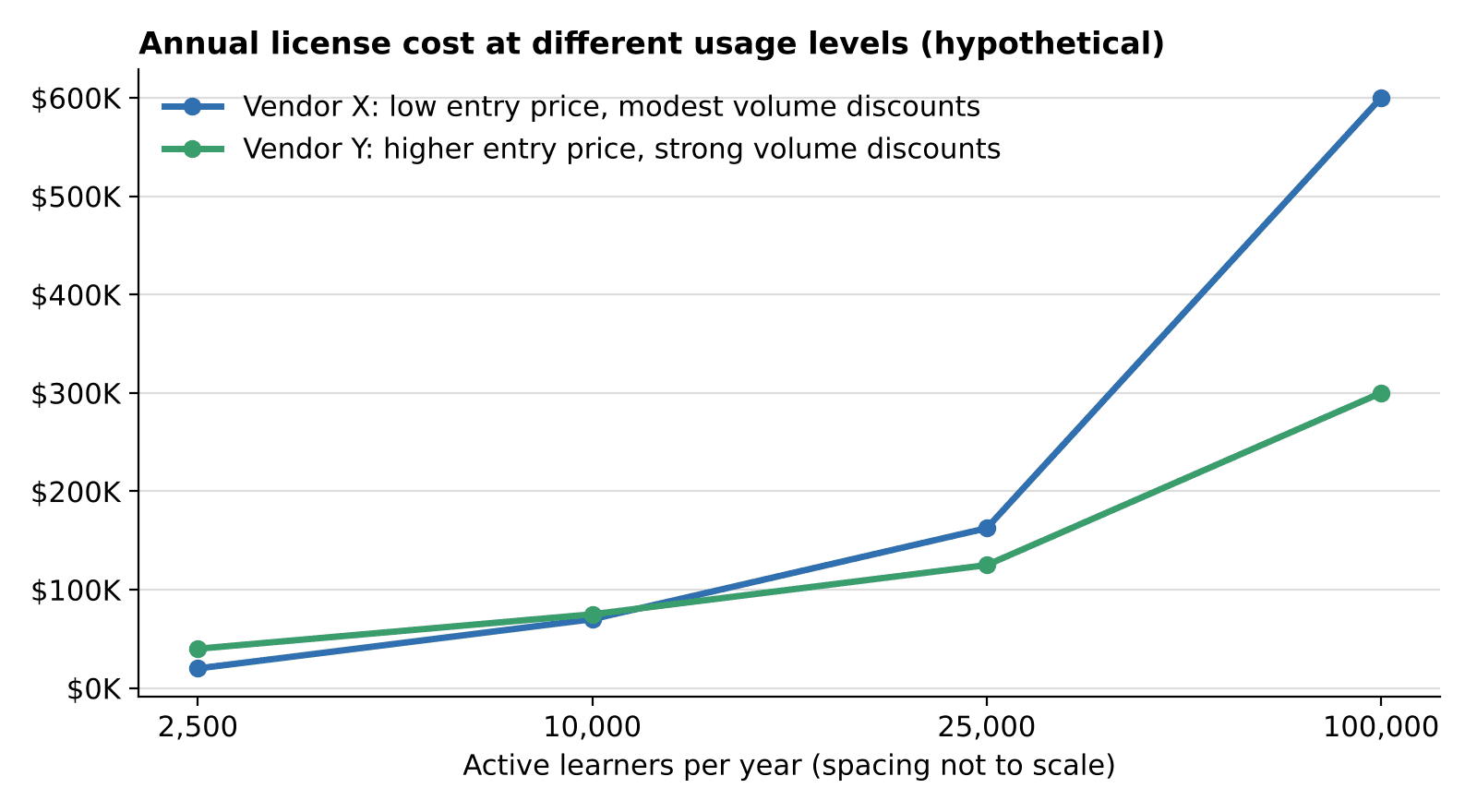
Buyers should understand minimum commitments, tier thresholds, volume discounts, overage rates and any changes in the unit price as usage grows. A vendor is not simply cheap or expensive. Its relative price may depend on where the organization sits on that vendor’s pricing curve.
That is why pricing should be modeled against expected growth, not just current usage. Plan & Compare Learning System Costs shows how to do that over a three-year scenario.
Before You Compare License Prices
For every vendor, document the pricing unit, measurement period, included functionality, audience or portal assumptions, volume bands, overage rules, renewal terms and expected price at future usage levels. If AI has a separate economic model, evaluate it independently using AI Pricing for Learning Systems.
Only after those variables are clear does a per-user or platform price become useful. The objective is not to find the lowest unit rate. It is to determine which license structure best fits the organization’s expected use and produces the most reasonable total cost over time.
