

EDITOR’S NOTE: Because enterprise learning involves multiple disciplines and perspectives, we regularly invite experts from other organizations to share their insights. Today, BenchPrep CEO/Co-Founder, Ashish Rangnekar, outlines a new way to evaluate professional education results.
Are Your Learning Programs Reaching Their Revenue Potential?
The best professional education programs do much more than help people achieve their career goals. They also help providers reach new audiences, strengthen existing relationships, and generate sustainable revenue streams.
This is especially true for associations, where it’s increasingly important to connect learning with revenue. 2026 Naylor benchmarking research confirms that generating non-dues revenue remains the top association management challenge for the fourth consecutive year, with 52% of leaders saying it is their most critical concern.
Every organization wants to grow. But a successful strategy depends on knowing how much revenue comes from existing programs and the best opportunities to expand. This kind of intelligence requires thoughtful measurement.
Don’t miss what’s happening at the leading edge of enterprise learning technology! Get our weekly email brief. SUBSCRIBE →
Why Traditional Learning Metrics Aren’t Enough
According to GP Strategies, 98% of learning professionals measure the business impact of their programs, yet, only 62% have the capability to do so. Why is this gap so prevalent?
In part, the problem is that many learning providers still measure success with operational metrics like registrations, course completions, time spent learning, assessment scores, and learner satisfaction. Although these measures are useful, they don’t fully reflect the connection between learning and broader organizational results.
A continuing education program may attract numerous paid registrations, but drive few repeat purchases. In contrast, another program may serve a smaller audience, but achieve better outcomes, stronger retention, and higher long-term revenue.
For clarity, it’s vital to look beyond simple activity measures and understand what each offering contributes to your broader business portfolio. In other words:
- Which products drive the most repeat purchases?
- Which experiences improve renewal or retention?
- Which learners become long-term customers?
- Which programs contribute the most revenue overall?
These insights can help you decide where to invest more resources (or less) with greater confidence.
Imagine an exam preparation program with high registration numbers but low completion rates and few repeat purchases. If you consider registration volumes alone, this program might appear to be successful. But what if you look at the entire learner journey and discover that participants are struggling to progress? This limits their likelihood of success, as well as the program’s revenue potential.
2026 OFFICE HOURS: If you’re buying a learning system, why not choose with confidence? Join analyst John Leh for this free webinar series just for LMS buyers. SAVE YOUR SEAT →
Learning Is a Business Strategy. Here’s How to Measure It That Way
No single, isolated metric can capture the full value of a professional education program. That’s why it’s important to approach measurement in a more connected, comprehensive way.
For a more complete picture, you’ll want to link four types of data:
- Engagement: How deeply are people involved with the program? Are they using and completing the content?
- Performance: Are participants developing knowledge, confidence, and readiness?
- Customer behavior: Do people return, renew, or purchase additional products?
- Business performance: How much does the program contribute to revenue, retention, or growth?
Start by defining what success looks like for each program. For an exam preparation program, you might focus on readiness and pass rates, while for a continuing education program you may prioritize repeat purchases, renewals, or long-term engagement.
Next, identify the learning and business metrics that show whether your programs are delivering on those outcomes.
With this approach, you can move beyond reporting what has happened to understanding why it happened, what it means for the business, and where there is room to improve.
What’s Your Learning Power Index?
Once your view of learning performance is more connected, you’ll want to establish a baseline. There’s actually a fairly simple way to measure how much your learning programs contribute overall to your business. We call it the Learning Power Index (LPI). Here’s the formula:
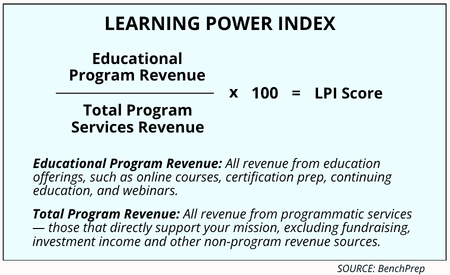
For example, if your organization generates $1 million in educational program revenue and $10 million in total program services revenue, your LPI is 10. [($1 mil/$10 mil) x 100 = 10]
How to Interpret Your Learning Power Index
As a standalone number, your LPI isn’t particularly meaningful. But it becomes much more useful when compared with industry benchmarks:
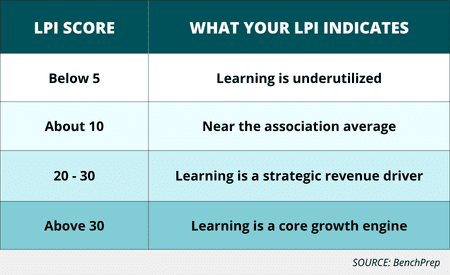
Your LPI indicates how much your learning programs contribute to revenue and whether there is room to grow. However, it does not tell you exactly where that growth should come from. To identify the best potential sources of growth, you’ll want to more closely analyze interrelated elements — target audiences, products, engagement behaviors, purchasing patterns, and market demand.
The goal is not to calculate your LPI once and move on. Rather, think of it aa a continuous feedback loop, indicating where you can adjust investments for better outcomes. For best results, use it to establish a baseline. Then align your professional education programs around the most promising opportunities and continue to iterate, tracking how much those efforts contribute to the business.
Find out how organizations achieve more with learning systems that create business value. Get inspired by dozens of success stories we’ve collected for our LMS Case Study Directory. CHECK IT OUT →
4 Ways to Grow Learning Revenue
Professional education programs often expand business revenue by building stronger products, reaching new audiences, creating more ways to buy, or scaling successful programs. Here’s how each of those strategies work in an LPI context:
1. Build Stronger Products
Growth doesn’t come from simply adding more content. It comes from developing products that deliver more measurable business value by helping people solve real, meaningful problems.
To improve your professional education programs, look at where learners struggle, what they value most, and which experiences produce the strongest outcomes. You can use these insights to enhance existing offerings or introduce new products, such as exam simulations, microcredentials, or personalized learning pathways.
For instance, you may discover that learners who complete an exam simulation are more likely to finish their preparation program, feel more confident, and pass the exam. That insight could justify expanding the simulation experience, including it in a premium package, or introducing it earlier in the learner journey.
2. Reach New Audiences
Your learner data may reveal an opportunity to expand beyond individual, direct-to-consumer sales into B2B channels such as employer partnerships, enterprise training, and university partnerships.
If you offer certifications, imagine noticing that a growing number of learners use their corporate email addresses to register. Further analysis shows that several of these companies independently purchase the same program for multiple employees.
This could be an opportunity to create an enterprise package that includes bulk purchasing, centralized administration, and group-level reporting.
3. Create More Ways to Buy
Monetization is not simply about charging more. It’s about giving learners the flexibility to choose the products, support, and an experience that best fits their goals.
By pricing and packaging creatively, you can offer more options that generate incremental revenue. In other words, you could provide more purchasing pathways, such as subscriptions, product bundles, premium content, supplemental practice products, or AI-powered learning support.
For example, you may want to offer an AI assistant as an optional upgrade, so learners have access to a built-in tutor that provides real-time, course-specific guidance. This more convenient, personalized experience can also drive additional revenue.
To decide which products belong together, look at existing purchase patterns. For instance, if you find that learners achieve stronger outcomes when they purchase a course and a related practice exam, you could combine both products into a higher-value package. This makes it easier for people to access the resources they need while increasing revenue per customer.
4. Scale Successful Programs
Measurement can also help you determine how to deliver educational experiences more efficiently and effectively. Depending on the audience and subject matter, you may want to offer self-paced learning, instructor-led programs, or a hybrid of the two.
An instructor-led course might produce excellent satisfaction scores, but serve only a limited number of learners at a high delivery cost. If the data shows that a self-paced or hybrid version delivers similar learner outcomes, trimming ILT could help you reach more learners while improving overall margins.
On the other hand, some learners may perform significantly better when live instruction or coaching is included. In that case, a higher-priced, instructor-supported tier could drive better outcomes for learners, while increasing revenue for your organization.
2026 OFFICE HOURS: If you’re buying a learning system, why not choose with confidence? Join analyst John Leh for this free webinar series just for LMS buyers. SAVE YOUR SEAT →
Measure, Test, and Refine
Once you identify a growth opportunity, you’ll want to establish a process to test its potential impact. Start by defining the outcome you expect to deliver for learners as well as your business. Then isolate data to establish a reliable baseline, structure changes around key metrics, and compare before-and-after results.
For example, you may want to explore B2B growth by piloting an enterprise package with a small group of employers. It would help to compare enrollment, engagement, revenue per customer, and renewal rates with the direct-to-consumer offering before rolling out the expanded model.
Also, you’ll want to continue monitoring results and recalculating your LPI at regular intervals. This creates an ongoing cycle of measuring, investing, and refining programs, so you can scale what works and adjust what does not.
For more inspiration, see how other organizations are using the Learning Power Index to measure and maximize business impact.
Don’t miss what’s happening at the leading edge of enterprise learning technology! Get our weekly email brief. SUBSCRIBE →
Investing in Learning as a Measurable Growth Strategy
Professional education programs may already be one of your most valuable sources of growth. But understanding their full potential requires looking beyond registrations and completions to see how learner success connects to ongoing customer engagement and revenue.
The Learning Power Index is a clear, actionable starting point. Combined with engagement, performance, and purchasing data, it can help you make more confident decisions about where to invest. And by measuring learning more strategically, you find it easier to build programs that create lasting value both for the learners you serve and your organization.
Need a Professional Education System? Let’s Talk…
For independent selection advice you can trust, schedule a free 30-minute phone consult with Talented Learning Founder and Lead Analyst, John Leh:
*NOTE TO SALESPEOPLE: Want to sell us something? Please contact us via standard channels. Thanks!
Share This Post
About the Author: Ashish Rangnekar

Related Posts

Headless LMS Business Drivers: Customer Ed Nugget 8
Many factors drive organizations to choose a headless learning system for customer education. Should you go headless? Find out what to consider in this brief Customer Ed Nuggets podcast episode

Top Instructional Video Advances: Customer Ed Nugget 7
Is your customer education content falling short? Kick it up a notch with top advances in instructional video. Learn more in this brief Customer Ed Nuggets podcast episode

CEO Circle 2: What Sparks Learning Systems Innovation?
Where does LMS innovation begin? Find out directly from founders and top executives of companies that develop and deliver cutting-edge learning solutions

Customer Onboarding Mistakes to Avoid: Customer Ed Nugget 6
First impressions are lasting. That's why companies must be careful to avoid customer onboarding mistakes. What to do? Get helpful tips in this brief Customer Ed Nuggets podcast

Customer Education ROI Metrics: Customer Ed Nugget 5
Countless ROI metrics can measure the results of customer education efforts throughout the relationship lifecycle. Which metrics should you choose? Find out in this brief Customer Ed Nuggets podcast

Top LMS Automation Trends: Customer Ed Nugget 4
LMS automation is quietly transforming customer education operations in powerful ways. How? Find out on this Customer Ed Nuggets podcast episode
Top Learning Analytics Challenges: Customer Ed Nugget 3
Customer education programs depend on strong learning analytics. But useful insights can be hard to find. How can you make it work? Find out on this Customer Ed Nuggets podcast episode

Customer Education LMS Integrations: Customer Ed Nugget 2
To make the most of any customer education platform, you'll need the right LMS integrations. Which integrations matter most? Find out on this Customer Ed Nuggets podcast episode

Presales Customer Education Pitfalls: Customer Ed Nugget 1
Want to attract and engage business prospects through customer education? Learn how to avoid common presales education pitfalls in this episode of our new podcast series





CASE STUDY DIRECTORY


FOLLOW US ON SOCIAL