

Why is artificial intelligence (AI) generating such frenzied buzz lately? If you don’t know what I mean, you must be living under a rock. In just a few short years, AI has become one of the most talked-about technology advances since the dawn of the internet.
AI: Mostly Smoke and Mirrors?
Naturally with all this chatter, expectations for AI have soared. Yet many people still remain confused about the realities of artificial intelligence and its lesser-known subset, machine learning.
As our lead analyst, John Leh, noted in a recent learning technology trends analysis, “It’s important to keep in mind that AI is hard to demonstrate and easy to exaggerate.”
No kidding. Here’s sobering proof: Recently, 2830 European startups were classified by industry tracking sites as “AI companies.” Yet researchers found that nearly 45% of those companies don’t actually base their products on AI. So the promise of AI is real, but some technology providers seem willing to blur the lines to attract deeper investment. Buyer beware.
What does that mean for you? At a time when it’s easy to cash-in on ignorance, knowledge is power.
No organization can afford to overlook innovation indefinitely. That’s why I’ve compiled a collection of AI insights for learning technology decision-makers.
Let’s start with the basics. What is AI, exactly? Is it really as powerful as it seems? What kind of role should AI play in extended enterprise learning? And what does it mean for your learning systems roadmap?
I have some thoughts about that. But first, let’s look at what other sources say…
AI Trends In Business
Gartner: 5 Emerging Tech Trends
Analysts at Gartner define artificial intelligence as technology that “applies advanced analysis and logic-based techniques (including machine learning) to interpret events, support and automate decisions and initiate action.”
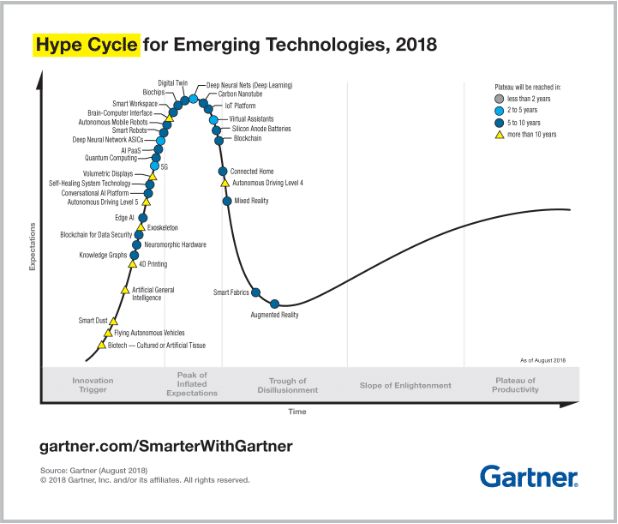 Gartner cautions against definitions that emphasize automation because they miss “hidden opportunities for greater personalization and differentiation.” Instead, they say it’s more effective to embrace AI for its ability to augment human decision making and interactions.
Despite confusion about its definition and its business value, AI continues to find its way forward. According to Gartner’s most recent Emerging Technology Hype Cycle, 5 key trends are blurring the lines between humans and machines.
For example, within the next 10 years “democratized AI” should arrive. That means AI will be everywhere, thanks to enabling technologies like cloud computing, the open source software movement, AI-as-a-Service, conversational AI, virtual assistants and more.
To reach this new world order, IT leaders are already shifting their attention. During the past few years, they focused on understanding where AI could be most effective and how to deploy it. But by 2020, 85% of businesses will actually be piloting AI programs through a combination of build, buy and outsourcing strategies.
MMC Ventures: The State of AI Report
UK venture capital firm, MMC, agrees that AI is moving into the mainstream. In a comprehensive new AI industry analysis, MMC says that as pervasiveness takes hold, the distinction between “AI companies” and other software providers will blur and eventually disappear. Industry statistics show that this shift is already underway. For example, in 2013, only 1 in 50 new European startups focused on AI. Only 5 years later, that ratio has grown to 1 in 12.
 In addition to clearly defining AI and its business value, the MMC report also breathes life into increasing AI adoption rates by outlining several compelling use cases.
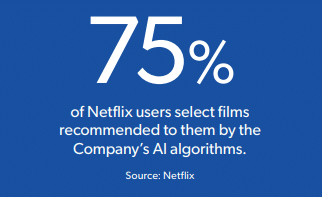
For example, AI-driven content personalization has been highly successful at Netflix, where 75% of users choose recommended video content. This contrasts sharply with typical online shopping environments where, according to Adobe, recommendations are often irrelevant or ignore user preferences, reducing the average conversion rate to less than 1.5% on smartphones and just under 4% on desktops.
By leveraging large, complex data sets, AI makes it possible to identify more subtle correlations than rules-based systems. For example, recommendations at Netflix are based not only on analysis of a user’s onsite searches, actions and content ratings, but also social media behaviors, third-party metadata and more.
But does AI success at Netflix and elsewhere mean that your learning systems should be at the head of the AI pack by now? Let’s look closer at what’s happening with AI in learning organizations…
AI Trends in Learning
Talented Learning Webinar Poll: Innovation Hype vs. Reality
Participants in our recent Technology vs. Innovation Webinar shared their opinions about this year’s most-hyped learning technologies. Not surprisingly, AI garnered the lion’s share of votes, with 38% of all responses.
 However, 46% of participants also noted that their primary learning technology challenge is a lack of resources (expertise and/or budget). This means that many may find it difficult to prioritize investment in new AI-driven capabilities without a clear business case.
If your organization is facing these issues, analyst John Leh offers some encouragement. “If you have a cloud-based LMS, AI will eventually be available to you through features that are being built into these systems. You’ll see it first in the learner UI and eventually in analytics. The timeframe for availability will vary by vendor, but the train has left the station. Learning platforms are already under strong pressure to roll-out new features that are driven by AI, so they can gain a competitive advantage.”
Learning and Development Global Sentiment Survey
The 5332 answers they submitted (3 maximum per voter) reveal a strong preference for technologies involving the smart use of data:

1) Personalization (heavily dependent on AI)
2) AI
3) Learning Analytics
In a similar poll with much broader reach, 1953 learning professionals from around the world recently told industry leader, Donald H. Taylor, their answer to a single question: “What will be hot in learning and development in 2019?”Interestingly, this is the first time since the survey began 6 years ago that the top three answers share a common link. It’s also the first time that data-driven answers have dominated. This is a powerful testament to the influence that AI is garnering across the global learning community.
Web Courseworks eLearning Hype Curve
Modeled after the Gartner Hype Cycle, this analysis focused on more than 2.3 million words, including 60,000+ tweets from a target segment of about 40 elearning influencers.
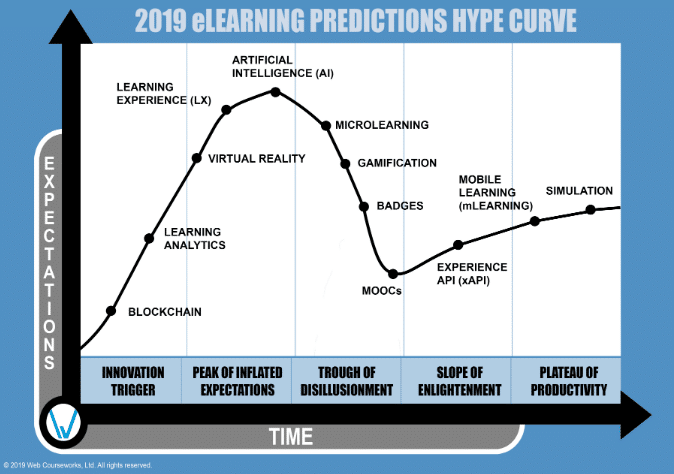 Late in 2018, learning systems provider Web Courseworks conducted a rigorous analysis of Twitter activity to determine which elearning-related keywords were mentioned most often across the social network.Findings show that AI has clearly reached a “peak of inflated expectations.” Specifically, tweet activity involving AI grew by more than 14% last year – the highest growth of any keyword used by the target population. Additionally, the “max hype” level for AI reached 52% – higher than any other term.
My View: AI is Best Served as a Combo Plate
AI clearly is sucking all the oxygen out of the learning technology conversation these days. But when you look beyond the surface, you’ll also see many other kinds of innovation are also actively shaping the future of elearning. Because today’s environment is so dynamic, it’s difficult to say which trend is most important right now. In fact, to realize their full potential, many learning technology trends depend on the success of enabling technologies like AI.
So, as I said recently in an interview with eLogic Learning, maybe what matters most is the ability to understand and leverage multiple advances, simultaneously. Here’s more from than Q&A:
Q: Which learning trend should companies invest in this year?
A: I think it’s important to consider the power of combining three emerging capabilities:
- Artificial intelligence (AI)
- Application programming interfaces (APIs)
- Analytics
Individually, each of these “three As” can add value. But when these elements work together in a cohesive strategy, it’s like strapping a rocket booster onto a learning experience.
Q: How will this affect the future of elearning?
A: Many organizations already rely on these capabilities to some degree, but not necessarily in a coordinated way. Coordination can potentially make a huge difference.
Q: How have you’ve seen this trend work?
A: Increasingly, AI is built into point solutions – for example, content recommendation systems and chatbots. However, these standalone applications don’t shape the entire learning journey. That journey involves many interactions across diverse applications, interfaces, systems and data sources.
This is where APIs provide the heavy lifting needed to share data securely across the extended enterprise, regardless of its source or format. In other words, APIs are the real-time connections – the points of dynamic data integration that breathe life into AI-driven learning experiences for customers, business partners and employees, alike.
But how do you know if AI-enabled learning initiatives are hitting the mark if you don’t have relevant insights? Integrated analytics fill this gap. More than simple activity reporting, analytics tools process complex data from across the learning journey to identify relevant audience-level behavior patterns and benchmark individual performance. They also pinpoint weaknesses within the learning experience, so organizations can continuously improve content quality, information structure, interaction design and underlying functionality.
Q: Should learning organizations invest in this trend?
The “three As” are rapidly becoming a priority for enterprise learning leaders, especially if their organizations are pursuing broader digital transformation initiatives. Staying open to a cross-functional implementation strategy makes sense because AI modules, APIs and analytics tools originally designed for other purposes can often be reused as building blocks for learning-related solutions. Early adopters are already demonstrating significant business benefits from an integrated approach, and this is motivating others to initiate pilot programs.
So don’t think of AI as a side dish (“Want AI with that?”) or even a standalone main course (“I’ll have the AI, please!”). Instead, think of AI as a fundamental ingredient, working in combination with data and other technologies to improve learning experiences, as well as our understanding of learning effectiveness.
Closing Notes:
To borrow a phrase from science fiction writer, William Gibson, AI is already here, it’s just not evenly distributed.
In other words, artificial intelligence may seem too complex, expensive or impractical for your organization today. However, eventually you’ll find it in your learning system – maybe even sooner than you expect.
Actually AI is already built into core functionality of some learning platforms. Credible industry analysts agree that it will become a central enabling technology for all kinds of business systems in the future. And although the marketplace is overheated now with hype and confusion, AI is already demonstrating profound value in a variety of business and learning applications.
So just how “great and powerful” is AI? Unfortunately, an exuberant market has put it at risk of being dismissed as nothing more than smoke and mirrors. But AI is real. It is making an impact in the learning sphere. And as long as it continues to prove itself in practical and measurable ways, AI adoption will continue.
WANT TO LEARN MORE? REPLAY THIS WEBINAR:
Technology vs. Innovation: Association Learning Strategies in Practice
AI. AR. VR. Digital breakthroughs like these are capturing headlines every day. Clearly, these innovations are promising. But many associations are focused on making the most of learning technologies that are already in place.
So how are these resourceful organizations actually transforming member learning experiences?
Join John Leh, CEO and Lead Analyst at Talented Learning, and Michelle Brien, VP Marketing at WBT Systems, as they explore real-world examples and discuss innovation strategies that will help you create lasting value. You’ll discover:
- The push/pull relationship between technology and change
- How to develop an innovation roadmap that works for your organization
- Tips for creating a business case your board will support
- How to avoid missteps when expanding your learning technology stack
- Guidelines for measuring results
Need Proven LMS Selection Guidance?
Looking for a learning platform that truly fits your organization’s needs? We’re here to help! Submit the form below to schedule a free preliminary consultation at your convenience.
Feature image credit: Turner Entertainment and Warner Brothers, Inc.
Share This Post
About the Author: Kathleen Kruse

Related Posts

Introducing the LMS Almanac: Corporate Edition 2016
The LMS Almanac defines corporate LMS market trends, types of corporate LMSs, business uses, feature and functions, hosting models, license models, service and support models, return on investment and provides real-life examples of all.

Public LMS Pricing: Proof You Can Overpay
It is foolish to pay more than you have to and get nothing in return but it is impossible to know if you are overpaying if you first don't define your LMS requirements.

Shrinking LMS Implementation Fees Drive Market Expansion
Making sure your LMS selection team is on the same page in regards to implementation/configuration needs will allow a buying organization to quickly disqualify many vendor options without the labor of investing a ton of time.

LMS License Models: What in the World is Going On?
Associations, training companies, corporate channel, customer and other extended enterprise buyers can create any number – hundreds of thousands even – of active ongoing accounts but a buying organization only pays for active usage.
Top Social Learning LMS Features
Common logic was flawed -- assuming training professionals and subject matter experts (SMEs) would regularly visit these social "spaces" and interact, keeping content fresh and learner engagement high.

2016 LMS Market Trends, Observations and Predictions
The behemoth TM providers such as Oracle or SuccessFactors devalued the LMS when they incorporated their LMSs into broader HR software suites and took their foot off the innovation accelerator.

Talented Learning: Greatest Hits of 2015
I concluded that it will take too long to teach 600+ LMS vendors the new anti-acronym trick and the easiest path would be to create a living, non-techie dictionary that decodes common acronyms for LMS buyers.

Mobile LMS: The Facts
At Talented Learning, an independent learning tech market research and consulting firm, we recently compiled an obnoxious 85 question survey detailing over 450 points of LMS business, market and functional data. We collected statistically significant [...]
2015 Talented Learning LMS Vendor Award Recipients
Learning management systems didn’t die. They evolved, and today we recognize them. Brief LMS History Corporate LMSs were invented almost 30 years ago to manage and report on the training and compliance of their employees [...]





CASE STUDY DIRECTORY


FOLLOW US ON SOCIAL