Podcast: Play in new window | Download
Subscribe: Apple Podcasts | Spotify | Amazon Music | Android | Youtube Music | RSS
EPISODE 110: WHAT’S AHEAD FOR L&D?

Donald H. Taylor
One simple, well-timed question can be a powerful force. That’s a concept learning industry luminary, Donald H. Taylor, has been proving for 13 years with his popular L&D Global Sentiment Survey.
Based on the question, “What will be hot in workplace L&D next year?” this annual pulse check is always illuminating. And 3 years ago, he expanded his research footprint with a separate must-read analysis of AI trends in L&D.
If you’re like me, you find it fascinating to compare opinions with thousands of other learning professionals from around the world, along with Donald’s interpretation of the data. So today, we’re all in for a treat, as I talk directly with Donald about the latest GSS results and what they mean for learning organizations.
Join us now, as we dig deeper on this episode of the Talented Learning Show…
WHAT’S AHEAD FOR L&D? — KEY TAKEAWAYS
- Learning industry surveys are a dime a dozen. But few have earned the buzz and credibility of the Global Sentiment Survey. Perhaps it’s the quick one-question format, or its massive reach. Or maybe it’s because we know the data is in good hands with one of the profession’s most respected leaders. Without bias, Donald Taylor adds keen insights, measured opinions, and a broad perspective.
- As expected, artificial intelligence continues to top the GSS “hot” trends list in 2026. But that’s not the whole story. AI clearly bleeds into other L&D themes, although it’s difficult to determine how deeply it skews overall results. This is one reason why Donald plans to replace “AI” with several more specific options next year, to ensure it doesn’t dominate everything else.
- While this survey has traditionally focused on employee learning, 2026 findings also suggest implications for extended enterprise education. For instance, with L&D facing increased pressure to demonstrate value, leaders may want to invest strategically in customer and partner training, where direct business impact is easier to measure.
WHAT’S AHEAD FOR L&D? — Q&A HIGHLIGHTS
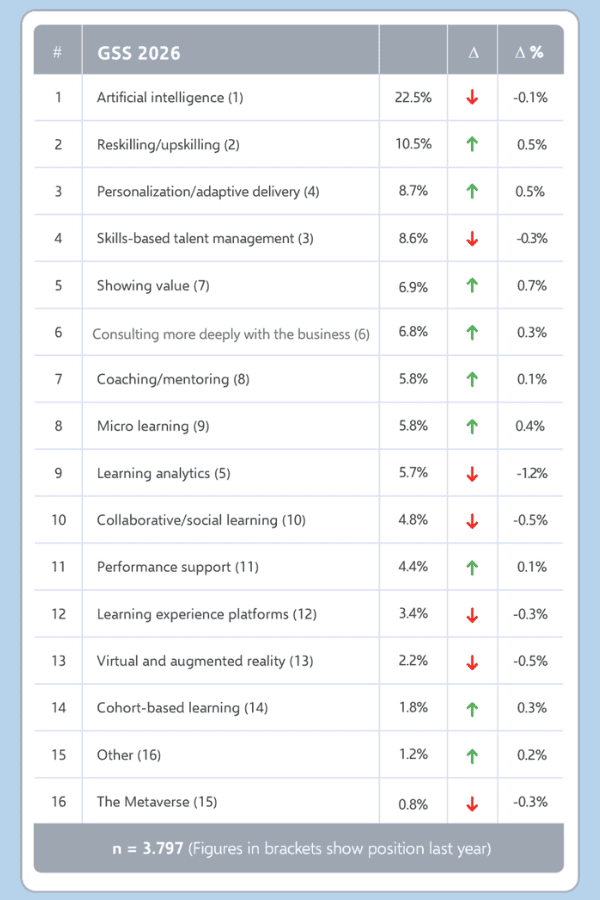
L&D Global Sentiment Survey 2026
Welcome back, Donald. It’s hard to believe, but the last time you were here was in 2019 — seven years ago!
Always a pleasure to be here, John.
For those who aren’t familiar with this survey, could you start with a brief snapshot?
Yes, I’ve been running this survey for 13 years. The goal is to find out what’s on people’s minds. It’s not about getting them to describe their plans for the year ahead — but rather to find out how they feel about things.
The idea is that this will uncover some pretty interesting stuff. Not in one year or two. Not if you ask only one person. But for each of the last 5-6 years, over 3000 people from something like 100 countries have participated. This year, we had nearly 3800 respondents from 105 countries. So, we’ve got a big sample and more than a decade of longitudinal data.
And certainly, a lot has changed since I was last on your show, John. Goodness me, it’s been an extraordinary journey since 2019.
Don’t miss what’s happening at the leading edge of enterprise learning technology! Get our weekly email brief. SUBSCRIBE HERE →
For sure. But when I read this year’s results, I wasn’t surprised at all…
Yes. I focus on one question, “What will be hot in L&D next year?” I ask people to choose no more than 3 answers from a from a list of 16 possibilities. They can choose one, two or three options, but almost everybody chooses three.
For the past three years, AI has topped the list. And as you say, that’s not a surprise. After ChatGPT launched at the end of 2022, AI picked up in 2023, and then broke all records in 24, 25, and 26.
But interestingly, this year, for the first time since ChatGPT launched, AI actually came down. Granted, it was only an infinitesimal decrease. But it is down.
And I think that’s significant. It means enthusiasm for the hype around AI has fallen.
Hmmm…
Now, that doesn’t mean we know what to do with AI. And it doesn’t mean less hype is coming.
It just means overall excitement has dropped amongst survey participants. And these people tend to be in the innovator or early adopter or segments of the Everett Rogers diffusion of innovation curve. They’re at the cutting edge.
So, I think we’ll see many more years of excitement, information, disinformation, and hype around AI.
2026 OFFICE HOURS: If you’re buying a learning system, why not choose with confidence? Join analyst John Leh for this free 6-part webinar series just for LMS buyers. SAVE YOUR SEAT →
Yes. I’m not surprised because I don’t know anyone that hasn’t been let down by AI. So, we’re all coming to terms with the reality that AI is not a save-all tool…
Right. It is not here to save all. But it’s also true that people are doing exciting and interesting things with AI.
The Global Sentiment Survey can be paired with another survey I produce, the AI in L&D Survey, which we’ve conducted for the past three years. The most recent version came out last September, and it includes 20 pages of case studies that look at how L&D is using AI.
It includes leading-edge stuff, as well as run of the mill stuff. And the focus is still on content. But the process is changing. That’s the exciting thing. AI is definitely changing how people work, compared with two or three years ago.
Nice.
Now, having said all of that, AI is still just a tool. I think it is transformative, but it’s still just a tool.
And for me, the key problem with AI is over-exaggerated promises on one hand, and over-exaggerated expectations on the other. That’s starting to change now. But for the past 2-3 years people thought it could do more than it could actually do.
Now, people use AI for a rather different set of things. But I think you’re right about one thing, in particular. A lot of people are making claims for AI that are insupportable. And that leads to expectations which will never match reality.
Celebrate the best in learning tech innovation! See our latest annual LMS Award recipients, featuring the top 10 solutions in 6 categories. SEE ALL THE WINNERS →
So, how are L&D teams applying AI? You said content. How about agentic or data analytics?
Great question, because that’s exactly how people are using it. In September, we didn’t find much evidence of people actually using agentic AI. But I hear that’s changing.
And as for data and analytics, people are increasingly using AI for research.
We count the number of words people use when they are responding to the question, “How do you use AI in L&D?” And 3 years ago, the words “research, data, and analysis” were almost nowhere to be seen. Now they’re among the top 10 words. In fact, analysis is the 10th most commonly mentioned word. Yet back in 2023, it wasn’t even in the top 50.
So, there’s been a huge change…
I see. To go a step further, a recurring L&D challenge is “showing value,” which is all about measuring effectiveness. Is this a top priority now?
Well, there was one breakout response this year, and it’s the idea that “showing value” is super important. This is interesting because everybody seems to think showing value is important. Vendors, in particular, say it’s very important. And L&D people agree.
Nice…
In the past, showing value bounced around between 5.5% and 6.5% of answers. But it has gone up for the past two years, which is unusual. And its biggest rise was this year, when it reached its highest level ever.
But if it goes up again next year, I think it tells us L&D is under pressure — in the sense that L&D is feeling the heat right now.
Which learning system is best for you? Check the newest RightFit Solution Grid, based on our team’s rigorous independent research. GET YOUR FREE COPY →
Interesting. I have another theory about that…
Go on, John, tell me more…
Well, when we spoke seven years ago, you thought extended enterprise learning — customer and partner training — was cutting-edge.
Yeah…
Do you think showing value is going up now because L&D is starting to reach beyond employee audiences, where it’s easier to show the impact of learning on revenue?
Interesting question, John. There might be something in that. L&D is definitely looking for ways to prove its value right now. And the extended enterprise is a core constituency L&D needs to support, but hasn’t always done so.
That’s a great idea, but I don’t have any direct evidence for it. So, I’ll consult our data. Because in each of the past five years, I’ve asked a second question: “What’s the biggest challenge in L&D next year?”
The answers are open-ended and 95% of people answer. Trouble is, those answers produce more than 40,000 words. That’s a lot. But I’ll look back to see whether the extended enterprise is increasing as a theme.
It might be, because that’s clearly one way L&D can show value — whether it’s in the commercial world, in government, or in the nonprofit sector.
But what’s your take, John? Are organizations more focused on extended enterprise learning?
2026 OFFICE HOURS: If you’re buying a learning system, why not choose with confidence? Join analyst John Leh for this free 6-part webinar series just for LMS buyers. SAVE YOUR SEAT →
Well, they’re certainly focused on it. But time is the paradox of our generation. You know, we have more access than ever, but time limits us.
Yeah…
For example, one of my clients is a large global heavy equipment manufacturer that sells through a dealer network. But dealers say the average technician has no more than two minutes a week to invest in learning.
Yes…
So, they’ve had to structure programs to get the most out of only 2 minutes a week.
That’s a classic case of extended enterprise, isn’t it? Dealerships are a really interesting case, because these people have to know their stuff, but they’re not employed by the organization.
How can they possibly learn what’s necessary in only 2 minutes a week? How did your client try to tackle that issue?
Don’t miss what’s happening at the leading edge of enterprise learning technology! Get our weekly email brief. SUBSCRIBE HERE →
Well, I don’t know if they’ve tackled this, but it comes down to really good skills and competency mapping, focused on exactly what each role must be able to do…
Right.
…and then delivering targeted microlearning, often at the point of need. Because, before you know it, that precious 2 minutes a week is gone. Of course, for 30 years we’ve been saying point-of-need learning is essential. But technology is finally making the process more instant.
Microlearning is interesting. On our survey, it has bubbled under the radar for years, going down, up, down, up. It has not followed the usual trend of falling away dramatically over time.
This year, it’s in 8th position. However, it’s actually on the rise. So, you may be on to something.
I think organizations are driving demand for microlearning because it’s a way to tackle a theme coming from our challenge question, which is that no one feels they have enough time.
Mmhmm. And which trends do you see falling off this year?
The biggest fall is with learning analytics. But at the same time, showing value has risen to its highest point ever. Now, that doesn’t make sense, right? How can you show value if you’re not using analytics? ….
… For complete answers to this and other questions about global L&D trends, listen to the full episode on Apple Podcasts, on Spotify, on Amazon, or right here on our site.
Watch This Podcast on YouTube
See John Leh and Donald Taylor discuss what’s ahead for L&D in this video podcast…
To learn more about The Talented Learning Show or to see the full collection of episodes visit the podcast main page→
Find Out More About The Global Sentiment Survey
Need an LMS That’s Ready for What’s Ahead? Let’s Talk
For independent advice you can trust, schedule a free 30-minute consult below with me, John Leh…
*NOTE TO SALESPEOPLE: Want to sell us something? Please contact us via standard channels. Thanks!
About the Author: John Leh